
United States Whiskey Market Size, Share, Trends and Forecast by Product Type, Quality, Distribution Channel, and Region, 2026-2034
United States Whiskey Market Summary:
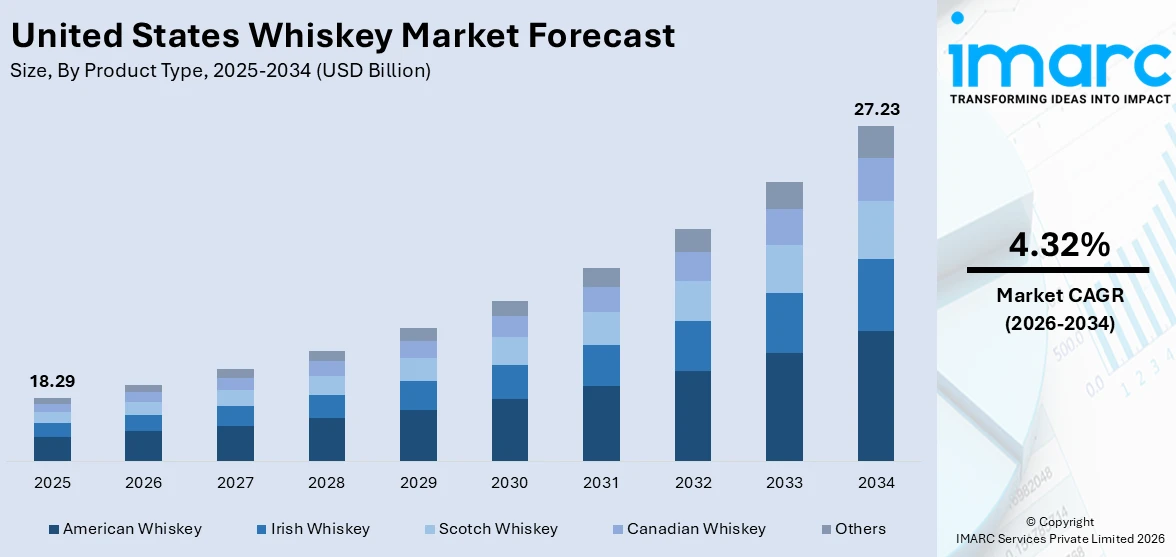
The United States whiskey market grew from USD 18.29 Billion in 2025 to USD 19.41 Billion in 2026 and is projected to reach USD 27.23 Billion by 2034, growing at a compound annual growth rate of 4.32% from 2026-2034.
The market is driven by a convergence of evolving consumer tastes, rising disposable incomes, and a broader cultural shift toward premiumization and authentic craft experiences. Growing enthusiasm for artisanal, small-batch, and heritage-rich whiskey expressions is actively reshaping purchasing behaviors across all demographic groups. Increasing adoption of whiskey in cocktail culture, combined with expanding retail and digital channels, is broadening consumer access and reinforcing a growing United States whiskey market share.
Key Takeaways and Insights:
- By Product Type: American whiskey dominates the market with a share of 55.2% in 2025, driven by bourbon's deep cultural roots, heritage identity, regulated production standards, and consumer preference for domestic expressions.
- By Quality: Premium leads the market with a share of 42.5% in 2025, owing to consumers increasingly seek higher-quality whiskey experiences that balance craftsmanship, brand storytelling, and accessible price points.
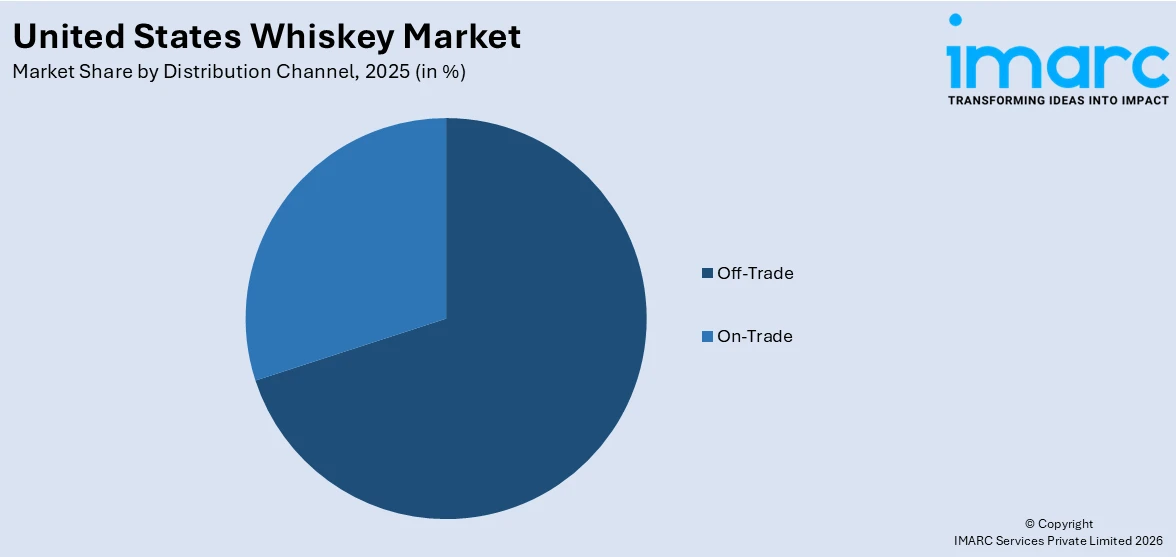
- By Distribution Channel: Off-trade represents the largest segment with a market share of 68.3% in 2025, driven by strong consumer preference for retail convenience, wider product selection, competitive pricing, and growing online purchasing options.
- By Region: South leads the market with a share of 28.6% in 2025, owing to deep-rooted bourbon culture, strong local distillery heritage, and high consumer affinity for domestic and craft whiskey varieties.
- Key Players: The United States whiskey market features a highly competitive landscape, with established multinational spirits companies competing actively alongside regional craft distilleries and independent producers across all price tiers, differentiating on brand heritage, flavor innovation, aging techniques, and national distribution reach.
To get more information on this market Request Sample
The United States whiskey market is shaped by a rich interplay of cultural heritage, evolving consumer preferences, and dynamic industry innovation. Consumers are increasingly gravitating toward premium and craft expressions, driven by a desire for authenticity, provenance, and superior sensory experiences. The growing integration of whiskey into cocktail culture has further amplified demand across on-premises and at-home consumption occasions. As per sources, prominent American bourbon brand Elijah Craig introduced its new Single Barrel 15‑Year‑Old Bourbon at 108 proof, underscoring industry focus on distinctive, high‑age releases appealing to aficionados and collectors. Distilleries continue to invest in novel aging techniques, cask experimentation, and limited-edition releases to cater to an increasingly discerning and adventurous audience. Expanding e-commerce infrastructure and multi-channel retail strategies are widening geographic reach and improving consumer accessibility. Whiskey tourism, immersive brand storytelling, and experiential marketing are reinforcing brand loyalty and attracting younger demographics, while eco-conscious production practices are emerging as key competitive differentiators.
United States Whiskey Market Trends:
Rise of Premiumization and Craft Whiskey
The premiumization trend is fundamentally reshaping the United States whiskey market as consumers increasingly prioritize quality, authenticity, and distinctive flavor experiences over volume. Demand for small-batch, single-barrel, and age-stated expressions has grown considerably, with buyers willing to invest in brands that demonstrate transparency in production and sourcing. This cultural shift toward connoisseurship encourages distilleries to focus on artisanal craftsmanship, refined aging techniques, and storytelling that connects consumers with the unique origin and heritage of each expression, fostering deeper brand loyalty.
Expansion of Cocktail Culture and Whiskey Mixology
Whiskey's integration into contemporary cocktail culture is a defining trend actively shaping demand in the United States market. From classic old fashioneds and manhattans to inventive craft menus, whiskey is increasingly featured as a versatile and sophisticated base spirit in both on-premise and home-bar settings. In August 2025, Jack Daniel’s launched Tennessee Blackberry nationwide, blending Old No. 7 Tennessee Whiskey with sweet, tangy blackberries, expanding its flavors lineup and targeting mixology and casual cocktail consumers. Bartenders and mixologists experiment with diverse styles, including rye, bourbon, and Tennessee whiskey, to create layered flavor profiles.
Innovation in Barrel Finishing and Flavor Experimentation
Product innovation through barrel finishing and cask experimentation has emerged as a pivotal trend driving consumer engagement in the United States whiskey market. Distilleries are actively exploring maturation in non-traditional casks, including port, sherry, rum, and wine barrels to introduce unique flavor nuances such as fruit-forward, spiced, or botanical profiles. In October 2025, Angel’s Envy released its first age‑stated 10‑year bourbon finished in port wine barrels nationwide, highlighting cask experimentation to create richer, wine‑influenced flavour profiles. These highly innovative techniques appeal to adventurous consumers seeking novel tasting experiences and help brands meaningfully differentiate on crowded retail shelves, attracting both seasoned collectors and entirely new whiskey enthusiasts.
Market Outlook 2026-2034:
The United States whiskey market is poised for sustained and consistent growth over the forecast period, underpinned by deepening premiumization trends, expanding craft distillery innovation, and rising consumer enthusiasm for experiential consumption. Increasing adoption of whiskey across cocktail culture, gifting occasions, and tourism-linked channels will continue to broaden the consumer base and unlock new revenue streams. Strategic investments in product differentiation, sustainable production, and digital retail infrastructure are expected to further reinforce long-term market expansion across all quality and distribution tiers. The market generated a revenue of USD 18.29 Billion in 2025, which is expected to reach USD 19.41 Billion in 2026 and further grow to USD 27.23 Billion by 2034, at a compound annual growth rate of 4.32% from 2026-2034.
United States Whiskey Market Report Segmentation:
| Segment Category | Leading Segment | Market Share |
|---|---|---|
|
Product Type |
American Whiskey |
55.2% |
|
Quality |
Premium |
42.5% |
|
Distribution Channel |
Off-Trade |
68.3% |
|
Region |
South |
28.6% |
Product Type Insights:
- American Whiskey
- Irish Whiskey
- Scotch Whiskey
- Canadian Whiskey
- Others
American whiskey dominates with a market share of 55.2% of the total United States whiskey market in 2025.
American whiskey leads the United States whiskey market, driven by bourbon's deeply rooted cultural identity, strict regulatory production standards, and an expansive portfolio that spans accessible everyday expressions to highly prized limited releases. Its heritage-driven narrative resonates strongly with domestic consumers who associate American whiskey with authenticity, craftsmanship, and national pride. As per sources, Buffalo Trace’s Antiques Collection celebrated its 25th anniversary with the first‑ever 15‑year E.H. Taylor Bottled‑in‑Bond bourbon alongside highly anticipated limited editions from George T. Stagg and William Larue Weller.
American whiskey remains an attractive option for both the seasoned connoisseur and the new consumer, as they enter the category through gateway brands and bourbon trail tourism experiences. The distilleries in this segment continue to focus on aging innovations, small-batch production, and engaging consumer experiences that drive consumer engagement and purchase intent. The segment's ability to deliver for both volume-driven and premium-driven consumers across the entire spectrum of pricing continues to be an important driver in the long-term growth and dominance of the category in the larger United States whiskey landscape.

Quality Insights:
- Premium
- High-End Premium
- Super Premium
Premium leads with a share of 42.5% of the total United States whiskey market in 2025.
Premium quality tier dominates the United States whiskey market, striking an optimal balance between elevated drinking experiences and accessible price positioning that appeals to a broad consumer demographic. Premium whiskey brands benefit from strong retail visibility, consistent quality benchmarks, and effective marketing campaigns centered on craftsmanship, heritage, and provenance. In 2025, Buffalo Trace unveiled Eagle Rare 12 bourbon, its newest permanent premium expression, leveraging a decade‑long distillery expansion to offer richer, age‑stated flavour at broad U.S. distribution.
Premium whiskey is also highly sought after in terms of gifting, which adds to the overall significance of premium whiskey in the context of celebrations such as birthdays, anniversaries, and professional achievements. Distilleries in this segment have been working hard on packaging innovations and storytelling and experiential marketing to ensure that consumer engagement is sustained in this crowded marketplace. Thus, the aspirational appeal and affordability factors ensure that the premium segment accounts for the maximum consumer base in the overall quality spectrum and is the driving force behind the United States whiskey market during the forecast period.
Distribution Channel Insights:
Access the comprehensive market breakdown Request Sample
- Off-Trade
- Supermarkets and Hypermarkets
- Discount Stores
- Online Stores
- Others
- On-Trade
- Restaurants and Bars
- Liquor Stores
- Others
Off-trade exhibits a clear dominance with a 68.3% share of the total United States whiskey market in 2025.
Off-trade holds the largest share of the United States whiskey market, reflecting strong consumer preference for the convenience, variety, and competitive pricing offered through supermarkets, hypermarkets, discount stores, and online platforms. The rapid expansion of e-commerce has further accelerated off-trade adoption, enabling distilleries and retailers to deliver an expansive product range directly to consumers nationwide. Promotional bundling, shelf-placement strategies, and curated digital storefronts continue to enhance visibility and drive trial purchases across mainstream and premium whiskey categories.
Off-trade retail also has an important role to play in laying the foundation for consumer brand familiarity and brand loyalty through product and category availability. As consumers increasingly get comfortable with online whiskey purchases, online retail is also investing heavily in personalization and subscription offerings, creating virtual tasting experiences for consumers. This is further cementing the strength of the off-trade retail sector and their dominance in driving revenue growth for the United States whiskey distribution sector.
Regional Insights:
- Northeast
- Midwest
- South
- West
South dominates with a market share of 28.6% of the total United States whiskey market in 2025.
South holds the largest share of the United States whiskey market, underpinned by Kentucky and Tennessee's status as the historic heartland of American bourbon and Tennessee whiskey production. Deep-rooted distillery heritage, an established bourbon trail tourism ecosystem, and strong regional consumer affinity for native whiskey styles collectively sustain its market leadership. The South benefits from proximity to key production centers, a thriving hospitality sector, and a culture of whiskey appreciation that permeates both everyday consumption and premium gifting occasions.
This continued dominance is also fueled by the rapidly growing craft distillery scene that is attracting the entrepreneurial spirits of distillers and whiskey enthusiasts to the region. The local distilleries are investing heavily in consumer engagement through visitor experiences and special releases to maximize additional revenue streams beyond the sale of the bottles themselves. The continued presence of legacy brands and the emerging craft distillery scene creates a thriving competitive landscape that fuels innovation and secures the South as the epicenter of the total United States whiskey market.
Market Dynamics:
Growth Drivers:
Why is the United States Whiskey Market Growing?
Rising Disposable Incomes and Evolving Consumer Lifestyles
Growing consumer affluence across the United States is directly translating into higher spending on premium and craft whiskey categories. As disposable incomes rise, consumers are actively trading up from value-tier products toward more refined and experience-rich expressions that reflect their evolving lifestyles and social identities. Whiskey has increasingly become a marker of sophistication and personal taste, particularly among working professionals and aspirational younger demographics. In 2025, Brown‑Forman’s King of Kentucky returned with a 17‑year‑old single‑barrel bourbon release, limited to about 5,000 bottles and priced at around $399 in the U.S. market.
Expanding E-Commerce and Digital Retail Infrastructure
The rapid growth of online retail channels is fundamentally transforming how consumers discover, research, and purchase whiskey across the United States. Digital platforms offer unmatched product variety, convenience, and access to rare or limited-edition expressions that are unavailable in traditional brick-and-mortar settings. In February 2026, Nevada‑based Frey Ranch Distillery launched a direct‑to‑consumer subscription service “Harvest the Savings,” offering tiered delivery discounts for flagship bourbon and rye via its online shop. Subscription services, virtual tastings, and algorithm-driven personalization tools are deepening consumer engagement and encouraging repeat purchases. This structural shift toward digital commerce is opening significant new revenue opportunities for distilleries of all sizes, enabling direct-to-consumer relationships that strengthen brand loyalty.
Growing Whiskey Gifting Culture and Seasonal Demand
Whiskey has now become synonymous with the idea of gifting, especially during various events and celebrations, ranging from holidays, birthdays, business events, and milestone events, etc. The association of premium whiskey with gifting has now created a predictable demand cycle, which not only helps in the discovery of whiskey as a drink by first-time consumers, who become repeat consumers, but distilleries are now leveraging this trend by creating gift sets, thereby adding value to the gifting aspect of whiskey, which has now become synonymous with the idea of gifting itself.
Market Restraints:
What Challenges the United States Whiskey Market is Facing?
Regulatory Complexity and Compliance Burden
The United States whiskey industry operates within a layered framework of federal and state regulations governing production, labeling, distribution, and taxation. Navigating varying alcohol control laws, three-tier distribution mandates, and evolving trade policies creates significant operational challenges, particularly for smaller craft producers. Compliance costs and licensing requirements constrain geographic expansion and weigh on profitability across independent distilleries.
Inventory Oversupply and Production Overcapacity
Rapid distillery capacity expansion during peak demand years has resulted in significant inventory accumulation across the American whiskey category. Excess supply creates downward pricing pressure and margin erosion risks for mid-tier brands competing in saturated retail environments. Smaller producers face elevated storage costs and capital inefficiency, limiting their ability to reinvest in innovation and brand development during periods of softening consumer demand.
International Trade Barriers and Tariff Volatility
The United States whiskey market's export growth remains vulnerable to disruption from international trade tensions and retaliatory tariff measures imposed by key trading partners. Elevated import duties reduce the competitiveness of American whiskey in lucrative overseas markets, creating revenue uncertainty for distilleries planning global distribution strategies. Craft producers with limited financial resilience are disproportionately impacted, constraining their capacity to diversify through meaningful international expansion.
Competitive Landscape:
The United States whiskey market features a highly competitive landscape shaped by the coexistence of large multinational spirits corporations, well-established regional distilleries, and a rapidly growing craft producer ecosystem. Established players leverage extensive distribution networks, powerful brand equity, and significant marketing investments to maintain category leadership, while craft distilleries compete through artisanal differentiation and localized consumer engagement. Competition is particularly intense within premium and super-premium tiers, where innovation in aging techniques, cask finishing, and limited-edition releases drives meaningful brand distinction. Growing e-commerce penetration and whiskey tourism are simultaneously creating new competitive dimensions, enabling smaller producers to build direct-to-consumer relationships and effectively challenge established brands.
Recent Developments:
- In March 2026, Evan Williams, produced by Heaven Hill Distillery, launched its first-ever blackberry-flavored whiskey, blending classic straight bourbon with fresh blackberry. Available nationwide at $14.99, it targets sipping and cocktail occasions, expanding the brand’s flavored lineup and appealing to summer drinkers seeking accessible, fruity, and refreshing whiskey experiences.
United States Whiskey Market Report Coverage:
| Report Features | Details |
|---|---|
| Base Year of the Analysis | 2025 |
| Historical Period | 2020-2025 |
| Forecast Period | 2026-2034 |
| Units | Billion USD |
| Scope of the Report | Exploration of Historical and Forecast Trends, Industry Catalysts and Challenges, Segment-Wise Historical and Predictive Market Assessment:
|
| Product Types Covered | American Whiskey, Irish Whiskey, Scotch Whiskey, Canadian Whiskey, Others |
| Quality Covered | Premium, High-End Premium, Super Premium |
| Distribution Channels Covered |
|
| Regions Covered | Northeast, Midwest, South, West |
| Customization Scope | 10% Free Customization |
| Post-Sale Analyst Support | 10-12 Weeks |
| Delivery Format | PDF and Excel through Email (We can also provide the editable version of the report in PPT/Word format on special request) |
Frequently Asked Questions About the United States Whiskey Market Report
The United States whiskey market size increased from USD 18.29 Billion in 2025 to USD 19.41 Billion in 2026.
The United States whiskey market is expected to grow at a compound annual growth rate of 4.32% from 2026-2034 to reach USD 27.23 Billion by 2034.
American whiskey holds the largest product type share in the United States whiskey market, reflecting bourbon's deep-rooted cultural heritage, strict regulatory production standards, broad portfolio diversity, and enduring domestic consumer preference for native expressions across all quality and price tiers.
Key factors driving the United States whiskey market include rising premiumization trends, growing cocktail culture integration, expanding craft distillery innovation, increasing consumer disposable incomes, whiskey tourism growth, expanding e-commerce distribution, and heightened consumer interest in artisanal, age-stated, and limited-edition expressions.
Major challenges include regulatory complexity and compliance costs across distribution channels, inventory oversupply from peak production cycles, international trade barriers and retaliatory tariffs, softening volume growth in mainstream segments, and intensifying retail shelf competition among independent and craft distillery brands.
Need more help?
- Speak to our experienced analysts for insights on the current market scenarios.
- Include additional segments and countries to customize the report as per your requirement.
- Gain an unparalleled competitive advantage in your domain by understanding how to utilize the report and positively impacting your operations and revenue.
- For further assistance, please connect with our analysts.
 Request Customization
 Speak to an Analyst
 Request Brochure
 Inquire Before Buying
Benefits of Customization
- Personalize this research
- Triangulate with your data
- Get data as per your format and definition
- Gain a deeper dive into a specific application, geography, customer, or competitor
- Any level of personalization
Get in Touch With Us
UNITED STATES
Phone: +1-201-971-6302
INDIA
Phone: +91-120-433-0800
UNITED KINGDOM
Phone: +44-753-714-6104
Email: sales@imarcgroup.com
Client Testimonials




.webp)




.webp)













Related Reports

Choose your plan
*Please note that the prices mentioned below are starting prices for each bundle type. Kindly contact our team for further details.*
Single User License
- 1 User License, Access on 2 Devices
- PDF Report + Excel Dataset (Password Protected)
- Lifetime Access
- No Printing Rights
- 10% Free Report Customization
- 10–12 Weeks of Analyst Support
Five User License
- Access for 5 Users, 2 Devices per User
- PDF Report + Excel Dataset (Password Protected)
- Lifetime Access
- Dedicated Account Manager
- 12–14 Weeks of Analyst Support
- No Printing Rights
- 15% Free Report Customization
- 25% Discount on Your Next Purchase
Corporate User License
- Unlimited User Access (Within Your Organization)
- PDF Report + Excel Dataset
- Lifetime Access
- Dedicated Account Manager
- 14–20 Weeks of Analyst Support
- No Printing Rights
- 20% Free Report Customization
- 30% Discount on Your Next Purchase
Essential Insights
What's included:
3 reports
- Lifetime Access
- PDF Reports
- Excel Datasets
- 2 Weeks of Free Analyst Support
- 2 User Licenses
- Access on 2 Devices
- Printing Rights
- Complimentary PowerPoint (PPT) Version
- Complimentary License Upgrade
Professional Access
What's included:
5 reports
- Lifetime Access
- PDF Reports
- Excel Datasets
- 8 Weeks of Free Analyst Support
- 2 User Licenses
- Access on 2 Devices
- Printing Rights
- Complimentary PowerPoint (PPT) Version
- Complimentary License Upgrade
Business Advantage
What's included:
8 reports
- Lifetime Access
- PDF Reports
- Excel Datasets
- 14 Weeks of Free Analyst Support
- 2 User Licenses
- Access on 2 Devices
- Printing Rights
- Complimentary PowerPoint (PPT) Version
- Complimentary License Upgrade
Enterprise Intelligence
What's included:
10 reports
- Lifetime Access
- PDF Reports
- Excel Datasets
- 20 Weeks of Free Analyst Support
- 2 User Licenses
- Access on 2 Devices
- Printing Rights
- Complimentary PowerPoint (PPT) Version
- Complimentary License Upgrade