
United States Revenue Cycle Management Market Size, Share, Trends and Forecast by Type, Component, Deployment, End User, and Region, 2026-2034
United States Revenue Cycle Management Market Summary:
The United States revenue cycle management market size was valued at USD 40,383.82 Million in 2025 and is projected to reach USD 91,283.42 Million by 2034, growing at a compound annual growth rate of 9.48% from 2026-2034. The United States revenue cycle management market is experiencing robust growth driven by the rapidly transforming healthcare system and increasing digitalization across provider networks. Healthcare organizations are adopting advanced RCM solutions to streamline billing workflows, reduce claim denials, and optimize reimbursement processes. The growing complexity of payer regulations, shift toward value-based care models, and rising patient financial responsibility are compelling providers to implement technology-driven solutions. Additionally, the integration of artificial intelligence and automation into RCM platforms is reducing administrative expenditure, and accelerating payment cycles across the healthcare continuum.
Key Takeaways and Insights:
By Type: Integrated dominates the market with a share of 73.75% in 2025, driven by their ability to centralize billing data, streamline departmental workflows, and improve claims submission accuracy across healthcare organizations.
By Component: Software leads the market with a share of 60.04% in 2025, attributed to the growing demand for integrated platforms offering real-time analytics, automated billing, and denial tracking capabilities.
By Deployment: Web-based represents the largest segment with a market share of 53.84% in 2025, owing to their affordability, ease of deployment, scalability, and real-time accessibility from any location.
By End User: Hospitals hold the largest share of 54.08% in 2025, due to large-scale patient volumes, complex billing processes, and the growing push toward digital transformation in hospital operations.
Key Players: The market exhibits a highly competitive landscape characterized by significant consolidation activity, strategic acquisitions, and technology-driven differentiation as established vendors expand portfolios through AI-powered innovations and end-to-end solution offerings.
The United States revenue cycle management market continues to evolve as healthcare providers seek comprehensive solutions to address mounting financial pressures and administrative complexities. The industry is witnessing significant consolidation activity, with private equity firms aggressively pursuing acquisitions of RCM companies to build scalable platforms and enhance value propositions. Strategic buyers are particularly focused on companies offering artificial intelligence-driven automation, recurring revenue models, and strong financial performance metrics. The growing demand for technology-enabled solutions that streamline billing workflows, reduce claim denials, and optimize reimbursement processes has made the sector highly attractive for investment. In August 2024, R1 RCM announced its acquisition by private equity firms TowerBrook Capital Partners and Clayton, Dubilier & Rice in a deal valued at USD 8.9 Billion, highlighting the sector's investment attractiveness.
United States Revenue Cycle Management Market Trends:
Accelerated Adoption of Artificial Intelligence and Automation
Artificial intelligence and machine learning are revolutionizing revenue cycle management across the United States healthcare sector. Healthcare organizations are deploying AI-driven tools to predict claim denials, enhance coding accuracy, and automate repetitive billing tasks. These advanced technologies enable providers to identify patterns in rejected claims, optimize collection strategies, and reduce administrative burdens while improving overall financial performance. The integration of natural language processing further streamlines clinical documentation and charge capture workflows.
Growing Shift Toward Cloud-Based RCM Solutions
Cloud-based revenue cycle management platforms are gaining significant traction among healthcare providers seeking scalability, flexibility, and enhanced data security. The need for efficiency, cost savings, and better patient experiences is driving the largest growth in the cloud-based deployment market. These solutions enable remote access, real-time data visibility, and seamless integration with electronic health record systems. Healthcare organizations benefit from reduced infrastructure costs, automatic software updates, and enhanced disaster recovery capabilities that strengthen operational resilience.
Increased Outsourcing of Revenue Cycle Functions
Healthcare providers are increasingly outsourcing revenue cycle management functions to specialized third-party vendors to reduce administrative burdens and focus on patient care delivery. In October 2024, Virginia's Mary Washington Healthcare, a 60-facility nonprofit health system, selected Ensemble Health Partners to handle its revenue cycle management, joining the growing trend of hospitals choosing to outsource some or all revenue cycle functions. This partnership highlights the growing industry movement toward outsourcing to optimize financial performance while ensuring healthcare organizations remain dedicated to their core mission of clinical delivery.
Market Outlook 2026-2034:
The United States revenue cycle management market is positioned for sustained growth as healthcare providers prioritize financial optimization and operational efficiency. The transition from fee-for-service to value-based care models continues to drive demand for comprehensive RCM solutions that integrate clinical and financial workflows. The rapid advancement of autonomous coding technology, with systems reducing coding time while enhancing accuracy, is expected to revolutionize medical billing practices. In March 2025, Titan Health introduced its AI-powered revenue cycle management as a Service platform, demonstrating the industry's commitment to innovative delivery models. The market generated a revenue of USD 40,383.82 Million in 2025 and is projected to reach a revenue of USD 91,283.42 Million by 2034, growing at a compound annual growth rate of 9.48% from 2026-2034.
United States Revenue Cycle Management Market Report Segmentation:
| Segment Category | Leading Segment | Market Share |
|---|---|---|
| Type | Integrated | 73.75% |
| Component | Software | 60.04% |
| Deployment | Web-based | 53.84% |
| End User | Hospitals | 54.08% |
Type Insights:
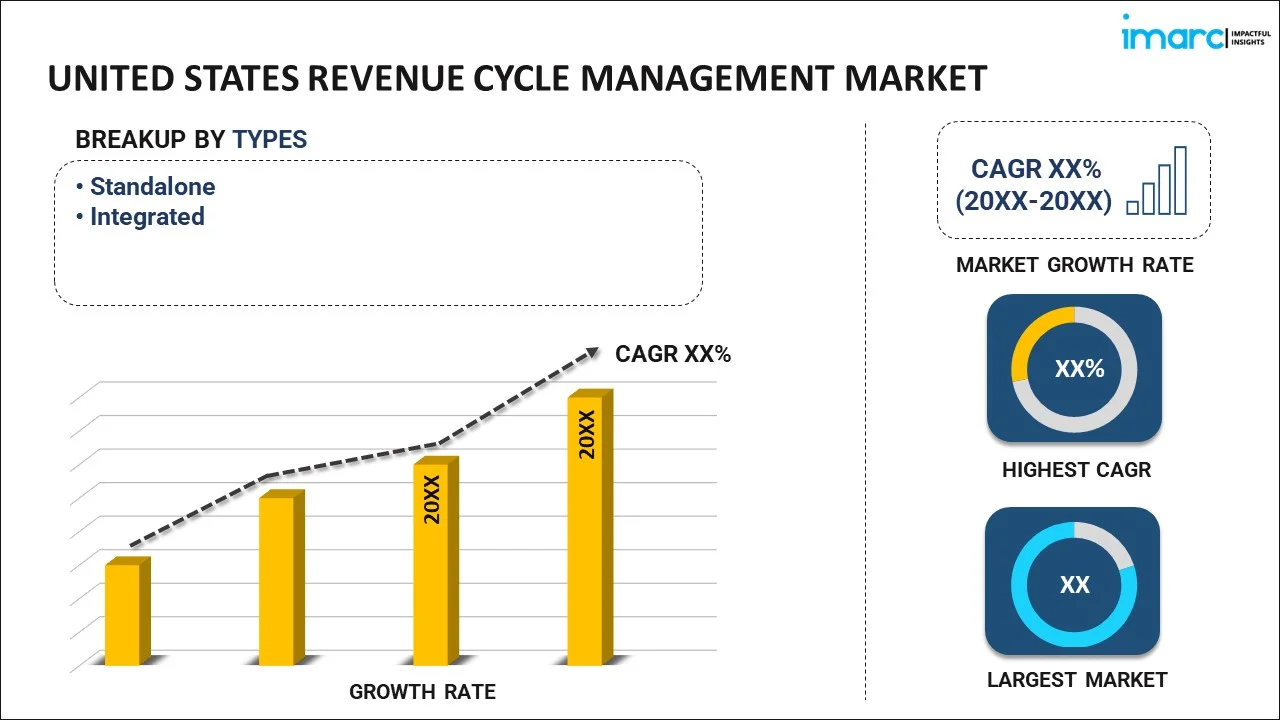
To get detailed segment analysis of this market Request Sample
- Standalone
- Integrated
The integrated dominates with a market share of 73.75% of the total United States revenue cycle management market in 2025.
Integrated revenue cycle management solutions have emerged as the preferred choice for healthcare organizations seeking unified platforms that connect all financial and operational workflows. These comprehensive systems provide significant advantages by centralizing billing data, streamlining departmental data flow, and substantially increasing claims submission accuracy. The integration of clinical documentation with billing processes enables healthcare providers to capture charges more accurately and reduce revenue leakage. According to Healthcare Financial Management Association data in August 2025, 88% of health systems use artificial intelligence (AI) internally, and 71% have found and implemented pilot or full solutions in clinical functional areas, revenue cycle management, or finance.
Healthcare institutions are increasingly adopting integrated solutions to minimize errors and decrease manual data entry, allowing clinical staff to concentrate more on patient care than administrative duties. Integrated RCM platforms offer synchronized management software solutions that connect patient registration, charge capture, claims submission, payment posting, and denial management within a single ecosystem. This holistic approach reduces the complexity of managing multiple standalone systems while providing enhanced visibility into financial performance metrics. The growing regulatory requirements and the shift toward value-based care models further reinforce the need for integrated platforms that can track quality metrics alongside revenue performance.
Component Insights:
- Software
- Services
The software leads with a share of 60.04% of the total United States revenue cycle management market in 2025.
Software solutions have become the backbone of modern revenue cycle management, driven by the increasing demand for automated billing, real-time analytics, and comprehensive denial tracking capabilities. The software segment's dominance reflects healthcare providers' preference for technology-driven solutions that can compress revenue leakage and enhance operational efficiency. According to the Medical Group Management Association, physician practices lose approximately 5% to 10% of potential revenue due to coding inaccuracies or missed charges, making advanced software solutions essential for revenue optimization. In December 2024, athenahealth introduced new automated and AI-driven RCM solutions created especially to streamline administrative duties for medical offices around the country.
RCM software platforms are increasingly incorporating artificial intelligence, machine learning algorithms, and predictive analytics to identify patterns in denied claims and optimize collection strategies. These advanced capabilities enable healthcare organizations to proactively address potential billing issues before they impact the bottom line. The software segment is expected to grow significantly during the forecast period as healthcare providers continue to prioritize digitalization and workflow streamlining. For compliance and performance improvement in healthcare settings of all sizes, cloud-native technologies that provide integrated scheduling, billing, claims administration, and analytics are becoming indispensable.
Deployment Insights:
- Web-based
- Cloud-based
- On-premises
The web-based holds the largest share with 53.84% of the total United States revenue cycle management market in 2025.
Web-based revenue cycle management solutions have gained substantial market share due to their affordability, ease of deployment, and accessibility advantages. These platforms enable healthcare providers and billing teams to access RCM systems from anywhere with an internet connection, offering enhanced flexibility for organizations with remote staff or multiple locations. Web-based solutions are particularly beneficial for organizations experiencing rapid growth or seasonal fluctuations in claims volume, as they can scale seamlessly without requiring expensive hardware infrastructure investments. The implementation of web-based RCM by healthcare organizations accelerated significantly following the increased need for remote accessibility in recent years.
The growing implementation of web-based solutions reflects the healthcare industry's recognition of the benefits these platforms provide, including quick deployment, improved flexibility, real-time data visibility, and customization capabilities. Web-based RCM solutions enable seamless integration with other healthcare software applications, including online booking systems and Internet-based payment portals. Service providers offer flexible payment options, such as monthly subscriptions and pay-as-you-go models, making web-based deployments a cost-effective choice compared to on-premises solutions. These advantages position web-based deployment as the preferred model for healthcare organizations seeking efficient and agile revenue management capabilities.
End User Insights:
- Hospitals
- Physicians
- Diagnostic and Ambulatory Care Centers
The hospitals represent the highest revenue share with 54.08% of the total United States revenue cycle management market in 2025.
Hospitals represent the largest end-user segment in the United States revenue cycle management market due to their extensive administrative demands and requirement for comprehensive financial solutions to manage diverse services and complex payer contracts. The large-scale patient volumes processed by hospitals, combined with intricate billing structures and multiple payer networks, necessitate robust RCM systems capable of handling high transaction volumes while maintaining accuracy and ensuring compliance with evolving healthcare regulations.
Effective revenue cycle management ensures financial stability for hospitals by boosting cash flow, reducing administrative expenses, and maintaining compliance with evolving healthcare standards. Hospital systems are increasingly adopting AI-enabled RCM tools to streamline operations, improve cash flow, and handle large-scale claims processing more efficiently. Hospitals are better positioned to adopt cutting-edge technology since they have more access to finance and infrastructure than smaller healthcare providers, which makes them important contributors to market domination in this sector. The growing push toward digital transformation in hospital operations continues to accelerate RCM solution adoption across health systems nationwide.
Regional Insights:
To get detailed regional analysis of this marketRequest Sample
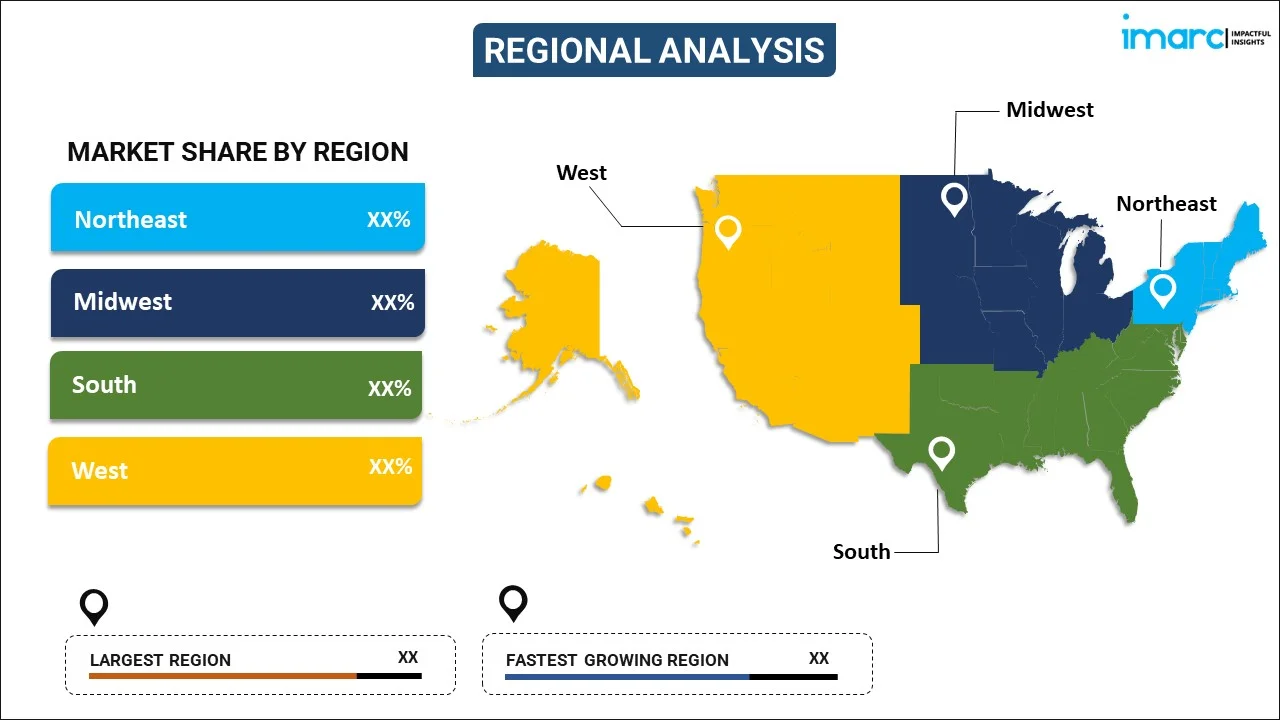
- Northeast
- Midwest
- South
- West
The Northeast demonstrates strong RCM adoption driven by high concentration of academic medical centers, established health systems, and advanced healthcare IT infrastructure across states including New York, Massachusetts, and Pennsylvania, with providers prioritizing integrated solutions for complex multi-payer environments.
The Midwest exhibits steady RCM growth supported by large integrated delivery networks and community hospital systems seeking operational efficiency. States like Ohio, Illinois, and Minnesota feature prominent health systems implementing advanced revenue cycle technologies to optimize rural and urban healthcare financial operations.
The South represents significant market opportunity owing to rapid population growth, expanding healthcare infrastructure, and increasing hospital consolidation activity. States including Texas, Florida, and Georgia demonstrate accelerating RCM adoption as healthcare organizations modernize billing systems to manage growing patient volumes effectively.
The West showcases innovation-driven RCM adoption led by technology-forward health systems and digital health pioneers in California, Washington, and Colorado. Healthcare organizations in this region demonstrate early adoption of AI-powered solutions and cloud-based platforms, establishing benchmarks for automated revenue cycle optimization nationwide.
Market Dynamics:
Growth Drivers:
Why is the United States Revenue Cycle Management Market Growing?
Increasing Complexity of Healthcare Billing and Reimbursement Processes
The escalating administrative burden imposed by regulatory and payer complexity continues to drive substantial demand for advanced revenue cycle management solutions across the United States healthcare landscape. Healthcare providers face mounting challenges related to evolving insurance requirements, frequent payer policy changes, and intricate compliance regulations that necessitate sophisticated billing systems. Experian Health's 2024 State of Claims survey revealed that 77% of healthcare finance decision-makers reported payer policy changes occur more frequently, while 55% indicated claim errors are increasing significantly compared to 2023.
Rising Adoption of Value-Based Care Models
The healthcare industry's transition from fee-for-service to value-based reimbursement models is fundamentally reshaping revenue cycle management requirements and driving investment in comprehensive RCM platforms. Value-based care emphasizes patient outcomes and cost-effectiveness, requiring providers to meet specific quality metrics to secure appropriate reimbursements. This transformation necessitates RCM systems capable of integrating clinical data with financial workflows to track performance against contractual obligations. The Centers for Medicare and Medicaid Services continues to expand value-based care initiatives, with bundled payment programs requiring coordinated care across pre-service, service delivery, and post-service phases. Healthcare organizations must implement sophisticated RCM solutions that can monitor patient outcomes, manage population health metrics, and ensure compliance with complex value-based contracts.
Growing Investment in Healthcare Technology and AI-Powered Automation
Substantial investment in healthcare technology and artificial intelligence-powered automation is accelerating revenue cycle management market growth as organizations seek operational efficiency and cost reduction. Healthcare systems are also channeling significant resources into AI solutions that enhance billing accuracy, predict claim denials, and streamline administrative workflows. The Black Book Research 2025 survey states that AI-powered solutions increased net collections, according to 68% of revenue cycle management (RCM) executives, with 39% reporting a six-month gain in cash flow of more than 10%.
Market Restraints:
What Challenges the United States Revenue Cycle Management Market is Facing?
Cybersecurity and Data Protection Vulnerabilities
Due to the sensitive nature of healthcare data and growing cyber threats, cybersecurity and data protection pose significant problems in the revenue cycle management market. RCM systems handle vast amounts of personal, medical, and financial information, making them attractive targets for ransomware attacks and data breaches that can disrupt operations and cause significant financial losses.
Interoperability and System Integration Challenges
Healthcare organizations face ongoing difficulties integrating RCM solutions with existing electronic health record systems and legacy infrastructure. Interoperability issues between different vendor platforms create data silos, workflow inefficiencies, and increased implementation complexity that can delay realization of expected benefits from technology investments, requiring substantial resources for customization and system harmonization efforts.
Workforce Shortages and Change Management Resistance
The healthcare industry continues to experience significant workforce shortages affecting skilled RCM professionals, coders, and billing specialists. Additionally, resistance to adopting new technologies and workflows among existing staff creates implementation challenges, as concerns about job security, training requirements, and apprehensions regarding data privacy necessitate careful change management strategies and comprehensive employee engagement initiatives.
Competitive Landscape:
Growing demand for technology-driven solutions, substantial player consolidation, and the rise of new entrants utilizing cutting-edge automation and artificial intelligence capabilities characterize the highly competitive and dynamic landscape of the United States revenue cycle management market. Major technology companies dominate through comprehensive end-to-end solutions while expanding portfolios through strategic acquisitions and partnerships. The market remains fragmented with many small, specialized players entering the market and launching innovative products. Competition intensifies as vendors integrate AI, machine learning, and predictive analytics into platforms to differentiate offerings and enhance value propositions for healthcare provider clients.
Recent Developments:
-
January 2025: Access Healthcare, a leading technology-powered revenue cycle management platform, received a strategic investment from affiliates of New Mountain Capital, LLC, a prominent growth-oriented investment company with approximately USD 55 billion in assets under management. The partnership aims to enhance Access Healthcare's capabilities and support expansion into new markets.
-
September 2024: CorroHealth completed the acquisition of the Xtend healthcare revenue cycle management business from Navient, further positioning the company as a leader in revenue cycle management consultancy and technology. Over 925 employees from Xtend joined CorroHealth's workforce, expanding operational capabilities and expertise.
United States Revenue Cycle Management Market Report Coverage:
| Report Features | Details |
|---|---|
| Base Year of the Analysis | 2025 |
| Historical Period | 2020-2025 |
| Forecast Period | 2026-2034 |
| Units | Million USD |
| Scope of the Report | Exploration of Historical and Forecast Trends, Industry Catalysts and Challenges, Segment-Wise Historical and Predictive Market Assessment:
|
| Types Covered | Standalone, Integrated |
| Components Covered | Software, Services |
| Deployments Covered | Web-based, Cloud-based, On-premises |
| End Users Covered | Hospitals, Physicians, Diagnostic and Ambulatory Care Centers |
| Regions Covered | Northeast, Midwest, South, West |
| Customization Scope | 10% Free Customization |
| Post-Sale Analyst Support | 10-12 Weeks |
| Delivery Format | PDF and Excel through Email (We can also provide the editable version of the report in PPT/Word format on special request) |
Frequently Asked Questions About the United States Revenue Cycle Management Market Report
The United States revenue cycle management market size was valued at USD 40,383.82 Million in 2025.
The United States revenue cycle management market is expected to grow at a compound annual growth rate of 9.48% from 2026-2034 to reach USD 91,283.42 Million by 2034.
The integrated dominated with 73.75% market share in 2025, driven by its ability to centralize billing data, streamline departmental workflows, and improve claims submission accuracy across healthcare organizations.
Key factors driving the United States revenue cycle management market include increasing complexity of healthcare billing and reimbursement processes, rising adoption of value-based care models, growing investment in healthcare technology and AI-powered automation, and the need for operational efficiency.
Major challenges include cybersecurity and data protection vulnerabilities, interoperability issues associated with RCM software integration, workforce shortages affecting skilled professionals, and resistance to change management during technology implementation initiatives.
Need more help?
- Speak to our experienced analysts for insights on the current market scenarios.
- Include additional segments and countries to customize the report as per your requirement.
- Gain an unparalleled competitive advantage in your domain by understanding how to utilize the report and positively impacting your operations and revenue.
- For further assistance, please connect with our analysts.
 Request Customization
 Speak to an Analyst
 Request Brochure
 Inquire Before Buying
Benefits of Customization
- Personalize this research
- Triangulate with your data
- Get data as per your format and definition
- Gain a deeper dive into a specific application, geography, customer, or competitor
- Any level of personalization
Get in Touch With Us
UNITED STATES
Phone: +1-201-971-6302
INDIA
Phone: +91-120-433-0800
UNITED KINGDOM
Phone: +44-753-714-6104
Email: [email protected]
Client Testimonials




.webp)




.webp)













Related Reports

Choose your plan
*Please note that the prices mentioned below are starting prices for each bundle type. Kindly contact our team for further details.*
Single User License
- 1 User License, Access on 2 Devices
- PDF Report + Excel Dataset (Password Protected)
- Lifetime Access
- No Printing Rights
- 10% Free Report Customization
- 10–12 Weeks of Analyst Support
Five User License
- Access for 5 Users, 2 Devices per User
- PDF Report + Excel Dataset (Password Protected)
- Lifetime Access
- Dedicated Account Manager
- 12–14 Weeks of Analyst Support
- No Printing Rights
- 15% Free Report Customization
- 25% Discount on Your Next Purchase
Corporate User License
- Unlimited User Access (Within Your Organization)
- PDF Report + Excel Dataset
- Lifetime Access
- Dedicated Account Manager
- 14–20 Weeks of Analyst Support
- No Printing Rights
- 20% Free Report Customization
- 30% Discount on Your Next Purchase
Essential Insights
What's included:
3 reports
- Lifetime Access
- PDF Reports
- Excel Datasets
- 2 Weeks of Free Analyst Support
- 2 User Licenses
- Access on 2 Devices
- Printing Rights
- Complimentary PowerPoint (PPT) Version
- Complimentary License Upgrade
Professional Access
What's included:
5 reports
- Lifetime Access
- PDF Reports
- Excel Datasets
- 8 Weeks of Free Analyst Support
- 2 User Licenses
- Access on 2 Devices
- Printing Rights
- Complimentary PowerPoint (PPT) Version
- Complimentary License Upgrade
Business Advantage
What's included:
8 reports
- Lifetime Access
- PDF Reports
- Excel Datasets
- 14 Weeks of Free Analyst Support
- 2 User Licenses
- Access on 2 Devices
- Printing Rights
- Complimentary PowerPoint (PPT) Version
- Complimentary License Upgrade
Enterprise Intelligence
What's included:
10 reports
- Lifetime Access
- PDF Reports
- Excel Datasets
- 20 Weeks of Free Analyst Support
- 2 User Licenses
- Access on 2 Devices
- Printing Rights
- Complimentary PowerPoint (PPT) Version
- Complimentary License Upgrade