
United States Packaging Machinery Market Size, Share, Trends and Forecast by Machine Type, Technology, End Use, and Region, 2026-2034
United States Packaging Machinery Market Summary:
The United States packaging machinery market size was valued at USD 13.94 Billion in 2025 and is projected to reach USD 17.22 Billion by 2034, growing at a compound annual growth rate of 2.38% from 2026-2034.
At present, the market is primarily driven by rapid e-commerce expansion necessitating flexible automated packaging solutions and persistent labor shortages accelerating automation adoption across manufacturing facilities. Apart from this, the escalating consumer and regulatory demands for sustainable packaging materials and energy-efficient equipment that together are fundamentally reshaping production workflows and investment priorities, thereby expanding the United States packaging machinery market share.
Key Takeaways and Insights:
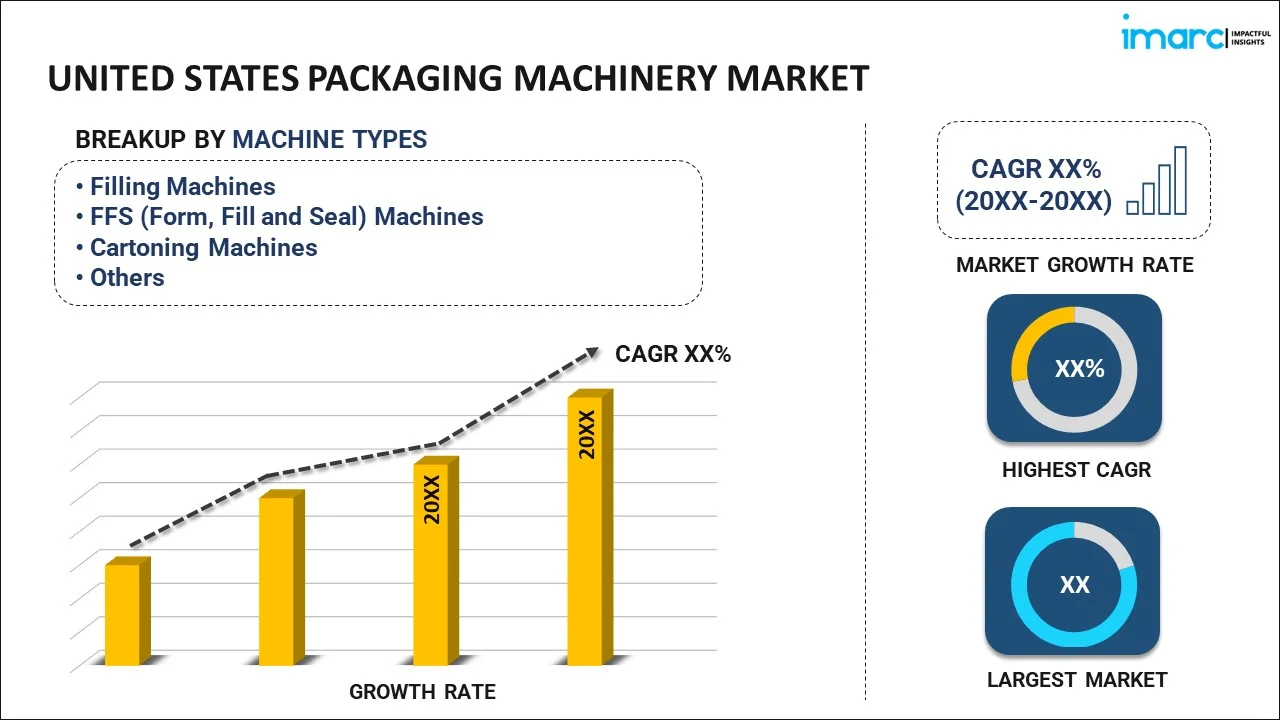
- By Machine Type: FFS (form, fill and seal) machines dominate the market with a share of 32% 2025, due to their integrated automation capabilities that create packages directly from raw material rolls.
- By Technology: General packaging leads the market with a share of 60% 2025, due to its broad applicability across diverse industries and product categories, offering versatile solutions that meet standard packaging requirements without specialized atmosphere control.
- By End Use: Food represents the largest segment with a market share of 35% 2025, driven by consistent consumer demand for packaged food products, stringent hygiene and safety requirements, and continuous product innovation necessitating diverse packaging formats.
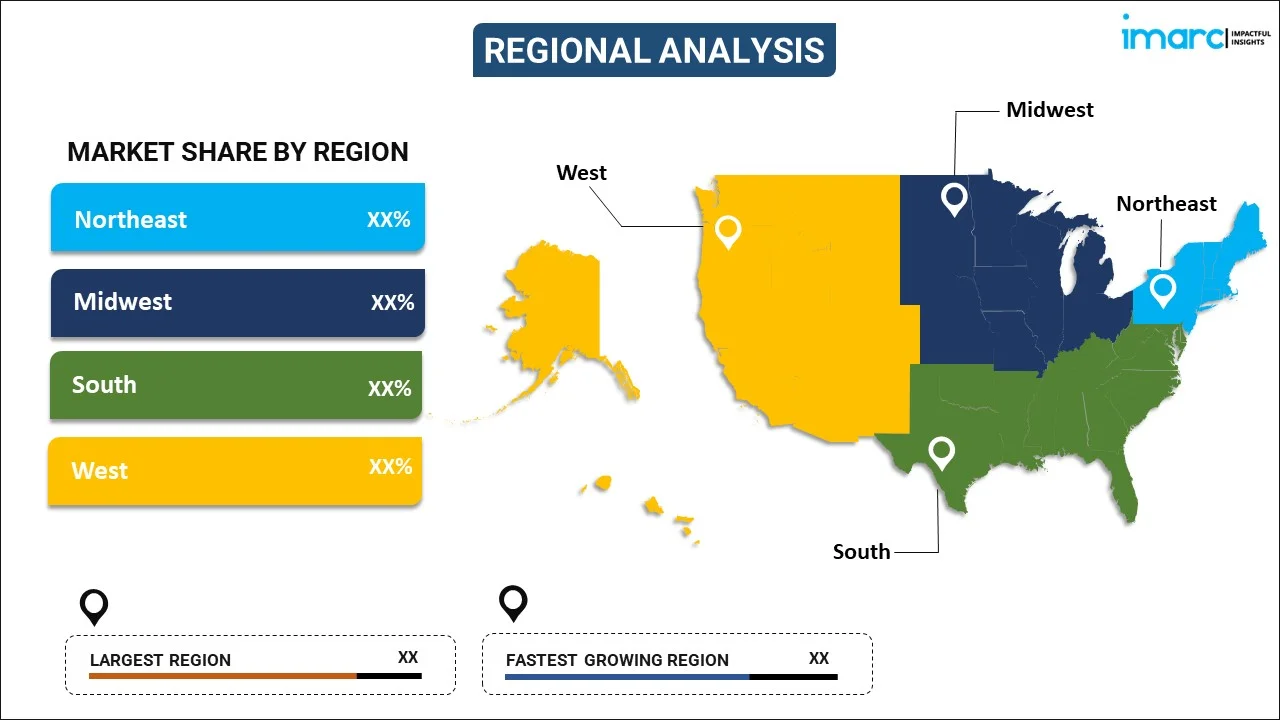
- By Region: South leads the market with a share of 31% 2025, driven by its substantial food and beverage manufacturing presence, favorable business environment, and strategic logistics infrastructure.
- Key Players: US packaging machinery companies are investing in automation, smart controls, and AI, upgrading equipment for speed and flexibility, offering service contracts, targeting food and pharma demand, and improving energy efficiency to stay competitive and protect margins.
The United States packaging machinery market has evolved into a technologically sophisticated sector characterized by significant investments in automation, robotics, and smart manufacturing systems. According to the Association for Packaging and Processing Technologies (PMMI) State of the Industry 2025 report, US packaging machinery sales reached $11.3 billion in 2024, driven by substantial investments in digital solutions and automation that fundamentally altered traditional production workflows through rapid technological adoption since 2020. In general, manufacturers of packaging machinery are responsible for creating space-saving devices that can accommodate delicate materials without causing harm and are user-friendly and easy to maintain. Additional elements influencing the industry involve workforce issues, artificial intelligence (AI), sustainability, and alterations in U.S. governmental policies. The convergence of labor shortage mitigation strategies, e-commerce fulfillment requirements, and sustainability mandates continues to drive manufacturers toward advanced machinery capable of handling diverse product formats with minimal human intervention while maintaining strict quality control and operational efficiency standards.
United States Packaging Machinery Market Trends:
Automation and Robotics Integration Transforming Production Lines
The integration of automation and robotics represents the most significant technological shift reshaping the United States packaging machinery market. According to PMMI's 2025 Embracing Operational Readiness report, more than three-quarters (78%) of survey participants selected productivity as one of their key priorities, followed by cost and automation (both 47%), reflecting manufacturers' strategic pivot toward intelligent equipment. This transformation manifests through the adoption of robotics-based pick-and-place systems, automated filling and sealing lines, vision-enabled quality assurance mechanisms, and advanced palletizing-to-warehouse integration software that collectively enhance operational efficiency while addressing persistent workforce challenges.
Sustainability-Driven Equipment Innovation and Material Transitions
Consumer and regulatory pressure are steering companies toward recyclable and renewable materials, fundamentally influencing packaging machinery design and capabilities. Manufacturers are developing equipment capable of processing alternative sustainable materials while maintaining production speeds and product integrity. This trend encompasses machinery designed for reduced material usage, energy efficiency improvements, and compatibility with biodegradable plastics and fiber-based packaging solutions. The sustainability imperative extends beyond materials to encompass entire production systems, with companies investing in equipment that minimizes waste generation, optimizes resource consumption, and supports circular economy principles throughout packaging operations. In 2024, Nestlé is advancing the limits of eco-friendly packaging with creative paper-based options for its leading brands. To substantially reduce plastic waste, the company is advancing with innovative packaging for several products. Nestlé has recently introduced paperboard canisters for its Vital Proteins brand in the U.S., cutting plastic usage by 90% compared to earlier packaging. Created in partnership with external collaborators at the R&D facility in Bridgewater, New Jersey, these canisters include a unique coverlid that is leak-resistant and sturdy, making them perfect for daily use.
E-commerce Acceleration Driving Flexible Packaging Solutions
The rapid growth of e-commerce has created unprecedented demand for packaging machinery capable of handling diverse product sizes, protective packaging requirements, and high throughput speeds. Companies require flexible automated packaging solutions to manage large order volumes efficiently while ensuring product safety during transit. This has driven investments in compact equipment that integrates into existing plant spaces, handles delicate materials without damage, and maintains user-friendly operation and maintenance characteristics. According to PMMI market development vice-president Jorge Izquierdo, end-user customers are increasingly challenged by high stock-keeping unit counts, innovative packaging formats, and the need to minimize downtime, necessitating adaptable machinery systems.
Market Outlook 2026-2034:
The United States packaging machinery market is poised for steady expansion driven by continued automation investments, sustainable packaging transitions, and e-commerce growth. The forward outlook remains robust, supported by several converging factors including new plant construction across food processing and pharmaceutical sectors, substantial line upgrades to accommodate evolving packaging formats, and favorable interest rate environments that reduce capital investment barriers. The market generated a revenue of USD 13.94 Billion in 2025 and is projected to reach a revenue of USD 17.22 Billion by 2034, growing at a compound annual growth rate of 2.38% from 2026-2034. Evolving consumer preferences continue to reshape machinery demand, particularly the growing popularity of individually packaged single servings, on-the-go products, and premium specialty items that necessitate sophisticated packaging equipment capable of handling diverse formats and maintaining product integrity.
United States Packaging Machinery Market Report Segmentation:
|
Segment Category |
Leading Segment |
Market Share |
|
Machine Type |
FFS (Form, Fill and Seal) Machines |
32% |
|
Technology |
General Packaging |
60% |
|
End Use |
Food |
35% |
|
Region |
South |
31% |
Machine Type Insights:
To get detailed segment analysis of this market, Request Sample
- Filling Machines
- FFS (Form, Fill and Seal) Machines
- Cartoning Machines
- Palletizing Machines
- Labeling Machines
- Wrapping Machines
- Cleaning and Sterilizing Machines
- Others
FFS (form, fill and seal) machines dominate with a market share of 32% of the total United States packaging machinery market in 2025.
Form, fill and seal machinery dominate the United States packaging machinery market due to their integrated automation capabilities that significantly reduce labor requirements while dramatically increasing production speeds. Apart from this, FFS systems demonstrated the fastest growth trajectory among machinery categories, driven by their versatility across multiple applications including food, pharmaceuticals, and consumer goods. These machines create packages directly from raw material rolls, immediately fill them with products, and seal them under one continuous process, ensuring maximum product integrity and protection while minimizing human intervention throughout the packaging operation.
The growing demand for convenient, portable, single-serve formats across fast-moving consumer goods, pharmaceuticals, and meal replacement products contributes significantly to FFS machinery adoption. These systems offer manufacturers substantial operational advantages through reduced material waste, consistent package quality, and rapid changeover capabilities between different product specifications. Additionally, FFS technology aligns with sustainability objectives by optimizing material usage and supporting transitions to recyclable mono-material structures, making it an increasingly attractive investment for companies balancing efficiency, cost-effectiveness, and environmental responsibility in their packaging operations.
Technology Insights:
- General Packaging
- Modified Atmosphere Packaging
- Vacuum Packaging
General packaging leads with a share of 60% of the total United States packaging machinery market in 2025.
General packaging equipment maintains market dominance due to its broad applicability across diverse industries and product categories, offering versatile solutions that meet standard packaging requirements without specialized atmosphere control or vacuum sealing capabilities. This technology segment encompasses conventional filling, sealing, labeling, and cartoning machinery that serves as the foundation for most packaging operations across food and beverages, personal care, household chemicals, and industrial products. General packaging systems provide manufacturers with cost-effective, reliable solutions that balance performance capabilities with operational simplicity and maintenance efficiency.
The widespread adoption of general packaging technology reflects its ability to accommodate various package formats, materials, and production scales while maintaining consistent quality standards. These systems integrate seamlessly with automated production lines and support incremental upgrades toward more sophisticated capabilities as operational requirements evolve. Additionally, general packaging equipment offers manufacturers flexibility in material selection, enabling transitions toward sustainable packaging alternatives without requiring complete system replacements, making it an economically prudent choice for companies navigating changing consumer preferences and regulatory requirements.
End Use Insights:
- Food
- Beverages
- Pharmaceutical and Personal Care
- Chemicals
- Others
Food exhibits a clear dominance with a 35% share of the total United States packaging machinery market in 2025.
The food industry maintains its position as the largest end-use segment for packaging machinery, driven by consistent consumer demand for packaged food products, stringent hygiene and safety requirements, and continuous product innovation necessitating diverse packaging formats. Food manufacturers require sophisticated machinery capable of handling various packaging materials, maintaining product integrity, extending shelf life, and ensuring compliance with food safety regulations throughout automated production processes. The sector's substantial investment in packaging equipment reflects the critical role of effective packaging in preserving product quality, facilitating distribution, and meeting evolving consumer preferences for convenience and sustainability.
Moreover, robust revenue growth in packaging machinery continues to be driven by strong demand from food manufacturers, with increasing throughput requirements and regulatory compliance driving consistent investments in case packing and bottling lines. The food segment's dominance extends across multiple machinery categories including filling machines, sealing equipment, labeling systems, and end-of-line automation, reflecting the complexity and scale of food packaging operations. Additionally, the growing popularity of single-serving packages, ready-to-eat meals, and premium specialty food products continues to drive demand for flexible, high-speed packaging machinery capable of accommodating diverse product characteristics and packaging formats.
Regional Insights:
To get detailed segment analysis of this market, Request Sample
- Northeast
- Midwest
- South
- West
South leads with a share of 31% of the total United States packaging machinery market in 2025.
The Southern region dominates the United States packaging machinery market, driven by its substantial food and beverage manufacturing presence, favorable business environment, and strategic logistics infrastructure that collectively attract packaging operations and machinery investments. The region benefits from concentrated food processing activities, growing pharmaceutical manufacturing facilities, and expanding consumer goods production that generate consistent demand for advanced packaging equipment. Additionally, the South's proximity to major ports facilitates raw material access and finished goods distribution, making it an attractive location for companies seeking to optimize their supply chain efficiency.
The region's market leadership reflects ongoing industrial expansion, with companies investing in new manufacturing facilities and equipment upgrades to meet growing production demands. State-level incentives for manufacturing investments, availability of skilled workforce programs, and lower operational costs compared to other regions further reinforce the South's competitive advantages in attracting packaging machinery installations. The concentration of major food manufacturers, beverage producers, and consumer goods companies in states including Texas, Georgia, North Carolina, and Florida continues to drive substantial machinery procurement across multiple packaging categories.
Market Dynamics:
Growth Drivers:
Why is the United States Packaging Machinery Market Growing?
Persistent Labor Shortages Accelerating Automation Adoption
The United States packaging machinery market experiences substantial growth driven by persistent labor shortages that compel manufacturers to invest in automated solutions capable of compensating for workforce constraints while maintaining production targets. Companies are increasingly willing to invest substantial capital in advanced machinery rather than continue struggling with high turnover rates, training costs, and the operational unpredictability associated with manual labor reliance, fundamentally reshaping equipment purchasing decisions across all packaging segments. Almost all U.S. industrial companies intend to implement additional automation in the next three years as they boost domestic manufacturing and address persistent labor shortages, based on recent findings from RobCo. The research revealed that 95% of American manufacturing firms anticipate implementing new automation by 2028.
E-commerce Expansion Driving Flexible Packaging Requirements
The explosive growth of e-commerce continues to drive packaging machinery demand as companies require equipment capable of handling diverse product sizes, protective packaging needs, and rapid fulfillment requirements. The pandemic-accelerated shift toward online shopping created lasting changes in packaging operations, with manufacturers investing in flexible automated solutions to manage large order volumes efficiently while ensuring product safety during transit. Companies need machinery that can quickly adapt to varying package sizes and shapes, often in smaller batches, reflecting the personalized nature of e-commerce orders compared to traditional retail distribution. According to industry analysis, the rise of e-commerce prompted significant form-factor changes including shifts from boxes to mailers as shipments became more frequent with fewer items per order, driving demand for versatile packaging systems. Manufacturers are prioritizing equipment investments that support right-sized packaging to reduce material waste, lower shipping costs, and improve sustainability metrics, while simultaneously maintaining the protection standards necessary for direct-to-consumer shipments. IMARC Group predicts that the United States e-commerce market is projected to reach USD 2,160.3 Billion by 2034.
Food Industry Expansion and Innovation Driving Equipment Investments
The food and beverage sector's continuous growth and product innovation drive substantial packaging machinery investments as manufacturers seek equipment capable of handling diverse formats, maintaining hygiene standards, and supporting shelf-life extension requirements. The sector's evolution toward convenient single-serving packages, ready-to-eat meals, and premium specialty products necessitates sophisticated machinery capable of accommodating various packaging materials and formats while maintaining product integrity throughout automated production processes. Changes in consumer preferences including the growing popularity of individually packaged single servings, along with new plant construction and line upgrades across the food processing industry, generate consistent machinery procurement activity. In 2025, Congressman Randy Weber (TX-14) presented the Packaging and Claims Knowledge (PACK) Act of 2025, a practical measure aimed at creating the initial voluntary federal standard for environmental claims on packaging, aiming to eliminate deceptive "green" labels that mislead consumers and hinder genuine recycling efforts. The PACK Act tackles this issue by advancing science-based, industry-led criteria for environmental labeling. According to the legislation, businesses are allowed to make environmental claims only if those claims are scientifically substantiated and acknowledged by current recycling or composting initiatives, promoting honesty and clarity without introducing new requirements.
Market Restraints:
What Challenges the United States Packaging Machinery Market is Facing?
High Initial Investment Costs Limiting Market Entry
The substantial capital requirements for advanced packaging machinery present significant barriers, particularly for small and medium-sized enterprises seeking to modernize operations. According to industry analysis, although fully automated machines carry substantial price tags, the complexity and sophistication of modern equipment necessitate major upfront investments that many smaller companies find difficult to justify despite long-term operational benefits. This financial constraint limits market penetration and slows the adoption of cutting-edge technologies among budget-conscious manufacturers.
Skilled Workforce Shortage for Equipment Operation
The packaging machinery sector faces critical challenges in securing qualified technicians and operators capable of managing sophisticated automated systems. According to PMMI reports, availability of qualified service technicians represents one of the toughest challenges facing machine builders, with many service technicians leaving the industry in favor of more flexible work arrangements following the pandemic. This shortage affects machinery utilization efficiency and maintenance quality across production facilities.
Supply Chain Disruptions Affecting Equipment Delivery
Ongoing supply chain volatility continues to impact packaging machinery manufacturers and end users through extended lead times, component shortages, and unpredictable delivery schedules. According to PMMI's 2024 Aftermarket Parts and Services report, 75% of end users identified delivery delays and part availability among their biggest concerns, creating operational uncertainties and complicating long-term capacity planning for packaging operations.
Competitive Landscape:
The United States packaging machinery market exhibits a competitive landscape characterized by the presence of established multinational corporations offering comprehensive equipment portfolios alongside specialized regional manufacturers focusing on niche applications. Major players maintain competitive advantages through continuous innovation, extensive service networks, and integrated solutions encompassing machinery, automation systems, and aftermarket support. Companies differentiate themselves through technological capabilities including advanced robotics integration, intelligent control systems, predictive maintenance features, and modular designs enabling flexible production configurations. Strategic initiatives including mergers and acquisitions, technology partnerships, and capacity expansions reflect ongoing consolidation trends aimed at achieving operational synergies and market share gains across packaging machinery segments.
Recent Developments:
- In January 2026, AOPACK, an expert producer of automated box-making machines for corrugated packaging, has finalized several equipment shipments to packaging producers throughout the United States, facilitating efficient and adaptable box production in industrial settings.
- In December 2025, ProAmpac, a worldwide leader in flexible packaging and material science, revealed that it has reached a final agreement to purchase TC Transcontinental Packaging (“TCP”) from TC Transcontinental (TSX: TCL.A TCL.B) for US $1.51 billion (roughly CAD $2.1 billion), pending standard adjustments for debt and debt-like items, cash, and net working capital. TCP produced around US $1.2 billion in revenue for the year ending July 27, 2025. The deal is anticipated to finalize in the first quarter of calendar 2026, pending shareholder consent, regulatory clearances, and other typical conditions.
United States Packaging Machinery Market Report Coverage:
| Report Features | Details |
|---|---|
| Base Year of the Analysis | 2025 |
| Historical Period | 2020-2025 |
| Forecast Period | 2026-2034 |
| Units | Billion USD |
| Scope of the Report | Exploration of Historical Trends and Market Outlook, Industry Catalysts and Challenges, Segment-Wise Historical and Future Market Assessment:
|
| Machine Types Covered | Filling Machines, FFS (Form, Fill and Seal) Machines, Cartoning Machines, Palletizing Machines, Labeling Machines, Wrapping Machines, Cleaning and Sterilizing Machines, Others |
| Technologies Covered | General Packaging, Modified Atmosphere Packaging, Vacuum Packaging |
| End Uses Covered | Food, Beverages, Pharmaceutical and Personal Care, Chemicals, Others |
| Regions Covered | Northeast, Midwest, South, West |
| Customization Scope | 10% Free Customization |
| Post-Sale Analyst Support | 10-12 Weeks |
| Delivery Format | PDF and Excel through Email (We can also provide the editable version of the report in PPT/Word format on special request) |
Key Questions Answered in This Report
The United States packaging machinery market size was valued at USD 13.94 Billion in 2025.
The United States packaging machinery market is expected to grow at a compound annual growth rate of 2.38% from 2026-2034 to reach USD 17.22 Billion by 2034.
FFS (form, fill and seal) machines leads the market with 32% share, followed by other categories including filling and dosing machines, cartoning machines, palletizing machines, wrapping and bundling machines, labeling and coding machines, and capping and closing machines.
Key factors driving the United States packaging machinery market include persistent labor shortages accelerating automation adoption, rapid e-commerce expansion requiring flexible packaging solutions, growing food industry demand, sustainability-driven equipment innovation, and investments in smart manufacturing technologies enhancing operational efficiency.
Major challenges include high initial investment costs limiting adoption among smaller manufacturers, skilled workforce shortages affecting equipment operation and maintenance, supply chain disruptions causing delivery delays and component availability issues, and technological complexity requiring specialized expertise for implementation.
Need more help?
- Speak to our experienced analysts for insights on the current market scenarios.
- Include additional segments and countries to customize the report as per your requirement.
- Gain an unparalleled competitive advantage in your domain by understanding how to utilize the report and positively impacting your operations and revenue.
- For further assistance, please connect with our analysts.
 Request Customization
 Speak to an Analyst
 Request Brochure
 Inquire Before Buying
Benefits of Customization
- Personalize this research
- Triangulate with your data
- Get data as per your format and definition
- Gain a deeper dive into a specific application, geography, customer, or competitor
- Any level of personalization
Get in Touch With Us
UNITED STATES
Phone: +1-201-971-6302
INDIA
Phone: +91-120-433-0800
UNITED KINGDOM
Phone: +44-753-714-6104
Email: sales@imarcgroup.com
Client Testimonials




.webp)




.webp)












