
United States Indoor LBS Market Size, Share, Trends and Forecast by Solution Type, Technology, Application, Vertical, and Region, 2026-2034
United States Indoor LBS Market Summary:
The United States indoor LBS market size was valued at USD 7.69 Billion in 2025 and is projected to reach USD 25.43 Billion by 2034, growing at a compound annual growth rate of 14.21% from 2026-2034.
The United States indoor location-based services market is experiencing significant expansion driven by rising demand for precise indoor positioning solutions across commercial and industrial environments. Organizations are increasingly adopting these technologies to enhance operational efficiency, improve customer experiences, and optimize workforce management. The proliferation of smart buildings, Internet of Things integration, and advanced wireless technologies is accelerating the widespread deployment of indoor LBS solutions across multiple industry verticals, positioning the market for sustained growth throughout the forecast period.
Key Takeaways and Insights:
- By Solution Type: Location and alerts dominate the market with a share of 26% in 2025, owing to its comprehensive real-time positioning capabilities and contextual notification features that enable businesses to deliver personalized navigation assistance and proximity-based alerts to users within enclosed spaces.
- By Technology: RFID and NFC leads the market with a share of 30% in 2025. This dominance is driven by the widespread deployment of RFID-enabled asset tracking systems across retail and logistics operations, enabling precise inventory management and seamless contactless interactions.
- By Application: Tracking holds the largest segment with a market share of 34% in 2025, reflecting the critical importance of real-time asset and personnel monitoring for enhancing operational transparency, optimizing workflow processes, and ensuring workplace safety protocols.
- By Vertical: Retail exhibits a clear dominance in the market with 27% share in 2025, driven by the increasing adoption of proximity marketing solutions, in-store navigation systems, and customer behavior analytics platforms that enhance shopper engagement and optimize retail operations.
- By Region: South represents the largest region with 30% share in 2025, driven by the concentration of major logistics hubs, distribution centers, and retail establishments across Texas, Florida, and Georgia metropolitan areas, coupled with robust investments in smart infrastructure projects.
- Key Players: Key players drive the United States indoor LBS market by expanding product portfolios, advancing positioning accuracy technologies, and strengthening enterprise partnerships. Their investments in research and development, cloud-based analytics platforms, and IoT integration boost market penetration and accelerate technology adoption across diverse industry verticals.
The United States indoor LBS market is witnessing transformative growth as enterprises increasingly recognize the strategic value of precise indoor positioning technologies for optimizing operations and enhancing customer experiences. The integration of advanced technologies including ultra-wideband, Bluetooth Low Energy beacons, and Wi-Fi fingerprinting is enabling sub-meter accuracy levels that were previously unattainable. The retail sector continues to pioneer adoption through proximity marketing initiatives that deliver personalized promotions based on shopper location, driving measurable increases in customer engagement and conversion rates. Manufacturing and logistics operations are implementing indoor LBS platforms to streamline warehouse management, monitor equipment utilization, and ensure worker safety compliance. Government investments in smart city initiatives and emergency response infrastructure are further catalyzing market expansion across public venues, transportation hubs, and commercial buildings nationwide.
United States Indoor LBS Market Trends:
Integration of Artificial Intelligence and Machine Learning
The convergence of artificial intelligence with indoor positioning systems is revolutionizing location-based analytics capabilities across the United States. AI-powered algorithms are enabling predictive positioning that anticipates user movements and optimizes routing recommendations in real time. Machine learning models analyze historical movement patterns to deliver increasingly accurate location predictions while reducing computational overhead. These intelligent systems automatically calibrate beacon placements and adjust signal parameters to maintain optimal positioning accuracy in dynamic indoor environments, transforming how enterprises leverage spatial data for operational decision-making. In September 2025, OpenSpace announced a breakthrough in Spatial AI technology called "AI Autolocation" that gives smartphones real-time indoor positioning capabilities. The patent-pending technology creates an adaptive system that progressively refines location estimations using advances in sensor fusion, machine learning, dynamic map creation, and computational efficiency specifically for mobile devices.
Proliferation of Ultra-Wideband Technology
Ultra-wideband technology is rapidly gaining traction as the preferred positioning standard for applications requiring centimeter-level accuracy. Major technology manufacturers are embedding UWB chips in smartphones and consumer devices, expanding the addressable market for precision indoor navigation services. In January 2025, the FiRa Consortium released the FiRa Core 3.0 Specifications and Certification Program, a major update to ultra-wideband (UWB) technology. The release includes Hybrid UWB Scheduling (HUS) for improved performance in complex environments, Dedicated Data Transfer for high-speed data transmission, and Car Connectivity Consortium (CCC) Digital Key UWB feature. In 2024, various new UWB radio chips passed FiRa v2.0 certification including chips from NXP, Qualcomm, GiantSemi, Chipsbank, Maxscend, and NewRadioTech, with approximately 60% of all UWB chips shipped being embedded in smartphones.
Cloud-Based Location Analytics Platforms
Cloud infrastructure is fundamentally transforming how organizations deploy and scale indoor location services across distributed facilities. Cloud-based platforms enable centralized management of positioning infrastructure while supporting real-time data aggregation from thousands of sensors simultaneously. In May 2024, Microsoft announced the unification of its enterprise maps offerings under Azure Maps, integrating advanced features including custom indoor maps, geolocation, weather information, and data residency compliance. The platform introduces AI-driven capabilities with Azure services integration, enabling organizations to add location context to data and visualize it on customizable interactive maps. At Microsoft Build 2024, Microsoft also announced the availability of NVIDIA's cuOpt service within the Azure Marketplace for dynamic routing and real-time re-optimization at scale.
Market Outlook 2026-2034:
The United States indoor LBS market outlook remains exceptionally positive as digital transformation initiatives continue accelerating across enterprise and public sector organizations. The growing emphasis on operational efficiency, workplace safety optimization, and enhanced customer engagement is driving sustained investments in indoor positioning infrastructure. Healthcare institutions are increasingly deploying real-time location systems for asset tracking and patient flow management, while retailers leverage location analytics to personalize shopping experiences and optimize store layouts. Additionally, the convergence of 5G connectivity with edge computing is enabling more sophisticated positioning applications. The market generated a revenue of USD 7.69 Billion in 2025 and is projected to reach a revenue of USD 25.43 Billion by 2034, growing at a compound annual growth rate of 14.21% from 2026-2034.
United States Indoor LBS Market Report Segmentation:
| Segment Category | Leading Segment | Market Share |
|---|---|---|
| Solution Type | Location and Alerts | 26% |
| Technology | RFID and NFC | 30% |
| Application | Tracking | 34% |
| Vertical | Retail | 27% |
| Region | South | 30% |
Solution Type Insights:
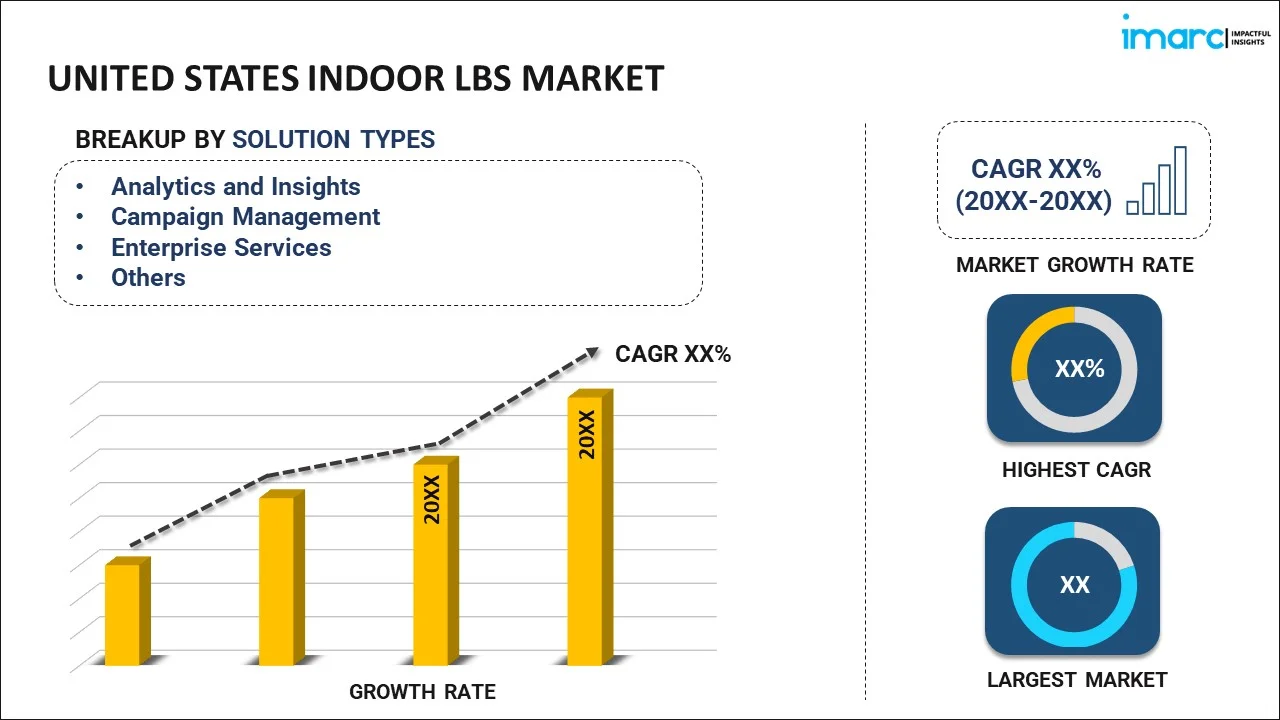
To get detailed segment analysis of this market Request Sample
- Analytics and Insights
- Campaign Management
- Enterprise Services
- Location and Alerts
- Maps
- Proximity Beacons
- Others
- Automotive Services
- Consumer Services
- Location-based Advertising Services
- Precision Geo-targeting
- Secure Transactions and Redemptions
- Others
Location and alerts dominate with a market share of 26% of the total United States indoor LBS market in 2025.
The location and alerts solution type encompasses comprehensive positioning capabilities combined with real-time notification systems that fundamentally transform how users interact within indoor environments. This segment delivers turn-by-turn navigation assistance, dynamic indoor mapping, and contextual alerts based on precise user locations. Advancements in Wi-Fi triangulation, Bluetooth beacons, and ultra-wideband systems have significantly enhanced positioning accuracy and reliability. Organizations across retail, healthcare, and transportation sectors are implementing these solutions to guide visitors through complex facilities while delivering personalized promotional content.
The integration of alerts functionality enables contextual notifications ranging from emergency safety warnings to personalized promotional offers based on proximity to specific locations. In October 2025, Walmart announced partnership with OpenAI to integrate real-time in-store navigation with IoT-enabled devices, providing customers with personalized shopping experiences and efficient store navigation through smartphone applications. This functionality supports geofencing applications that trigger automated responses when users enter or exit designated zones, enabling sophisticated proximity marketing campaigns and streamlined visitor management across commercial venues.
Technology Insights:
- Context Aware Technology
- OTDOA and E-OTDOA
- RFID and NFC
- Satellite, Microwave and Infrared Sensing
- Others (Wi-Fi/WLAN, UWB, BT/BLE, Beacons, A-GPS, etc.)
RFID and NFC leads with a share of 30% of the total United States indoor LBS market in 2025.
Radio frequency identification and near-field communication technologies have emerged as the fundamental enablers of indoor location services across the United States market. RFID systems facilitate precise asset localization through active and passive tag deployments that communicate with networked reader infrastructure positioned throughout indoor environments. These technologies deliver reliable positioning in challenging RF environments where competing signals create interference patterns. Retail establishments leverage RFID for comprehensive inventory management while enabling seamless checkout experiences through automated product identification and tracking capabilities.
NFC technology enables secure short-range interactions that support contactless payment processing, access control applications, and proximity-triggered content delivery systems. In 2024, close to 450 Million UWB chips were shipped globally, representing a 21% increase year over year, demonstrating accelerating adoption of precision positioning technologies that complement RFID deployments. The combination of RFID infrastructure with NFC-enabled smartphones creates powerful location ecosystems that support both asset tracking and consumer engagement applications across healthcare, manufacturing, and hospitality sectors throughout the country.
Application Insights:
- Monitoring
- Navigation
- Tracking
- Analytics
- Others
Tracking exhibits a clear dominance with a 34% share of the total United States indoor LBS market in 2025.
The tracking application segment delivers essential capabilities for monitoring the real-time locations of assets, personnel, and inventory across industrial, commercial, and institutional environments. Indoor LBS-driven tracking solutions enable efficient inventory management, optimize logistics workflows, and streamline warehouse operations by providing precise visibility into goods movement within complex facilities. Manufacturing environments benefit from continuous equipment monitoring and component tracking that enhances process optimization and improves safety through real-time worker location awareness and geofenced hazard zone alerts.
Healthcare facilities increasingly deploy tracking applications to manage patient flow, monitor medical equipment utilization, and optimize resource allocation across clinical departments. The ability to locate high-value assets instantly reduces search time and prevents equipment loss while enabling data-driven decisions about capital equipment investments and facility space utilization. Hospitals leverage these systems to track wheelchairs, infusion pumps, and portable diagnostic devices, ensuring critical equipment remains available when needed. Staff coordination improves significantly as administrators gain visibility into personnel locations during emergencies and routine operations.
Vertical Insights:
- Retail
- Transportation and Logistics
- Media and Entertainment
- Healthcare Life Sciences
- Government and Public Buildings
- Aerospace and Defense
- BFSI
- Others
Retail represents the leading segment with a 27% share of the total United States indoor LBS market in 2025.
The retail vertical demonstrates extensive adoption of indoor location services to enhance customer engagement, optimize store operations, and generate actionable behavioral insights from shopper movements. Retailers implement proximity marketing solutions that deliver personalized promotions and product recommendations based on customer locations within store environments. Indoor navigation capabilities help shoppers efficiently locate products across large retail formats while beacon-based analytics provide valuable data on customer dwell times, pathway preferences, and conversion patterns across different store zones.
The expansion of omnichannel fulfillment operations has driven substantial investments in indoor positioning infrastructure to support buy-online-pickup-in-store and same-day delivery services. Store associates leverage real-time location data to fulfill orders efficiently while ensuring optimal inventory placement based on demand patterns and shopper traffic analytics. Retailers utilize these systems to streamline curbside pickup coordination and improve order accuracy through precise product location tracking. The integration of indoor positioning with inventory management platforms enables seamless synchronization between online orders and physical store operations.
Regional Insights:
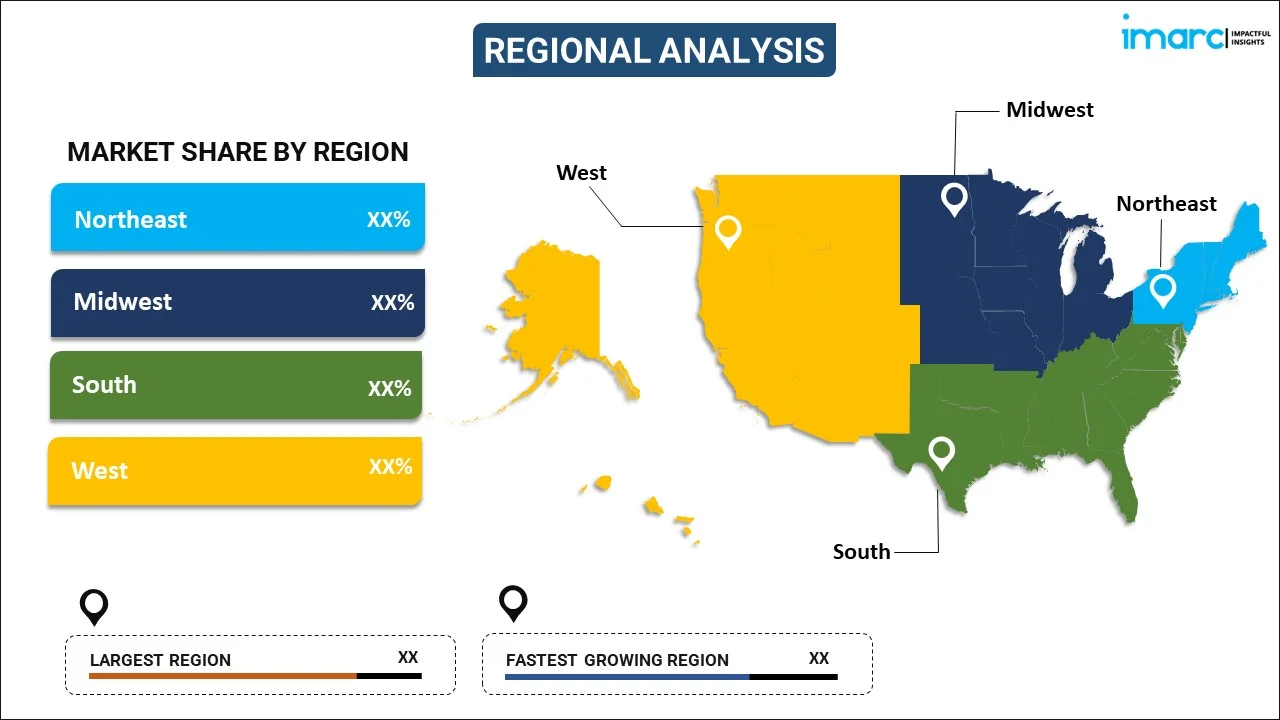
To get detailed regional analysis of this market Request Sample
- Northeast
- Midwest
- South
- West
The South exhibits a clear dominance with a 30% share of the total United States indoor LBS market in 2025.
The South commands the largest share of the United States indoor LBS market, driven by the concentration of major logistics operations, distribution centers, and retail headquarters across Texas, Florida, Georgia, and surrounding states. The region hosts numerous large-format retail establishments and e-commerce fulfillment centers that require sophisticated indoor positioning infrastructure to manage complex inventory operations and optimize warehouse workflows. Additionally, favorable business climates and lower operational costs continue attracting technology companies establishing regional operations requiring advanced location services.
Healthcare facility expansion across Sun Belt metropolitan areas has further accelerated indoor LBS adoption as hospital systems implement real-time location solutions for asset management and patient flow optimization. Smart city initiatives in major Southern urban centers including Dallas, Houston, Atlanta, and Miami are driving investments in connected infrastructure that incorporates indoor positioning capabilities across public venues, transportation hubs, and commercial developments. The region's growing population base and expanding commercial real estate sector create sustained demand for intelligent building technologies.
Market Dynamics:
Growth Drivers:
Why is the United States Indoor LBS Market Growing?
Rising Adoption of Smart Building Technologies
The proliferation of smart building initiatives across commercial real estate portfolios is fundamentally driving demand for indoor location services throughout the United States. Property owners and facility managers are integrating indoor positioning infrastructure to enable automated climate control, intelligent lighting systems, and optimized space utilization based on real-time occupancy data. These deployments support hybrid workplace strategies by providing accurate room booking, hot-desking capabilities, and wayfinding assistance for employees navigating complex office environments. The convergence of building management systems with indoor location platforms enables unprecedented operational efficiency gains while enhancing occupant comfort and safety. In May 2024, Microsoft unified enterprise maps offerings under Microsoft Azure Maps to enable customers to leverage advanced service authentication methods, data residency compliance, geolocation capabilities, and custom indoor maps for comprehensive facility management. Enterprise organizations are increasingly recognizing indoor LBS as essential infrastructure for achieving sustainability targets through energy optimization based on precise occupancy monitoring across building zones.
Growing Demand for Real-Time Asset Visibility
Organizations across manufacturing, healthcare, and logistics sectors are implementing indoor location services to achieve comprehensive visibility into asset locations and movements within their facilities. Real-time tracking capabilities eliminate time wasted searching for equipment, reduce asset loss and theft, and enable data-driven decisions about capital investments and resource allocation. Healthcare systems particularly benefit from RTLS deployments that provide instant visibility into medical equipment locations, enabling clinical staff to locate critical devices rapidly during patient care situations. Manufacturing facilities leverage indoor positioning to monitor work-in-progress inventory, track tool locations, and ensure compliance with material handling protocols. In February 2024, Cisco Systems launched its new AP Auto find capability, revolutionizing large-scale wireless AP network administration by enabling users to precisely locate access points at the campus, building, and floor level. The expanding emphasis on supply chain resilience and operational continuity is accelerating enterprise investments in indoor location infrastructure that supports comprehensive asset management across distributed facility networks.
Expansion of Location-Based Marketing Applications
The retail and hospitality industries are driving substantial growth in indoor location services through expanding deployments of proximity marketing and customer engagement solutions. Businesses are leveraging indoor positioning to understand consumer behavior patterns, optimize store layouts, and deliver personalized promotional content that resonates with shoppers based on their precise locations within commercial venues. Beacon-based marketing platforms enable contextual messaging that reaches consumers at precisely the right moment during their shopping journey, significantly improving campaign effectiveness compared to traditional advertising approaches. The convergence of indoor location data with customer relationship management systems creates powerful personalization capabilities that enhance brand loyalty and drive repeat purchases. Venue operators across entertainment, hospitality, and retail sectors are implementing indoor navigation features within mobile applications that guide visitors while simultaneously capturing valuable behavioral analytics.
Market Restraints:
What Challenges the United States Indoor LBS Market is Facing?
Privacy and Data Security Concerns
Indoor location tracking raises significant privacy concerns regarding personal data collection and usage within enclosed spaces. Organizations must navigate complex regulatory requirements including consumer consent mechanisms, data retention policies, and protection obligations while building user trust through transparent location data handling practices. Balancing operational benefits with privacy preservation requires robust governance frameworks and clear communication.
High Implementation and Infrastructure Costs
Deploying comprehensive indoor positioning infrastructure requires substantial upfront investments in hardware including beacons, sensors, access points, and network upgrades. Smaller organizations often find deployment financially challenging while ongoing maintenance, calibration requirements, and periodic system upgrades add significantly to total ownership expenses. Professional services for site surveys and installation further increase implementation budgets across facility portfolios.
Integration Complexity with Legacy Systems
Integrating indoor positioning solutions into existing building management and enterprise systems presents significant technical challenges requiring specialized expertise. Legacy infrastructure often lacks compatibility with modern positioning technologies, necessitating substantial upgrades or custom integration development. These requirements extend implementation timelines, increase project complexity, and demand ongoing technical support to maintain seamless interoperability across diverse organizational platforms.
Competitive Landscape:
The United States indoor LBS market exhibits a moderately consolidated competitive landscape characterized by the presence of established technology giants alongside specialized positioning solution providers. Leading participants maintain market presence through comprehensive product portfolios spanning hardware infrastructure, software platforms, and managed services offerings. Key competitive strategies include continuous research and development investments targeting enhanced positioning accuracy, expanded technology interoperability, and advanced analytics capabilities. Strategic partnerships between platform providers, system integrators, and vertical-specific solution developers enable comprehensive go-to-market approaches addressing diverse enterprise requirements. Market participants increasingly emphasize cloud-based deployment models that reduce customer capital requirements while generating recurring revenue streams through subscription licensing arrangements.
Recent Developments:
- In September 2025, NextNav expanded its Metropolitan Beacon System by acquiring additional spectrum licenses in the lower 900 MHz band in June 2025, enhancing their ability to provide high-precision indoor positioning services in areas where GPS signals are unreliable and supporting the integration of IoT devices in smart environments across major metropolitan areas.
- In August 2024, HID Global Corporation acquired Sewio Networks s.r.o. to enhance its real-time location services capabilities by integrating Sewio's ultra-wideband technology, strengthening HID Global's position in the manufacturing and automotive sectors while accelerating the global adoption of smart factory solutions.
Report Coverage:
| Report Features | Details |
|---|---|
| Base Year of the Analysis | 2025 |
| Historical Period | 2020-2025 |
| Forecast Period | 2026-2034 |
| Units | Billion USD |
| Scope of the Report | Exploration of Historical Trends and Market Outlook, Industry Catalysts and Challenges, Segment-Wise Historical and Future Market Assessment:
|
| Solution Types Covered |
|
| Technologies Covered | Context Aware Technology, OTDOA and E-OTDOA, RFID and NFC, Satellite, Microwave and Infrared Sensing, Others (Wi-Fi/WLAN, UWB, BT/BLE, Beacons, A-GPS, etc.) |
| Applications Covered | Monitoring, Navigation, Tracking, Analytics, Others |
| Verticals Covered | Retail, Transportation and Logistics, Media and Entertainment, Healthcare and Life Sciences, Government and Public Buildings, Aerospace and Defense, BFSI, Others |
| Regions Covered | Northeast, Midwest, South, West |
| Customization Scope | 10% Free Customization |
| Post-Sale Analyst Support | 10-12 Weeks |
| Delivery Format | PDF and Excel through Email (We can also provide the editable version of the report in PPT/Word format on special request) |
Key Questions Answered in This Report
The United States indoor LBS market size was valued at USD 7.69 Billion in 2025.
The United States indoor LBS market is expected to grow at a compound annual growth rate of 14.21% from 2026-2034 to reach USD 25.43 Billion by 2034.
Location and alerts dominated the market with a share of 26%, driven by rising demand for real-time positioning capabilities and contextual notification features enabling personalized indoor navigation experiences.
Key factors driving the United States indoor LBS market include rising adoption of smart building technologies, growing demand for real-time asset visibility, and expansion of location-based marketing applications across retail and hospitality sectors.
Major challenges include privacy and data security concerns, high infrastructure implementation costs, integration complexity with legacy building management systems, and maintaining positioning accuracy in challenging RF environments.
Need more help?
- Speak to our experienced analysts for insights on the current market scenarios.
- Include additional segments and countries to customize the report as per your requirement.
- Gain an unparalleled competitive advantage in your domain by understanding how to utilize the report and positively impacting your operations and revenue.
- For further assistance, please connect with our analysts.
 Request Customization
 Speak to an Analyst
 Request Brochure
 Inquire Before Buying
Benefits of Customization
- Personalize this research
- Triangulate with your data
- Get data as per your format and definition
- Gain a deeper dive into a specific application, geography, customer, or competitor
- Any level of personalization
Get in Touch With Us
UNITED STATES
Phone: +1-201-971-6302
INDIA
Phone: +91-120-433-0800
UNITED KINGDOM
Phone: +44-753-714-6104
Email: sales@imarcgroup.com
Client Testimonials




.webp)




.webp)












