
United States Crane Market Size, Share, Trends and Forecast by Product Type, Application, and Region, 2026-2034
United States Crane Market Summary:
The United States crane market size was valued at USD 6.57 Billion in 2025 and is projected to reach USD 8.63 Billion by 2034, growing at a compound annual growth rate of 3.08% from 2026-2034.
The United States crane industry is growing considerably due to significant government infrastructure spending, rising building activity, and improvements in lifting technology. The competitive landscape is being drastically altered by a combination of government-backed development projects, rising demand from renewable energy agreements, and industrial facility upgrades. Modern crane technologies with automation, telematics, and enhanced safety features are gaining traction, making the country a major market for cutting-edge lifting solutions.
Key Takeaways and Insights:
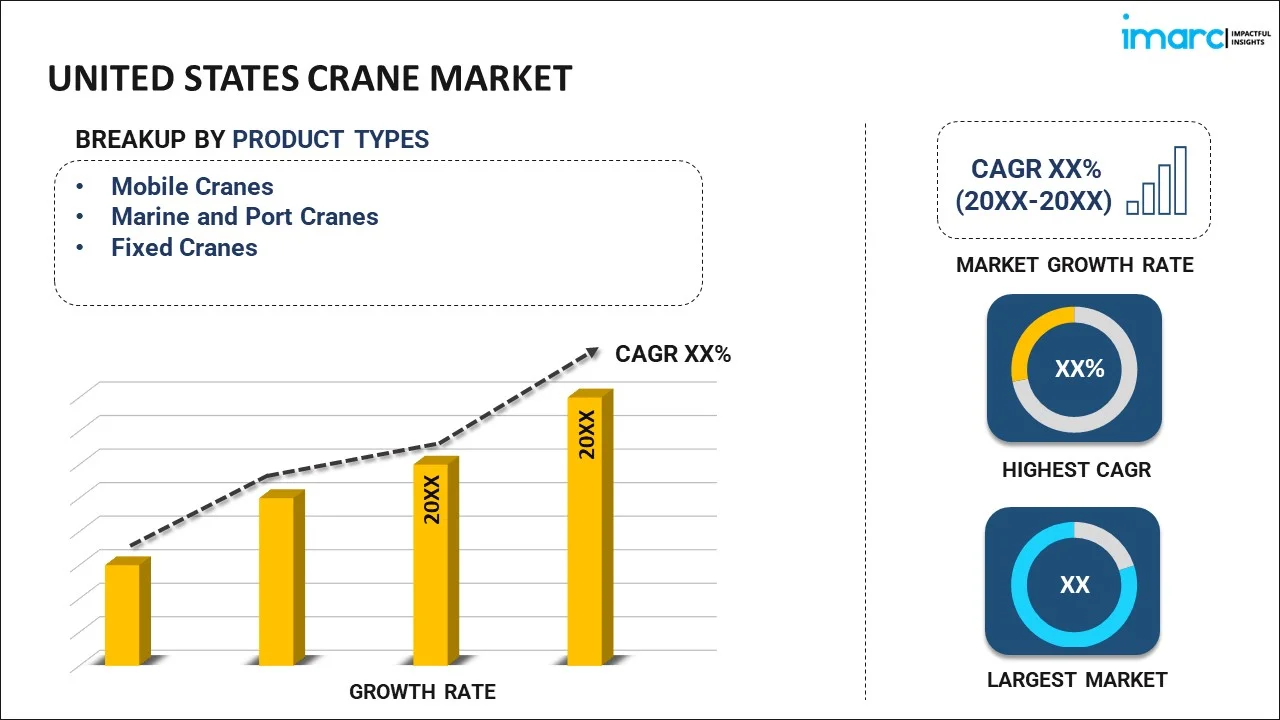
- By Product Type: Mobile cranes dominate the market with a share of 44% in 2025, supported by their remarkable flexibility across construction sites, quick setup for diverse terrains, and appropriateness for infrastructure projects such as highways, bridges, and commercial structures.
- By Application: Construction and infrastructure dominate the market with a share of 50% in 2025. This supremacy results from significant federal investment schemes, continuous commercial and residential construction efforts, and the increasing need for heavy lifting solutions in construction initiatives.
- Key Players: The United States crane market shows highly competitive pressure, with global equipment makers competing with local service providers. Market players concentrate on technological advancements, fleet growth, strategic buyouts, and improved service provisions to gain market share.
Several key factors drive the United States crane market, such as the increasing demand for sophisticated lifting solutions in construction, energy, logistics, and industrial sectors. With the growing demand for infrastructure development and upgrades, cranes are vital for managing extensive tasks, including lifting heavy objects and transporting materials. Technological progress, such as automation and telematics, is enhancing the efficiency and safety of cranes. Furthermore, the increasing emphasis on bolstering domestic production is impelling the market growth by decreasing reliance on international suppliers and improving supply chain security. A significant effort to support domestic manufacturing is implemented through initiatives like the 2025 Port Cranes Tax Credit Act. This bill proposes a 25% investment tax credit for US facilities manufacturing or repairing ship-to-shore cranes, aiming to boost national security, port resiliency, and supply chain efficiency. Such efforts underline the importance of strengthening domestic crane manufacturing, ultimately bolstering the market growth by enhancing operational capabilities and reducing reliance on foreign-made equipment.
United States Crane Market Trends:
Increasing Infrastructure Development
With significant investments from both the government and private sectors in roads, bridges, airports, and utilities, there is a rise in the need for cranes for hoisting heavy materials and equipment. In 2026, the Port Authority of New York and New Jersey announced a $45 billion, decade-long initiative to enhance its extensive transportation infrastructure system. Major initiatives consist of the replacement of the Midtown Bus Terminal and LaGuardia's Terminal A, as well as enhancements to bridges, tunnels, and freight transport. The size and intricacy of these projects require sophisticated cranes to guarantee effectiveness, safety, and accuracy in construction activities. This trend is expected to continue as infrastructure maintenance and expansion are prioritized to accommodate urbanization and economic development across the country.
Rise in Renewable Energy Projects
The transition toward renewable energy sources is driving the demand for cranes, particularly in wind, solar, and hydroelectric power projects. Cranes are essential for installing large-scale energy equipment, such as wind turbines, solar panel arrays, and heavy machinery in power plants. As the country expands its renewable energy capacity to meet sustainability goals, there is a rise in the need for specialized cranes that can handle the unique requirements of these installations. For example, in 2025, the Charybdis, the first US-built offshore heavy lift vessel, was delivered by Seatrium in Brownsville, Texas. The vessel, designed to support offshore wind energy projects, features a 426-foot crane with a lifting capacity of up to 2,200 tons.
Technological Advancements in Crane Design
Advancements in crane technology, such as improved telematics, automation, and energy-efficient systems, are bolstering the United States crane market growth. These innovations enhance operational efficiency, reduce maintenance costs, and improve safety standards. As technology continues to evolve, cranes are becoming smarter, more adaptable, and capable of performing a wider range of tasks. For instance, in 2025, Franna launched its largest crane, the AT44 US, in North America, designed for heavy lifting applications with a 44-ton capacity. The crane featured innovative safety technologies like the Dynamic Load Moment Indicator and Safety Radar, enhancing operator control and decision-making. Powered by a 308-horsepower Mercedes engine, the AT44 US is optimized for performance and compliance with emissions standards.
Market Outlook 2026-2034:
The United States crane market is poised for significant revenue growth, driven by ongoing infrastructure investments and evolving construction demands. The market generated a revenue of USD 6.57 Billion in 2025 and is projected to reach a revenue of USD 8.63 Billion by 2034, growing at a compound annual growth rate of 3.08% from 2026-2034. This growth is supported by the increasing need for advanced crane solutions in large-scale construction projects, particularly in sectors such as infrastructure development, commercial real estate, and energy.
United States Crane Market Report Segmentation:
| Segment Category | Leading Segment | Market Share |
|---|---|---|
| Product Type | Mobile Cranes | 44% |
| Application | Construction and Infrastructure | 50% |
Product Type Insights:
To get detailed segment analysis of this market Request Sample
- Mobile Cranes
- Marine and Port Cranes
- Fixed Cranes
Mobile cranes dominate with a market share of 44% of the total United States crane market in 2025.
Mobile cranes hold the biggest market share because of their adaptability and capacity to function in a range of settings. Mobile cranes are suitable for building projects with fluctuating demands as they are simple to move between job sites. They are particularly useful in the oil and gas, road building, and infrastructure development sectors, where rapid setup and flexibility are crucial. Their broad use in a variety of industries is also influenced by their small size and capacity to fit through confined areas.
Additionally, mobile cranes offer a wide range of lifting capacities and configurations, allowing them to handle different types of loads and tasks. Their ease of use, combined with technological advancements like telematics and automation, is improving safety and efficiency, making them increasingly popular in the market. For instance, in 2024, Big Red Crane Company in California expanded its fleet with a Liebherr LTM 1100-5.3 mobile crane. The crane’s 50-foot additional reach and ability to access difficult sites made it ideal for larger, more complex jobs in California’s challenging terrain, highlighting the growing demand for versatile, cost-effective lifting solutions.
Application Insights:
- Construction and Infrastructure
- Mining
- Oil and Gas
- Others
Construction and infrastructure lead with a market share of 50% of the total United States crane market in 2025.
Construction and infrastructure represent the largest segment driven by the country’s continuous need for large-scale development and modernization projects. Cranes are essential on construction sites because they are needed for an extensive array of jobs, spanning from assembling structural components to lifting large goods. With increasing federal and state investments in infrastructure renewal and expansion, including highway construction and public works, the demand for specialized crane solutions is growing. Cranes play a critical role in tasks, such as demolitions, equipment installation, and bridge construction.
Furthermore, with ongoing projects in commercial, residential, and industrial construction, as well as significant infrastructure improvements like roads, bridges, and airports, cranes are essential for increasing efficiency, productivity, and safety during these complex operations. For instance, in 2024, Federal Aviation Administration (FAA) of the U.S. Department of Transportation declared $1.9 billion for 519 grants across 48 states, Guam, the Marshall Islands, Micronesia, the Northern Mariana Islands, Puerto Rico, and the Virgin Islands in its fifth announcement relating to the Airport Improvement Program (AIP).
Regional Insights:
To get detailed regional analysis of this market Request Sample
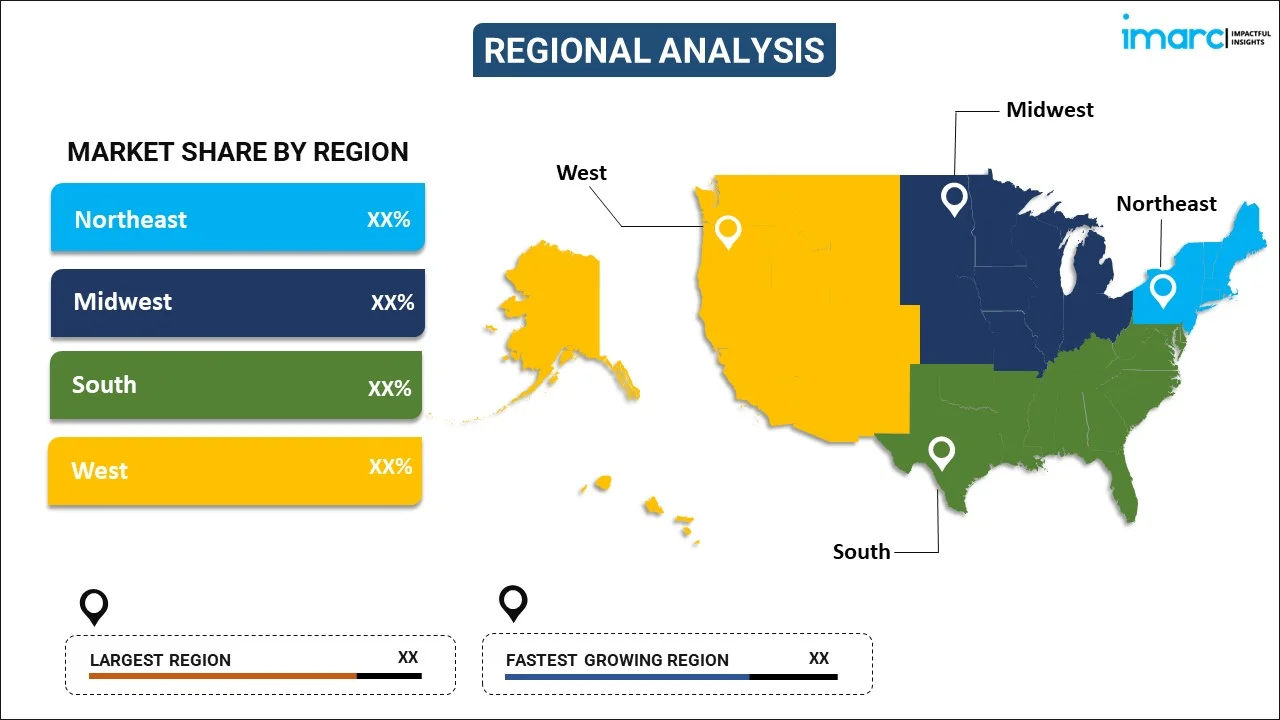
- Northeast
- Midwest
- South
- West
The market in Northeast is driven by high urban density and large-scale infrastructure projects, such as skyscrapers, bridges, and public transportation systems. With major cities like New York and Boston, demand for cranes in construction, urban renewal, and government projects is strong, making the region a key market for advanced crane solutions.
Midwest benefits from robust manufacturing, agricultural, and energy sectors. Cranes are vital in industries like automotive manufacturing, steel production, and wind energy development. The region’s industrial focus and infrastructure projects, including highways and utilities, lead to consistent demand for cranes, especially for heavy-duty lifting tasks.
The market in South is supported by significant demand from the construction, energy, and petrochemical industries. Rapid infrastructure development, alongside projects in oil, gas, and renewable energy, is catalyzing the demand for cranes. Cities like Houston, Atlanta, and Miami contribute to a diverse market, with cranes essential for both commercial and industrial projects.
West is bolstered by booming construction in states like California, Nevada, and Washington. High-rise buildings, renewable energy projects, such as solar and wind, and seismic retrofitting drive crane demand. The region’s technological advancements and focus on green energy projects also lead to a rising need for specialized, eco-friendly crane solutions.
Market Dynamics:
Growth Drivers:
Why is the United States Crane Market Growing?
Rise in Oil and Gas Projects
The oil and gas sector plays a vital role in the United States crane market growth, as cranes are essential for tasks such as exploration, drilling, refining, and pipeline construction, where heavy lifting is required. As the energy industry grows, particularly with new oil exploration and shale gas projects, the demand for cranes remains robust. This trend is especially evident in regions with active oil and gas production, where cranes ensure operational efficiency and safety. For example, in 2025, the Trump administration announced a new offshore oil drilling plan, including six sales from 2027 to 2030 targeting the California and Florida coasts, further increasing the demand for crane support in these areas.
Growing Demand in Construction Industry
As construction projects grow in size and complexity, the demand for cranes capable of handling heavy loads and ensuring efficient project execution is becoming essential. Modern cranes are crucial for tasks, such as steel erection, heavy lifting, and material handling, helping to ensure the timely completion of projects. In line with this increasing demand, Liebherr launched its MK series of mobile construction cranes in the US in 2024. These cranes, with a 4,400 lbs capacity and a 147-foot radius, can be operational in under 30 minutes, significantly improving efficiency in tasks like roofing and meeting the needs of both new developments and renovations.
Expansion of Manufacturing Capacity
The expansion of domestic manufacturing capabilities is a crucial factor impelling the growth of the United States crane market. As demand for cranes continues to rise, particularly in construction, infrastructure, and energy sectors, the need for localized production to meet this demand is increasing. In 2026, France-based REEL USA Corp. responded to this need by opening its first U.S. manufacturing facility in Springfield, Illinois. The company acquired a 65,800-square-foot industrial complex for $1.6 million in December 2025, which will focus on crane production for export. This development highlights the broader trend of strengthening domestic manufacturing, which improves production efficiency and helps meet both local and global market demands.
Market Restraints:
What Challenges the United States Crane Market is Facing?
Critical Skilled Labor Shortages Constraining Operational Capacity
The construction industry is grappling with critical skilled labor shortages, which are severely constraining operational capacity. This shortage limits the ability to meet the growing project demands, delays timelines, and increases labor costs. With a lack of qualified workers in key trades, companies are struggling to maintain productivity levels, which ultimately affects project completion and profitability. Addressing this issue is essential for sustaining industry growth and efficiency.
High Capital Investment Requirements for Advanced Equipment
The high capital investment required for modern crane equipment creates financial barriers, especially for smaller contractors and rental companies. The integration of advanced technologies, such as telematics, autonomous features, and electric power systems, significantly raises equipment costs. This price increase can limit adoption rates among price-sensitive market segments, making it challenging for these companies to invest in cutting-edge cranes while balancing their budgets.
Supply Chain Disruptions Affecting Equipment Availability
Global supply chain constraints are significantly impacting crane manufacturing and component availability. Rising steel prices, semiconductor shortages affecting electronic control systems, and ongoing logistics challenges are causing production delays and cost pressures. These disruptions not only extend equipment delivery timelines but also affect the availability of maintenance parts, ultimately constraining the market growth and creating further obstacles for companies relying on timely production and service.
Competitive Landscape:
The United States crane market exhibits robust competitive intensity characterized by the presence of multinational equipment manufacturers alongside regional rental and service providers. Market dynamics are shaped by continuous technological innovation, strategic expansion initiatives, and service differentiation strategies. Leading manufacturers focus on advancing product capabilities through automation integration, safety feature enhancement, and sustainable technology development. The competitive landscape is increasingly influenced by digitalization initiatives, fleet management solutions, and comprehensive lifecycle support offerings that enable equipment providers to establish lasting customer relationships and strengthen market positioning.
Recent Developments:
- January 2026: CraneSafe USA introduced its Green Sticker program, the first standardized approach to periodic crane and load-handling equipment inspections in the United States. This new initiative aims to provide consistent, reliable inspection outcomes through certified inspectors and detailed inspection forms. CraneSafe USA strives to set a national "Gold Standard" for crane safety, improving accountability and safety across the industry.
- January 2026: Stafford Port Cranes and Core Lifting Services announced a joint venture to manufacture port cranes in the US. The new company, Port Cranes of America, will begin production with a 40-ton RTG crane, aiming for high local content to comply with the Build America Buy American program. The cranes will be manufactured at Seatrax’s plant in Belle Chasse, Louisiana.
United States Crane Market Report Coverage:
| Report Features | Details |
|---|---|
| Base Year of the Analysis | 2025 |
| Historical Period | 2020-2025 |
| Forecast Period | 2026-2034 |
| Units | Billion USD |
| Scope of the Report | Exploration of Historical Trends and Market Outlook, Industry Catalysts and Challenges, Segment-Wise Historical and Future Market Assessment:
|
| Product Types Covered | Mobile Cranes, Marine and Port Cranes, Fixed Cranes |
| Applications Covered | Construction and Infrastructure, Mining, Oil and Gas, Others |
| Regions Covered | Northeast, Midwest, South, West |
| Customization Scope | 10% Free Customization |
| Post-Sale Analyst Support | 10-12 Weeks |
| Delivery Format | PDF and Excel through Email (We can also provide the editable version of the report in PPT/Word format on special request) |
Key Questions Answered in This Report
The United States crane market size was valued at USD 6.57 Billion in 2025.
The United States crane market is expected to grow at a compound annual growth rate of 3.08% from 2026-2034 to reach USD 8.63 Billion by 2034.
Mobile cranes hold the largest revenue share of 44% in 2025, driven by their exceptional versatility, rapid deployment capabilities across varied terrain, and suitability for diverse construction and infrastructure development applications.
Key factors driving the United States crane market include significant investments in infrastructure by both the government and private sectors. For example, in 2026, the Port Authority of New York and New Jersey unveiled a $45 billion, ten-year plan to upgrade its transportation infrastructure, including projects like the Midtown Bus Terminal replacement and LaGuardia's Terminal A overhaul. These large-scale projects require advanced cranes for efficient, safe, and precise construction.
Major challenges include critical skilled labor shortages, which are severely constraining operational capacity, high capital investment requirements for advanced equipment, supply chain disruptions affecting equipment and component availability, and the increasing regulatory compliance costs.
Need more help?
- Speak to our experienced analysts for insights on the current market scenarios.
- Include additional segments and countries to customize the report as per your requirement.
- Gain an unparalleled competitive advantage in your domain by understanding how to utilize the report and positively impacting your operations and revenue.
- For further assistance, please connect with our analysts.
 Request Customization
 Speak to an Analyst
 Request Brochure
 Inquire Before Buying
Benefits of Customization
- Personalize this research
- Triangulate with your data
- Get data as per your format and definition
- Gain a deeper dive into a specific application, geography, customer, or competitor
- Any level of personalization
Get in Touch With Us
UNITED STATES
Phone: +1-201-971-6302
INDIA
Phone: +91-120-433-0800
UNITED KINGDOM
Phone: +44-753-714-6104
Email: sales@imarcgroup.com
Client Testimonials




.webp)




.webp)












