
Saudi Arabia Office Furniture Market Size, Share, Trends and Forecast by Product Type, Material Type, Distribution Channel, Price Range, and Region, 2026-2034
Saudi Arabia Office Furniture Market Summary:
The Saudi Arabia office furniture market size was valued at USD 745.07 Million in 2025 and is projected to reach USD 1,306.05 Million by 2034, growing at a compound annual growth rate of 6.44% from 2026-2034.
The Saudi Arabia office furniture industry is increasing rapidly due to government initiatives under Vision 2030, growing commercial infrastructure, and fast urbanization. Demand is being driven by an increase in commercial construction projects, the creation of contemporary office spaces, and the growth of coworking spaces. Demand for ergonomic and technologically advanced furniture solutions is rising throughout the Kingdom due to an increasing focus on worker productivity and well-being.
Key Takeaways and Insights:
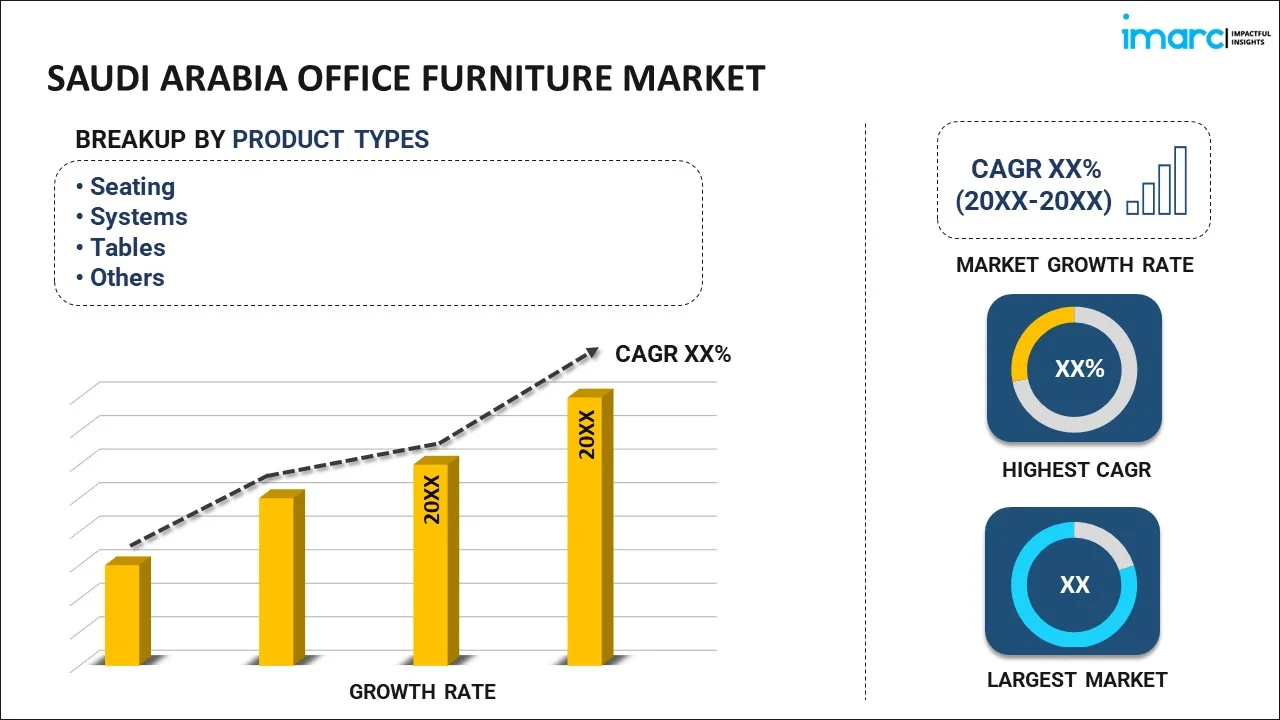
- By Product Type: Seating dominates the market with a share of 65.1% in 2025, owing to the heightened focus on employee comfort, ergonomic designs, and workplace wellness initiatives. Rising corporate investments in adjustable and posture-supportive seating solutions are accelerating market expansion.
- By Material Type: Wood leads the market with a share of 45.06% in 2025. This dominance is driven by consumer preference for durable, aesthetically appealing, and sustainable furniture options that complement professional office environments and align with eco-conscious procurement practices.
- By Distribution Channel: Direct sales represent the biggest segment with a market share of 40.08% in 2025, reflecting the established business-to-business procurement model where corporations engage directly with manufacturers for customized bulk orders and comprehensive workspace solutions.
- By Price Range: Low exhibits a clear dominance in the market with 45.05% share in 2025, driven by cost-conscious procurement strategies among small and medium enterprises, startups, and businesses establishing new offices seeking functional yet affordable furniture solutions.
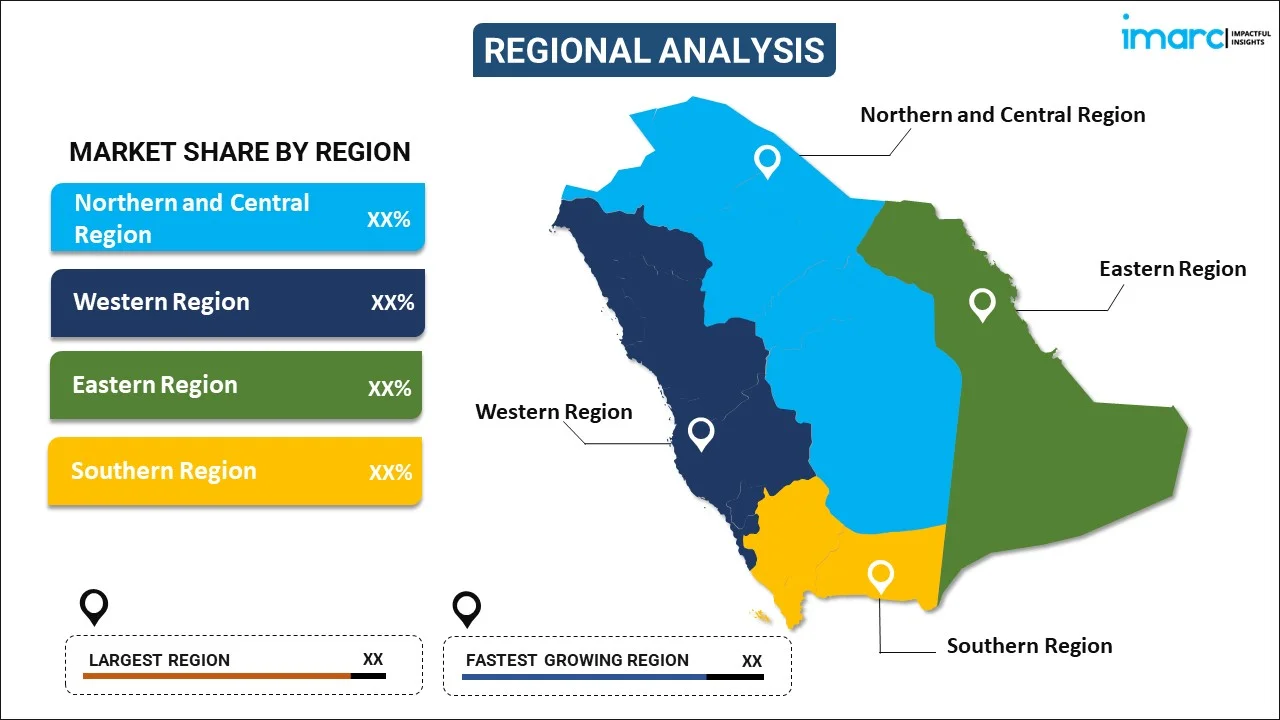
- By Region: Northern and Central Region is the largest region with 35% share in 2025, driven by the concentration of government institutions, corporate headquarters, and mega-developments in Riyadh, alongside significant infrastructure investments supporting commercial real estate expansion.
- Key Players: Key players drive the Saudi Arabia office furniture market by expanding product portfolios, enhancing ergonomic and smart furniture technologies, and strengthening nationwide distribution networks. Their investments in innovation, sustainability, and strategic partnerships accelerate adoption and ensure consistent product availability across diverse corporate segments.
The Saudi Arabia office furniture market is advancing as corporations, government entities, and entrepreneurs embrace modern workspace solutions aligned with Vision 2030 objectives. The market benefits from substantial infrastructure development, with giga-project contracts reaching USD 196 Billion in 2025, representing a twenty percent increase from the previous year, driving unprecedented demand for office fit-outs across commercial developments. The transformation of traditional office environments toward open-plan layouts and collaborative workspaces has accelerated procurement of modular and flexible furniture systems. Technology integration is reshaping product offerings, with manufacturers introducing smart desks featuring wireless charging capabilities and IoT-connected furniture that enhances workplace productivity. The emphasis on employee wellness has elevated demand for ergonomic seating, height-adjustable desks, and posture-supportive solutions that reduce workplace injuries and improve comfort. Sustainability considerations are increasingly influencing purchasing decisions, with eco-friendly materials and recyclable designs gaining prominence. The expansion of coworking spaces and flexible office facilities is creating additional demand channels, particularly in major urban centers. These developments collectively position the Saudi Arabia office furniture market for sustained growth throughout the forecast period.
Saudi Arabia Office Furniture Market Trends:
Expansion of Flexible and Collaborative Workspaces
As businesses adopt hybrid work models and collaborative settings, the Saudi Arabian office furniture market is witnessing a notable trend toward flexible workspace solutions. Major cities are experiencing significant increases in coworking spaces as Vision 2030 initiatives have licensed numerous accelerators, incubators, and coworking sites across the Kingdom, representing substantial growth compared to previous years. This expansion reflects the evolving preferences of modern professionals seeking adaptable work environments that offer networking opportunities and operational flexibility. The proliferation of flexible workspaces increases the need for modular furniture systems and adaptable workstations that encourage teamwork and creativity in contemporary office environments while meeting changing workforce demands. Organizations operating these facilities require furniture that can be easily reconfigured to accommodate varying group sizes, event formats, and individual work preferences throughout the day. The growing acceptance of flexible work arrangements among employers and employees alike ensures sustained demand for versatile furniture solutions that support diverse working styles and collaborative activities.
Integration of Smart Technology in Office Furniture
As manufacturers incorporate smart features into their goods, technological advancements are changing the growth trajectory of the Saudi Arabian office furniture industry. In order to improve workstation functionality, modern office furniture is increasingly including wireless charging stations, USB connections, cable management systems, and Internet of Things connectivity. Technology-forward companies looking to maximize employee productivity and develop digitally linked work environments are increasingly adopting height-adjustable smart desks with programmable settings and furniture with embedded sensors tracking user behavior.
Rising Emphasis on Sustainable and Eco-Friendly Materials
As corporate buyers become more environmentally conscious, sustainability factors are having an increasing impact on Saudi Arabia's office furniture market share. Businesses are giving preference to furniture made of recycled materials, bamboo, sustainable wood, and low-impact coatings that lessen their environmental impact. Global trends toward ethical buying methods that support corporate social responsibility goals are reflected in the increased demand for environmentally friendly solutions. As a result, manufacturers are developing product lines using water-based adhesives, certified sustainable timber, and recyclable components that meet international environmental standards. The government's dedication to promoting domestic sustainable production capacities through financial programs for regional furniture producers shows congruence with more general environmental and economic diversification aims. Corporate procurement policies are increasingly incorporating sustainability criteria into vendor selection processes, favoring suppliers who demonstrate transparent sourcing practices and environmental certifications. This shift is compelling traditional manufacturers to invest in sustainable production technologies and supply chain improvements.
How Vision 2030 is Transforming the Saudi Arabia Office Furniture Market:
Vision 2030 is fundamentally reshaping the Saudi Arabia office furniture market through comprehensive economic diversification initiatives that are expanding commercial infrastructure across the Kingdom. The program's emphasis on developing non-oil sectors including technology, finance, tourism, and entertainment is driving unprecedented demand for modern office spaces equipped with contemporary furniture solutions. Mega-projects and urban developments under Vision 2030 are creating entirely new business districts, technology hubs, and mixed-use developments that require extensive office furniture. The initiative's focus on attracting foreign investment and establishing regional headquarters is bringing multinational corporations to the Kingdom, elevating demand for premium, ergonomic, and technologically integrated office furniture that meets international workplace standards and supports employee productivity.
Market Outlook 2026-2034:
The Saudi Arabia office furniture market outlook remains positive as economic diversification initiatives and infrastructure investments continue to drive demand. The commercial construction sector presents unprecedented opportunities with major urban developments, technology hubs, and business districts creating sustained furniture procurement requirements. Riyadh is projected to unveil over 1.6 Million square meters of Grade A office space by 2028, significantly expanding the addressable market. The market generated a revenue of USD 745.07 Million in 2025 and is projected to reach a revenue of USD 1,306.05 Million by 2034, growing at a compound annual growth rate of 6.44% from 2026-2034. The increasing establishment of regional headquarters by multinational corporations, expansion of technology companies, and growth of the startup ecosystem will continue fueling demand. Enhanced focus on employee wellness, productivity optimization, and sustainable procurement practices will shape product innovation and market evolution throughout the forecast period.
Saudi Arabia Office Furniture Market Report Segmentation:
|
Segment Category |
Leading Segment |
Market Share |
|
Product Type |
Seating |
65.1% |
|
Material Type |
Wood |
45.06% |
|
Distribution Channel |
Direct Sales |
40.08% |
|
Price Range |
Low |
45.05% |
|
Region |
Northern and Central Region |
35% |
Product Type Insights:
To get more information on this market, Request Sample
- Seating
- Systems
- Tables
- Storage Units and File Cabinets
- Overhead Bins
- Others
Seating dominates with a market share of 65.1% of the total Saudi Arabia office furniture market in 2025.
Seating commands the largest share of the Saudi Arabia office furniture market, driven by increasing corporate emphasis on employee comfort and workplace ergonomics. Organizations across the Kingdom are investing in advanced seating solutions that promote proper posture and reduce musculoskeletal issues among employees. The growing awareness of health and productivity correlations has elevated procurement standards, with buyers demanding chairs featuring lumbar support, adjustable armrests, and breathable materials that enhance comfort during extended work hours. Companies are recognizing that quality seating directly impacts employee well-being, concentration levels, and overall job satisfaction, making it a priority investment area.
The transformation of office environments toward open-plan layouts and collaborative spaces has further accelerated seating demand across diverse configurations. Executive chairs, task seating, conference room chairs, and lounge seating are witnessing increased adoption as businesses establish modern workspaces that balance functionality with aesthetic appeal while prioritizing employee wellness across all organizational levels. The emphasis on creating dynamic work environments has driven demand for versatile seating options that accommodate various work styles and activities. Additionally, the growing hospitality and tourism sectors are contributing to seating demand as hotels, restaurants, and entertainment venues require quality furniture for their business centers and administrative offices throughout the Kingdom.
Material Type Insights:
- Wood
- Metal
- Plastic and Fiber
- Glass
- Others
Wood leads with a share of 45.06% of the total Saudi Arabia office furniture market in 2025.
Wood office furniture maintains its dominant position in the Saudi Arabia market due to its timeless aesthetic appeal, durability, and versatility across diverse office environments. Corporate clients favor wood-based furniture for executive offices, conference rooms, and reception areas where professional appearance and quality craftsmanship are paramount. The material's natural warmth and ability to complement various interior design themes make it the preferred choice for organizations seeking to project professionalism and establish prestigious workplace environments. Wood furniture conveys stability and success, making it particularly popular among financial institutions, legal firms, and government offices seeking to create impressive client-facing spaces.
The growing emphasis on sustainable procurement practices has further strengthened wood's market position as organizations prioritize eco-friendly materials. Local manufacturers are investing in sustainable sourcing practices and advanced processing technologies to meet quality standards while addressing environmental concerns, ensuring wood-based office furniture remains competitive against alternative materials throughout the forecast period. The versatility of wood allows manufacturers to create diverse product ranges spanning traditional designs favored by established corporations to contemporary minimalist styles preferred by modern enterprises. Furthermore, wood's adaptability to various finishes and treatments enables customization that meets specific brand aesthetics and interior design requirements, reinforcing its continued dominance across premium and mid-range market segments.
Distribution Channel Insights:
- Direct Sales
- Specialist Store
- Non-Specialist Stores
- Online
- Others
Direct sales exhibit a clear dominance with 40.08% share of the total Saudi Arabia office furniture market in 2025.
The direct sales channel maintains its leading position in the Saudi Arabia office furniture market through established business-to-business relationships between manufacturers and corporate clients. Large organizations, government entities, and institutional buyers prefer direct engagement with manufacturers for customized solutions, bulk pricing advantages, and comprehensive after-sales support. This procurement model enables buyers to specify exact requirements for design, materials, and configurations while ensuring consistent quality across large-scale office fit-out projects. Direct relationships also facilitate ongoing maintenance agreements and warranty support that corporate clients value when furnishing extensive facilities.
Contract furniture sales for mega-projects and corporate headquarters significantly contribute to the direct sales channel's dominance. The regulatory framework encouraging local content in public procurement strengthens direct sales relationships between domestic producers and government clients, supporting domestic manufacturing capabilities while ensuring sustained demand through this channel across government and private sector procurements. Manufacturers offering direct sales benefit from deeper customer insights that inform product development and enable tailored solutions addressing specific industry requirements. The direct channel also allows manufacturers to provide comprehensive workspace planning services, installation support, and post-purchase consultations that enhance customer satisfaction. As organizations increasingly seek turnkey office solutions encompassing design, supply, and installation, direct manufacturer engagement becomes essential for coordinating complex procurement requirements efficiently.
Price Range Insights:
- Low
- Medium
- High
Low represents the leading segment with 45.05% share of the total Saudi Arabia office furniture market in 2025.
Low captures the largest market share driven by cost-conscious procurement strategies among small and medium enterprises, startups, and businesses establishing new operations. The Kingdom's thriving entrepreneurial ecosystem has created substantial demand for affordable office furniture that enables new businesses to establish functional workspaces without excessive capital expenditure while maintaining acceptable quality standards. Budget-conscious buyers prioritize value-oriented solutions that deliver essential functionality and reasonable durability at accessible price points, allowing them to allocate resources toward core business activities rather than premium furnishings.
The proliferation of coworking spaces and flexible office facilities has further strengthened demand for economically priced furniture that balances functionality with affordability. These facilities require furniture solutions that accommodate high-turnover usage while remaining cost-effective for operators managing multiple locations. Manufacturers have responded by developing competitively priced product lines that incorporate essential ergonomic features without premium pricing, enabling broader market accessibility and supporting the expansion of flexible workspace offerings throughout the Kingdom. The growing number of branch offices, satellite locations, and temporary project spaces also contributes to demand for economical furniture that serves functional purposes without long-term investment considerations. Additionally, educational institutions and training centers seeking to furnish classrooms and administrative offices frequently opt for budget-friendly solutions that accommodate large-scale procurement requirements within constrained funding allocations.
Regional Insights:
To get more information on this market, Request Sample
- Northern and Central Region
- Western Region
- Eastern Region
- Southern Region
Northern and Central Region holds the largest share with 35% of the total Saudi Arabia office furniture market in 2025.
The Northern and Central Region dominates the Saudi Arabia office furniture market driven by Riyadh's concentration of government institutions, corporate headquarters, and major commercial developments. The capital city serves as the primary hub for business and administrative activities, hosting ministries, regulatory authorities, and public sector organizations that generate consistent furniture procurement requirements. The region benefits from significant infrastructure investments, with giga-project developments like Diriyah Gate and King Salman Park creating substantial furniture demand across residential, commercial, and hospitality applications. The SAL Logistics Zone's SAR 4 Billion investment has created 1.5 Million square meters of automated warehousing, enhancing furniture distribution efficiency across the Kingdom.
The region's advanced logistics infrastructure enhances furniture distribution efficiency, enabling manufacturers and retailers to serve customers across the Kingdom from centrally located facilities. Riyadh's position as the preferred destination for multinational corporations establishing regional headquarters further amplifies office furniture demand, as these organizations typically require high-quality furnishings that meet international standards. The concentration of financial institutions, consulting firms, and professional services companies in the capital creates sustained demand for executive furniture and premium workspace solutions. Additionally, the growing number of coworking spaces and flexible office facilities in Riyadh contributes to regional market leadership, catering to entrepreneurs, freelancers, and businesses seeking adaptable work environments without long-term lease commitments.
Market Dynamics:
Growth Drivers:
Why is the Saudi Arabia Office Furniture Market Growing?
Rise of Remote and Hybrid Work Models Driving Flexible Furniture Demand
The transformation of traditional work patterns toward remote and hybrid arrangements is significantly driving demand for versatile office furniture solutions across Saudi Arabia. Organizations are redesigning their workspaces to accommodate flexible working schedules, creating environments that support both in-office collaboration and individual focused work. This shift has accelerated procurement of modular furniture systems, hot-desking solutions, and adaptable workstations that can be reconfigured based on daily occupancy requirements. Companies are investing in furniture that serves multiple purposes, including convertible desks, mobile storage units, and flexible seating arrangements that maximize space utilization while maintaining functionality. The hybrid work model has also elevated demand for home-office furniture as employees seek ergonomic solutions for residential workspaces, expanding the addressable market beyond traditional corporate procurement. Employers are recognizing that well-designed furniture supports productivity regardless of work location, prompting investment in quality pieces for both office and remote settings. This workplace evolution is reshaping furniture specifications, with buyers prioritizing lightweight, easily movable pieces that facilitate quick layout changes. The sustained adoption of flexible work arrangements ensures continued demand for adaptable furniture solutions that accommodate evolving workforce preferences and organizational requirements throughout the forecast period.
Rapid Expansion of the Information Technology Sector
The growth of Saudi Arabia's technology sector is significantly driving office furniture demand as digital transformation accelerates across the economy. The Kingdom's IT sector is experiencing substantial expansion as part of broader economic diversification efforts, creating considerable requirements for modern office infrastructure. Technology hubs such as Riyadh Techno Valley and Digital City are attracting numerous technology companies that demand contemporary office environments supporting collaborative work and technological integration. These developments are establishing the Kingdom as a regional technology destination, drawing both established enterprises and emerging startups seeking strategic positioning in the growing digital economy. Tech companies typically prioritize ergonomic furniture, flexible workstation configurations, and smart furniture solutions that enhance productivity and employee well-being. The nature of technology work demands furniture that supports extended computer usage, team collaboration, and creative problem-solving activities. This sector's growth is creating sustained demand for innovative office furniture that accommodates dynamic work patterns and supports the creative, collaborative nature of technology-focused workplaces. As technology companies continue expanding their presence across the Kingdom, the resulting office space requirements will generate ongoing furniture procurement opportunities throughout the forecast period.
Increasing Focus on Employee Wellness and Workplace Productivity
Growing corporate awareness of the relationship between workspace design and employee productivity is driving substantial investment in quality office furniture. Organizations are increasingly recognizing that ergonomic furniture reduces absenteeism, prevents workplace injuries, and enhances overall employee satisfaction. Employers are investing in height-adjustable desks, ergonomic seating, and wellness-oriented furniture configurations that promote physical health and mental well-being. The adoption of international workplace health and safety standards by Saudi corporations has elevated procurement specifications, with buyers demanding furniture that meets global ergonomic guidelines. This focus on employee wellness aligns with broader human capital development objectives under Vision 2030, ensuring sustained investment in quality office furniture that supports workforce productivity and organizational performance throughout the forecast period.
Market Restraints:
What Challenges the Saudi Arabia Office Furniture Market is Facing?
Fluctuating Raw Material Prices and Import Dependency
Fluctuating raw material prices pose significant challenges to the Saudi Arabia office furniture market, impacting production costs and supply chain stability. The Kingdom's limited domestic production of essential materials such as wood and metal necessitates substantial reliance on imports, making the industry vulnerable to global price volatility. Geopolitical tensions have disrupted supply chains, leading to increased costs for timber and other critical materials. These factors contribute to higher production costs that impact pricing strategies and profit margins across the value chain.
Intense Competition from International Manufacturers
The Saudi Arabia office furniture market faces intense competition from international manufacturers offering diverse product ranges at competitive price points. Global brands leverage economies of scale, established supply chains, and brand recognition to capture market share from local manufacturers. This competitive pressure challenges domestic producers to invest in quality improvements, design innovation, and operational efficiency while maintaining price competitiveness. Smaller local manufacturers particularly struggle to compete against well-resourced international competitors with broader product portfolios.
Limited Skilled Workforce for Specialized Manufacturing
The availability of skilled workforce for specialized furniture manufacturing remains a constraint for the Saudi Arabia office furniture market. Advanced furniture production requires expertise in computer-aided design, precision manufacturing, and quality control that demands trained professionals. The industry faces challenges in recruiting and retaining skilled craftsmen and technicians, impacting production capacity and quality consistency. Developing local manufacturing capabilities requires sustained investment in workforce training and skills development programs to reduce dependency on imported expertise.
Competitive Landscape:
The Saudi Arabia office furniture market features a competitive landscape comprising domestic manufacturers, regional players, and international brands competing for market share. Competition is characterized by product differentiation through design innovation, ergonomic features, and technology integration. Manufacturers are focusing on expanding product portfolios, enhancing customization capabilities, and strengthening distribution networks to capture opportunities across corporate, government, and commercial segments. Strategic partnerships between local distributors and international brands are enabling broader market reach while supporting localization objectives. The emphasis on sustainability and eco-friendly manufacturing is emerging as a competitive differentiator, with companies investing in sustainable materials and production processes to meet evolving buyer preferences and regulatory requirements.
Recent Developments:
- In October 2025, King Abdullah Financial District (KAFD) announced the opening of The Executive Centre, marking the premium flexible workspace provider's first center in Saudi Arabia. Spanning approximately 36,500 square feet, the facility features private offices, coworking lounges, meeting spaces, and technology-enabled work environments designed to support multinational companies, freelancers, and entrepreneurs seeking flexible workspace solutions.
Saudi Arabia Office Furniture Market Report Coverage:
| Report Features | Details |
|---|---|
| Base Year of the Analysis | 2025 |
| Historical Period | 2020-2025 |
| Forecast Period | 2026-2034 |
| Units | Million USD |
| Scope of the Report | Exploration of Historical and Forecast Trends, Industry Catalysts and Challenges, Segment-Wise Historical and Predictive Market Assessment:
|
| Product Types Covered | Seating, Systems, Tables, Storage Units and File Cabinets, Overhead Bins, Others |
| Material Types Covered | Wood, Metal, Plastic and Fiber, Glass, Others |
| Distribution Channels Covered | Direct Sales, Specialist Store, Non-Specialist Stores, Online, Others |
| Price Ranges Covered | Low, Medium, High |
| Regions Covered | Northern and Central Region, Western Region, Eastern Region, Southern Region |
| Customization Scope | 10% Free Customization |
| Post-Sale Analyst Support | 10-12 Weeks |
| Delivery Format | PDF and Excel through Email (We can also provide the editable version of the report in PPT/Word format on special request) |
Key Questions Answered in This Report
The Saudi Arabia office furniture market size was valued at USD 745.07 Million in 2025.
The Saudi Arabia office furniture market is expected to grow at a compound annual growth rate of 6.44% from 2026-2034 to reach USD 1,306.05 Million by 2034.
Seating dominated the market with a share of 65.1%, driven by increasing corporate emphasis on employee comfort, ergonomic designs, and workplace wellness initiatives that prioritize posture-supportive solutions.
Key factors driving the Saudi Arabia office furniture market include Vision 2030 infrastructure development, expanding IT sector, increasing focus on employee wellness, growth of coworking spaces, and rising demand for ergonomic and smart furniture solutions.
Major challenges include fluctuating raw material prices, import dependency for essential materials, intense competition from international manufacturers, limited skilled workforce for specialized manufacturing, and supply chain disruptions affecting production costs and delivery timelines.
Need more help?
- Speak to our experienced analysts for insights on the current market scenarios.
- Include additional segments and countries to customize the report as per your requirement.
- Gain an unparalleled competitive advantage in your domain by understanding how to utilize the report and positively impacting your operations and revenue.
- For further assistance, please connect with our analysts.
 Request Customization
 Speak to an Analyst
 Request Brochure
 Inquire Before Buying
Benefits of Customization
- Personalize this research
- Triangulate with your data
- Get data as per your format and definition
- Gain a deeper dive into a specific application, geography, customer, or competitor
- Any level of personalization
Get in Touch With Us
UNITED STATES
Phone: +1-201-971-6302
INDIA
Phone: +91-120-433-0800
UNITED KINGDOM
Phone: +44-753-714-6104
Email: sales@imarcgroup.com
Client Testimonials




.webp)




.webp)












