
Saudi Arabia Electric Vehicle Charging Station Market Size, Share, Trends and Forecast by Charging Station Type, Vehicle Type, Installation Type, Charging Level, Connector Type, Application, and Region, 2026-2034
Saudi Arabia Electric Vehicle Charging Station Market Size, Share, Trends & Forecast (2026-2034)
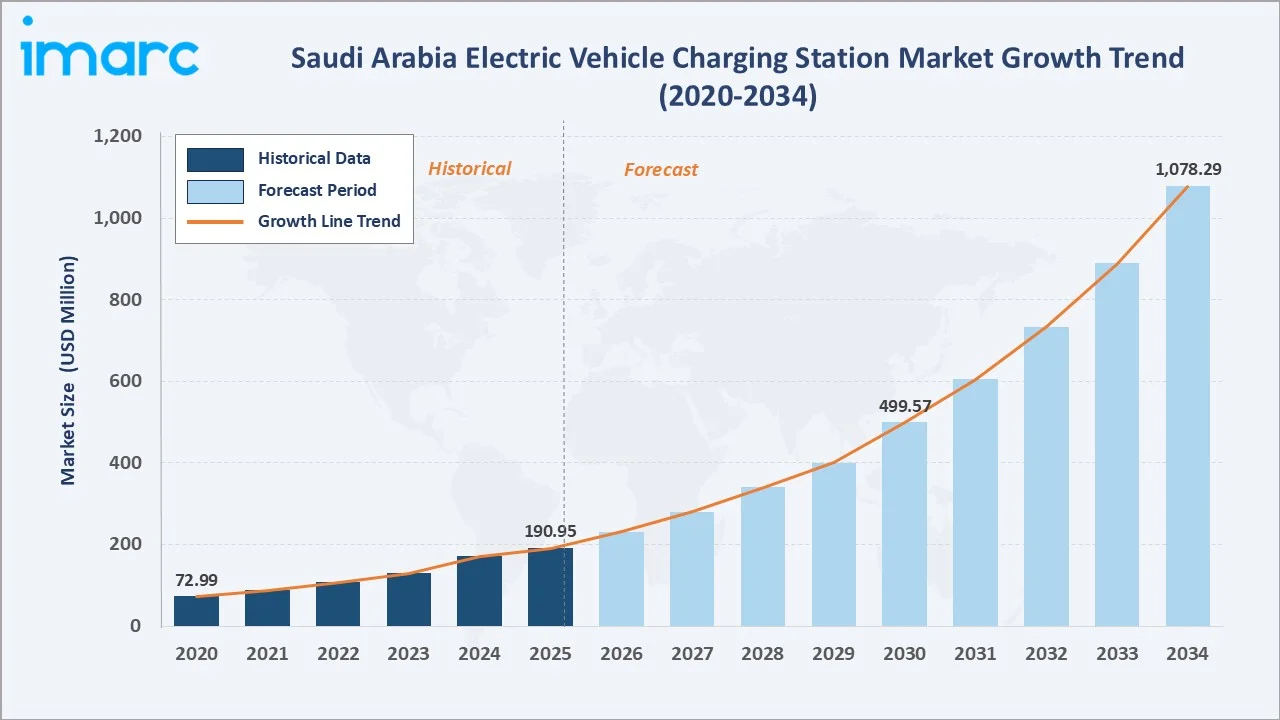
The Saudi Arabia electric vehicle charging station market reached USD 190.95 Million in 2025 and is projected to reach USD 1,078.29 Million by 2034, growing at a CAGR of 21.21% during 2026-2034. The market is propelled by Vision 2030 mandates, rising EV adoption, and expanding public charging networks.
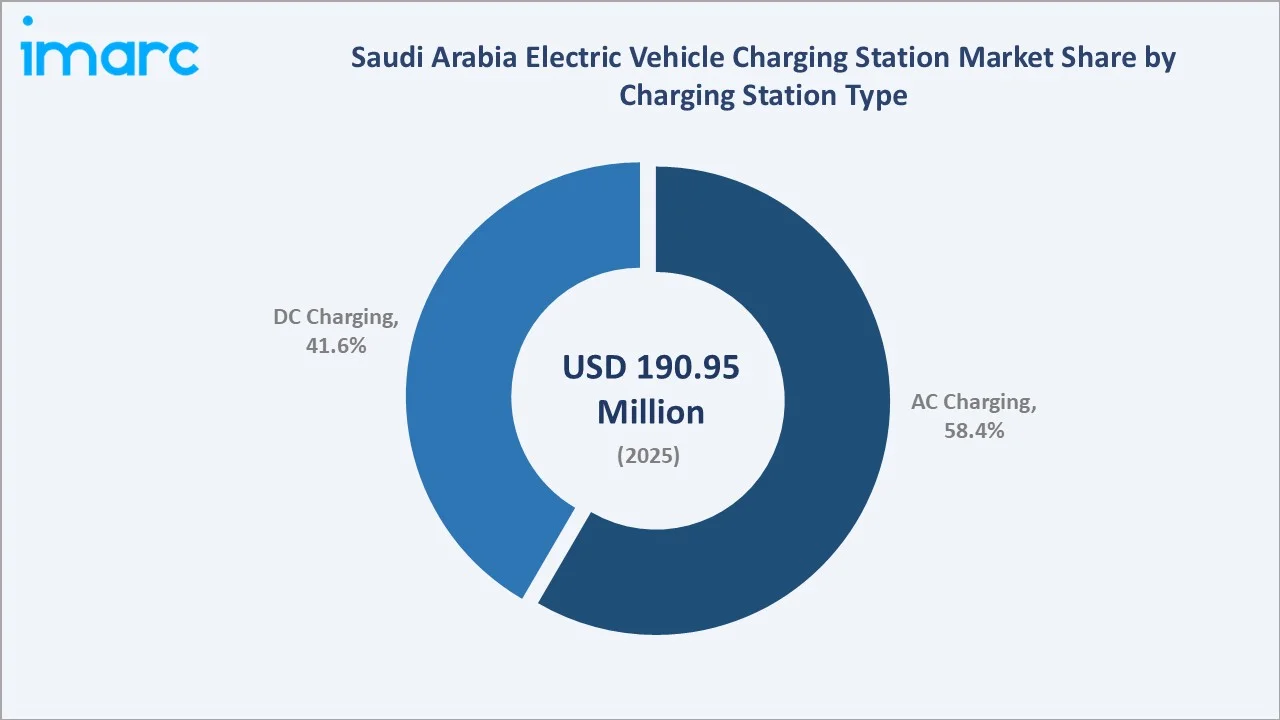
AC Charging leads at 58.4%, Battery Electric Vehicle (BEV) dominates at 57.9%, and Northern & Central Region commands 44.7% of regional share.
Market Snapshot
|
Metric |
Value |
|
Market Size (2025) |
USD 190.95 Million |
|
Forecast Market Size (2034) |
USD 1,078.29 Million |
|
CAGR (2026-2034) |
21.21% |
|
Base Year |
2025 |
|
Historical Period |
2020-2025 |
|
Forecast Period |
2026-2034 |
|
Dominant Charging Station Type |
AC Charging (58.4%, 2025) |
|
Dominant Vehicle Type |
BEV (57.9%, 2025) |
|
Leading Region |
Northern & Central Region (44.7%, 2025) |
The market expanded from USD 72.99 Million in 2020 to USD 190.95 Million in 2025, nearly tripling in five years, anchored at USD 499.57 Million in 2030 and forecast to reach USD 1,078.29 Million by 2034. Vision 2030 EV mandates, PIF infrastructure investment, and international CPO market entry have sustained compound growth throughout the historical period.
To get more information on this market, Request Sample
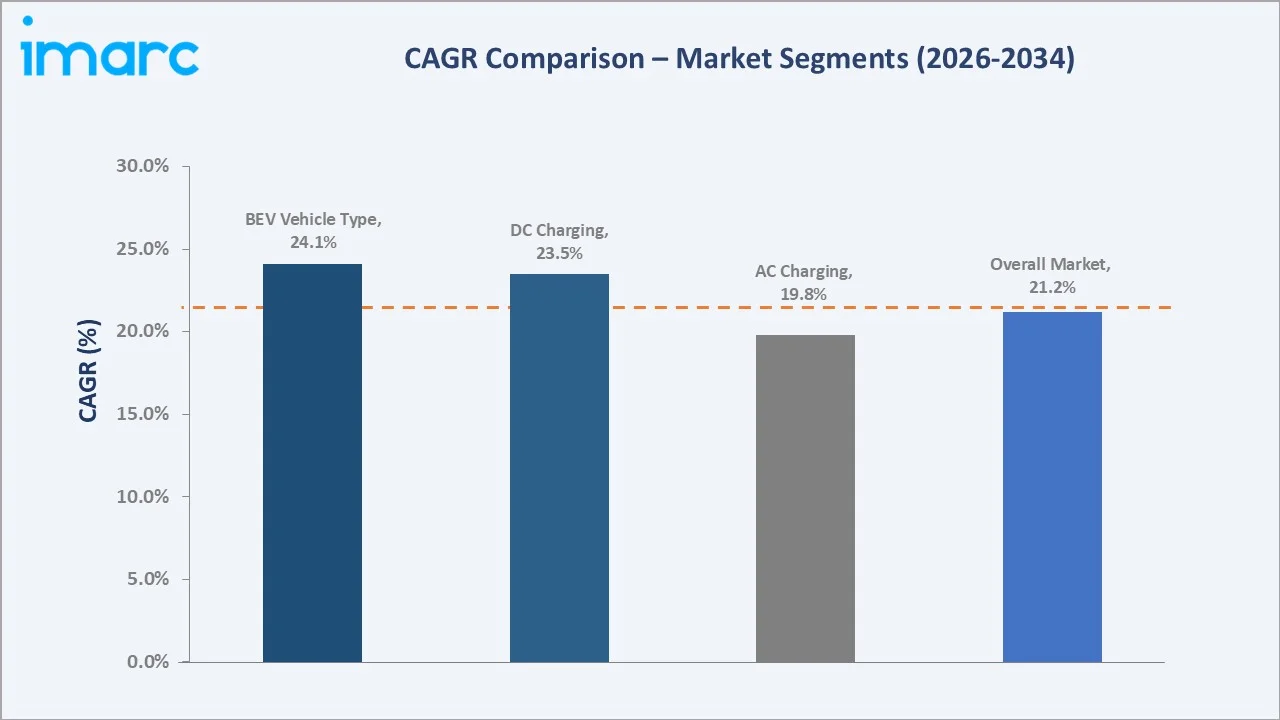
AC Charging grows at ~19.8% CAGR as residential and commercial deployments proliferate across Saudi cities. DC Charging grows fastest at ~23.5% CAGR driven by highway and mega-project fast-charging investment. BEV segment grows at ~24.1% CAGR as Saudi Arabia's BEV fleet expands through Vision 2030 targets.
Executive Summary
The Saudi Arabia electric vehicle charging station market reached USD 190.95 Million in 2025, driven by Vision 2030 commitments, rising EV adoption, and public-private infrastructure investment. The market is projected to reach USD 1,078.29 Million by 2034, representing a CAGR of 21.21%.
AC Charging at 58.4% dominates through widespread residential and commercial deployment. Battery Electric Vehicle (BEV) at 57.9% leads vehicle type through government fleet electrification and Saudi consumer EV adoption. Northern & Central Region at 44.7% commands regional leadership through Riyadh's dense urban EV fleet and mega-project investments.
Key Market Insights
|
Insight |
Data |
|
Dominant Charging Station Type |
AC Charging - 58.4% market share (2025) |
|
Dominant Vehicle Type |
BEV - 57.9% market share (2025) |
|
Leading Region |
Northern & Central Region - 44.7% market share (2025) |
|
Market Opportunity |
DC fast-charging corridors; NEOM smart grid; fleet electrification; solar-integrated charging |
Key Analytical Observations Supporting The Above Data:
- AC Charging at 58.4%: AC chargers dominate due to lower installation cost, compatibility with Level 1 and Level 2 standards, and widespread residential and commercial deployment. Their affordability and ease of grid integration support broad consumer adoption across Saudi Arabia's major cities.
- BEV at 57.9%: Battery electric vehicles lead as Saudi Arabia's Vision 2030 programs, fleet electrification, and manufacturer partnerships with Ceer and Lucid Motors. BEV charging creates higher per-station utilization and stronger CPO revenue generation.
- Northern & Central Region at 44.7%: The Northern & Central Region leads through Riyadh's high EV fleet concentration, dense commercial charging demand, mega-project investment, and the concentration of government EV programs and smart city infrastructure initiatives.
Saudi Arabia Electric Vehicle Charging Station Market Overview
The Saudi Arabia electric vehicle charging station market encompasses the installation, operation, and servicing of AC and DC charging infrastructure across residential, commercial, and public locations throughout Saudi Arabia's four major regions.
The ecosystem integrates charging hardware manufacturers, software platform providers, utility companies, EV OEMs, property developers, and regulatory bodies, including ECRA and SASO. Macroeconomic drivers include Vision 2030, the Saudi Green Initiative, rising energy diversification targets, and PIF giga-project investments.
Market Dynamics
To evaluate market opportunities, Request Sample
Market Drivers
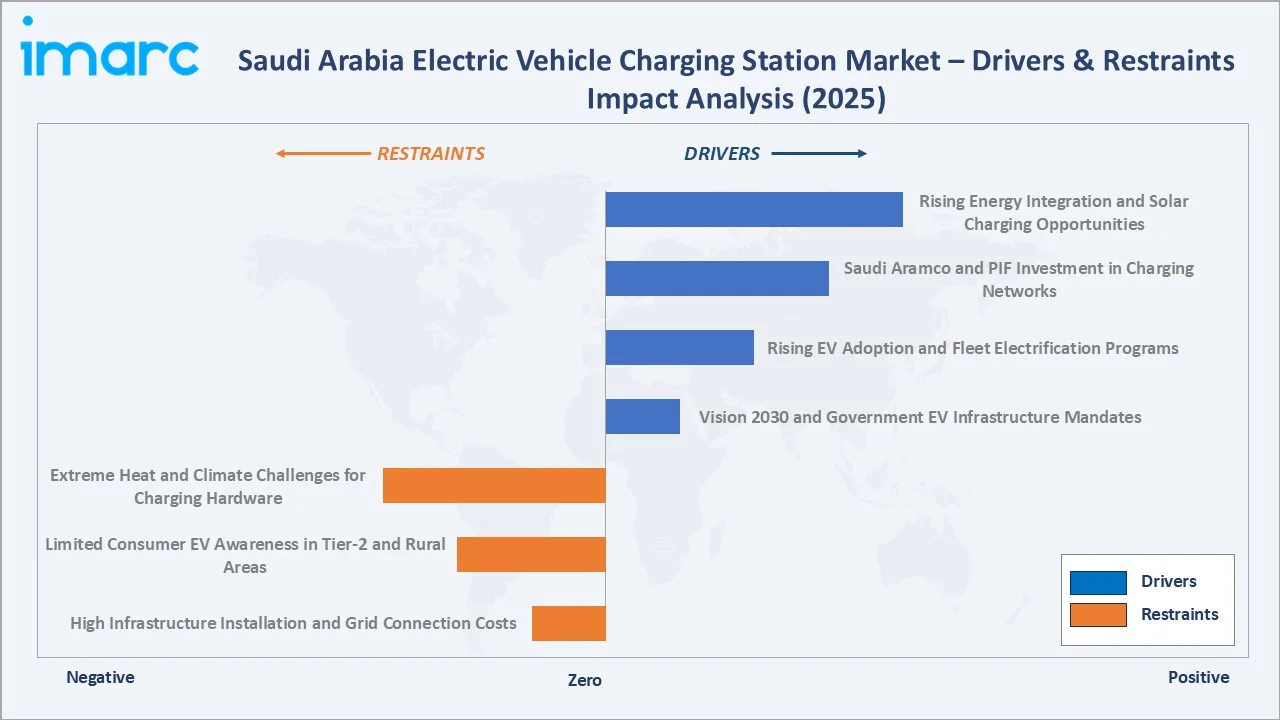
- Vision 2030 and Government EV Infrastructure Mandates: Saudi Arabia's Vision 2030 program mandates significant EV adoption and charging infrastructure deployment. The government has committed to install 1,000+ charging stations nationwide, with NEOM and other giga-projects integrating mandatory EV charging infrastructure across all new developments.
- Rising EV Adoption and Fleet Electrification Programs: EV registrations in Saudi Arabia are accelerating through government fleet electrification mandates, tax exemptions on EV imports, and growing EV model availability from Chinese OEMs. Each new EV adds durable incremental demand for residential and public charging infrastructure.
- Saudi Aramco and PIF Investment in Charging Networks: The Public Investment Fund (PIF) and Saudi Aramco are actively investing in EV charging network development as part of national energy diversification. These sovereign-backed investments create durable capital flows supporting large-scale charging infrastructure deployment across all Saudi regions.
- Renewable Energy Integration and Solar Charging Opportunities: Saudi Arabia's abundant solar resource creates significant opportunities for solar-integrated EV charging. Operators are deploying photovoltaic coupled charging stations, reducing grid dependency and aligning with the Saudi Green Initiative's renewable energy targets.
Market Restraints
- High Infrastructure Installation and Grid Connection Costs: EV charging station installation in Saudi Arabia requires substantial capital expenditure for hardware, grid connection, and civil works. High import costs for charging equipment and grid infrastructure reinforcement restrict rapid deployment in commercial and suburban locations outside major urban centers.
- Limited Consumer EV Awareness in Tier-2 and Rural Areas: Persistent consumer concerns about charging availability and range limit EV adoption in cities beyond Riyadh, Jeddah, and Dammam. Lower EV penetration in Tier-2 and rural areas reduces charging infrastructure demand and commercial viability for CPOs outside major metropolitan centers.
- Extreme Heat and Climate Challenges for Charging Hardware: Saudi Arabia's extreme summer temperatures present significant engineering challenges for EV charging hardware. High ambient temperatures reduce battery charging efficiency, increase thermal management requirements, and raise hardware maintenance costs, increasing the total cost of ownership for charging network operators.
Market Opportunities
- NEOM and Giga-Project Integrated EV Charging Infrastructure: Saudi Arabia's giga-projects including NEOM, The Line, Diriyah, and KAEC are mandating fully electric mobility ecosystems. These developments represent multi-billion-dollar captive charging infrastructure deployment opportunities for hardware manufacturers and CPO operators.
- Highway Corridor DC Fast-Charging Network Development: Saudi Arabia's major inter-city highway routes between Riyadh, Jeddah, Dammam, and Mecca remain significantly underserved by DC fast-charging. Corridor network development unlocks inter-city EV travel and accelerates consumer EV adoption beyond urban centers.
Market Challenges
- Fragmented Connector Standards and Interoperability: Multiple connector standards, including CCS, CHAdeMO, and Type-2 create interoperability challenges. Standardization gaps increase hardware costs and complicate network planning across Saudi Arabia's diverse EV fleet from European, American, and Chinese manufacturers.
- Regulatory Framework Development for Commercial Charging Tariffs: Saudi Arabia's regulatory framework for commercial EV charging tariffs is still evolving. Uncertainty over electricity resale pricing and CPO licensing frameworks creates business model risk and slows private capital deployment into public charging infrastructure.
Emerging Market Trends
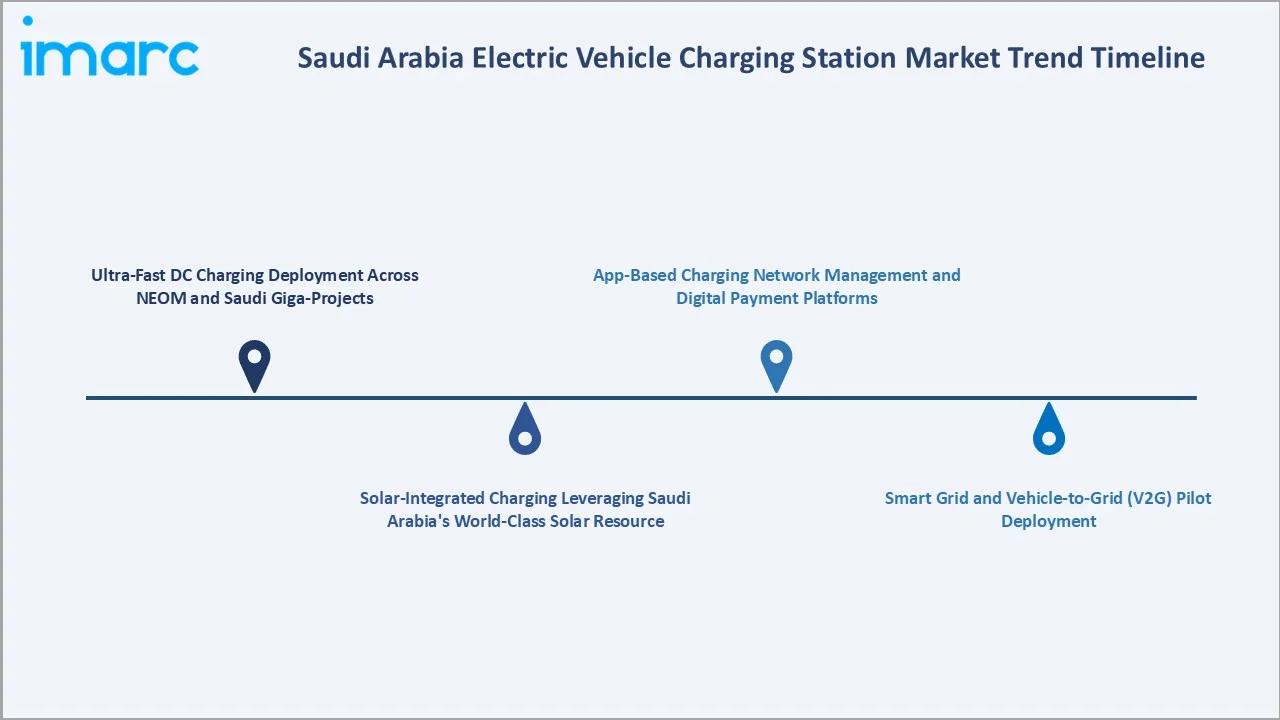
1. Ultra-Fast DC Charging Deployment Across NEOM and Saudi Giga-Projects
NEOM and Vision 2030 giga-projects are mandating ultra-fast DC charging infrastructure as core smart city infrastructure. These developments are deploying 150-350 kW DC chargers with integrated smart grid management, establishing Saudi Arabia as a showcase for advanced EV charging ecosystem design and implementation.
2. Solar-Integrated Charging Leveraging Saudi Arabia's World-Class Solar Resource
Charging operators are deploying photovoltaic-coupled EV stations, reducing grid exposure and operational costs. Saudi Arabia's exceptional solar irradiation makes solar-integrated charging highly economical and aligns with the Saudi Green Initiative's renewable energy targets and sustainability commitments.
3. Smart Grid and Vehicle-to-Grid (V2G) Pilot Deployment
V2G technology is entering pilot phases across Saudi Arabia's smart city projects. V2G infrastructure supports grid stability during peak cooling demand periods, creates revenue opportunities for EV owners, and accelerates utility and fleet operator interest in integrated energy management platforms.
4. App-Based Charging Network Management and Digital Payment Platforms
Digital platforms from various operators enable consumers to locate, reserve, and pay for charging via smartphone apps. This improves station utilization, reduces idle time, and provides operators with data for ongoing network optimization across Saudi Arabia's major cities.
Industry Value Chain Analysis
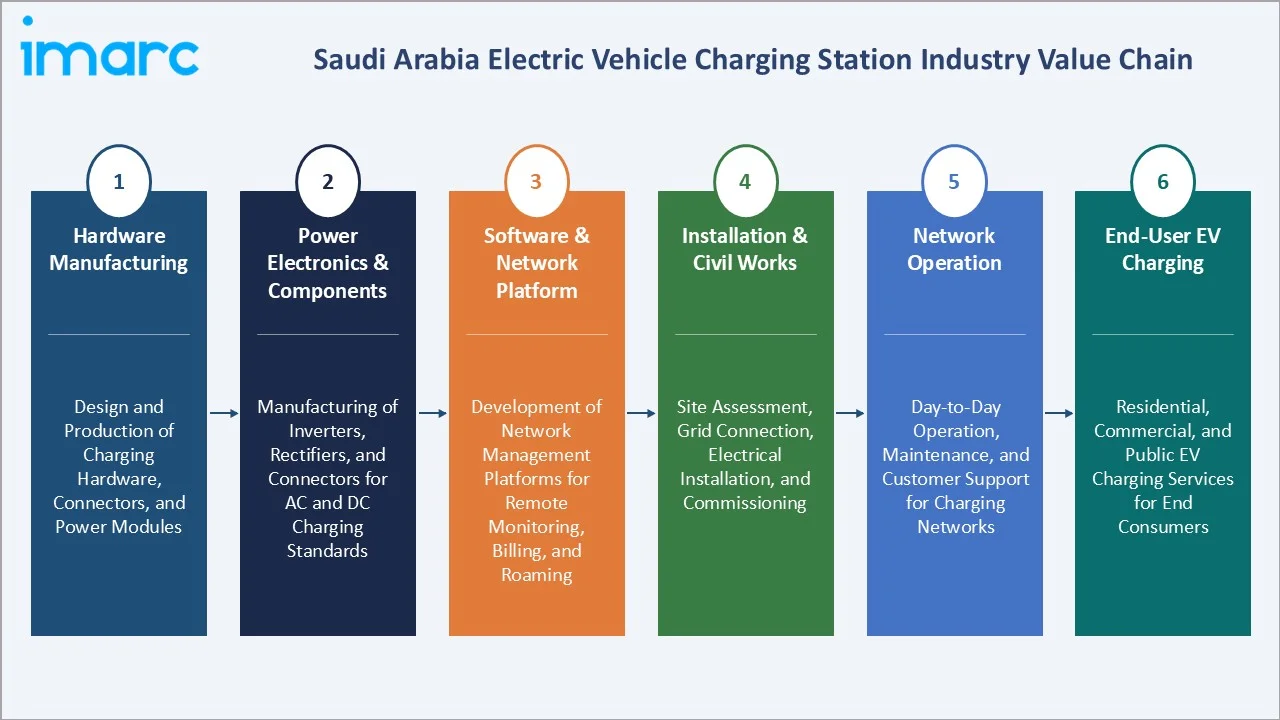
The EV charging station value chain spans hardware manufacturing, power electronics supply, software and network platform development, installation and civil works, operator network management, and end-user vehicle charging services.
|
Stage |
Key Activities |
|
Hardware Manufacturing |
Design and production of charging hardware, connectors, and power modules |
|
Power Electronics & Components |
Manufacturing of inverters, rectifiers, and connectors for AC and DC charging standards |
|
Software & Network Platform |
Development of network management platforms for remote monitoring, billing, and roaming |
|
Installation & Civil Works |
Site assessment, grid connection, electrical installation, and commissioning |
|
Network Operation |
Day-to-day operation, maintenance, and customer support for charging networks |
|
End-User EV Charging |
Residential, commercial, and public EV charging services for end consumers |
The software and network platform stage represents the highest-margin segment, while installation and civil works is the most capital-intensive for DC fast-charging deployment. Vertically integrated operators increasingly control multiple value chain stages to improve margins and service reliability.
Technology Landscape in the Saudi Arabia EV Charging Station Industry
AC Charging Technology (Level 1 & Level 2)
AC charging operates at 3.7-22 kW, suitable for residential, workplace, and commercial parking applications. Level 2 AC chargers represent the most widely deployed segment in Saudi Arabia, offering cost-effective overnight charging compatible with the standard electricity grid across all Saudi regions.
DC Fast-Charging Technology (Level 3)
DC fast chargers (50-350 kW) enable rapid charging in 20-60 minutes, supporting highway corridors, commercial destinations, and giga-project sites.
Smart Charging and Solar-Integrated Technology
Smart charging platforms enable dynamic load management, time-of-use pricing optimization, and demand response integration with Saudi Arabia's grid. Solar-integrated charging stations leverage Saudi Arabia's exceptional solar resource to reduce operational costs and meet the Saudi Green Initiative's renewable energy deployment targets.
Market Segmentation Analysis
The report covers the following segments:
|
Segment Category |
Leading Segment |
Market Share |
Year |
|
Charging Station Type |
AC Charging |
58.4% |
2025 |
|
Vehicle Type |
Battery Electric Vehicle (BEV) |
57.9% |
2025 |
|
Installation Type |
🔒 |
🔒 |
2025 |
|
Charging Level |
🔒 |
🔒 |
2025 |
|
Connector Type |
🔒 |
🔒 |
2025 |
|
Application |
🔒 |
🔒 |
2025 |
|
Region |
Northern & Central Region |
44.7% |
2025 |

By Charging Station Type
AC Charging leads at 58.4% in 2025, capturing the dominant residential, workplace, and commercial parking charging market. Its lower installation cost, compatibility with Level 2 charging standards, and alignment with mainstream EV consumer charging behaviour consolidate its leadership across Saudi Arabia's major urban centers.
To access detailed market analysis, Request Sample
DC Charging at 41.6% serves highway corridors, commercial destinations, and giga-project locations requiring rapid recharge times. DC Charging grows fastest at ~23.5% CAGR as Vision 2030 highway infrastructure investment and premium EV adoption in urban centers accelerates fast-charging network expansion.
By Vehicle Type
Battery Electric Vehicle (BEV) leads at 57.9% in 2025, capturing the highest per-station charging demand through pure-electric drivetrain reliance on public and residential charging infrastructure. Saudi Arabia's Vision 2030 fleet electrification mandates and BEV purchase incentives are accelerating BEV adoption across consumer and government vehicle segments.
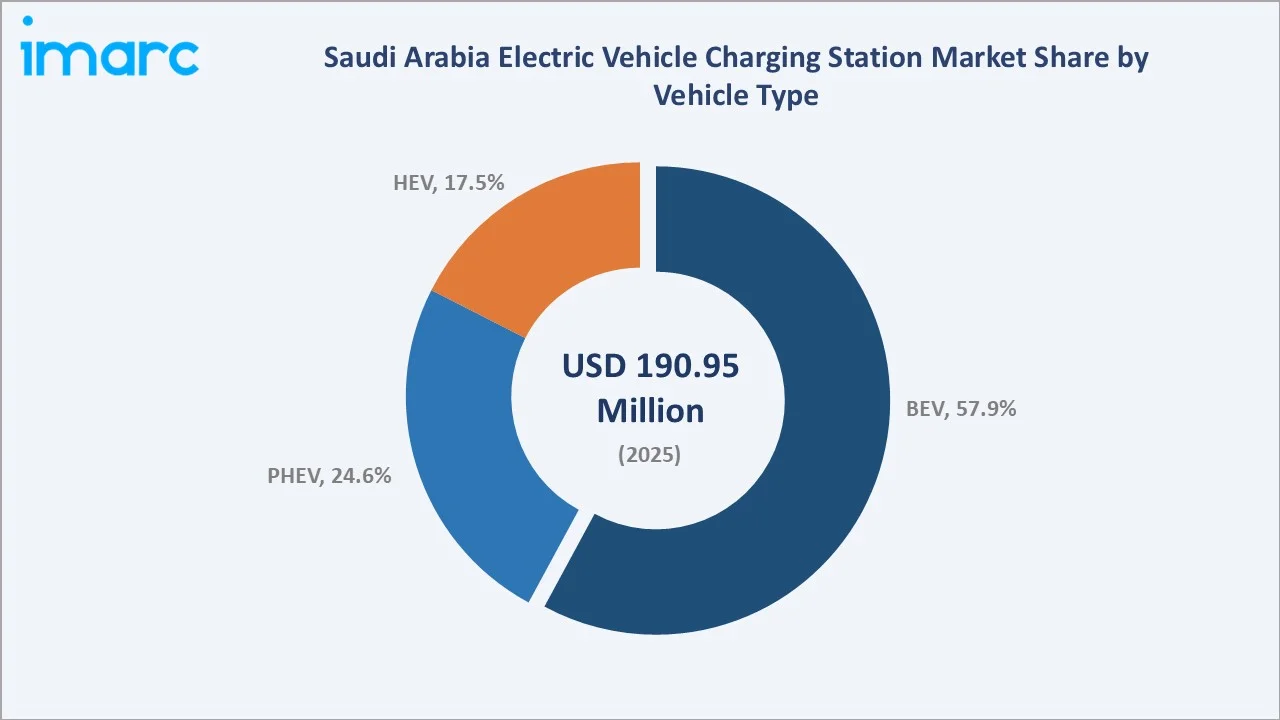
Plug-in Hybrid Electric Vehicle (PHEV) at 24.6% serves consumers seeking dual-mode mobility during the EV infrastructure development transition. Hybrid Electric Vehicle (HEV) at 17.5% represents the most limited charging demand segment, growing at ~17.6% CAGR as mild-hybrid and full-hybrid adoption expands in Saudi Arabia's mainstream vehicle market.
Regional Market Insights
|
Region |
Share (2025) |
Key Drivers & Characteristics |
|
Northern & Central Region |
44.7% |
Highest EV fleet density, strong giga-project investment, and concentration of government EV programs |
|
Western Region |
27.3% |
Growing urban EV adoption, commercial charging demand, and expanding highway corridor infrastructure |
|
Eastern Region |
18.4% |
Supported by industrial fleet electrification, energy sector EV programs, and commercial deployments |
|
Southern Region |
9.6% |
Early-stage market with growing residential and commercial EV charging deployments in major cities |
Northern & Central Region, at 44.7%, leads through Riyadh's urban EV fleet concentration, NEOM and giga-project investment, and the concentration of government EV programs. Western Region, at 27.3%, reflects commercial charging density and highway corridor infrastructure investment.
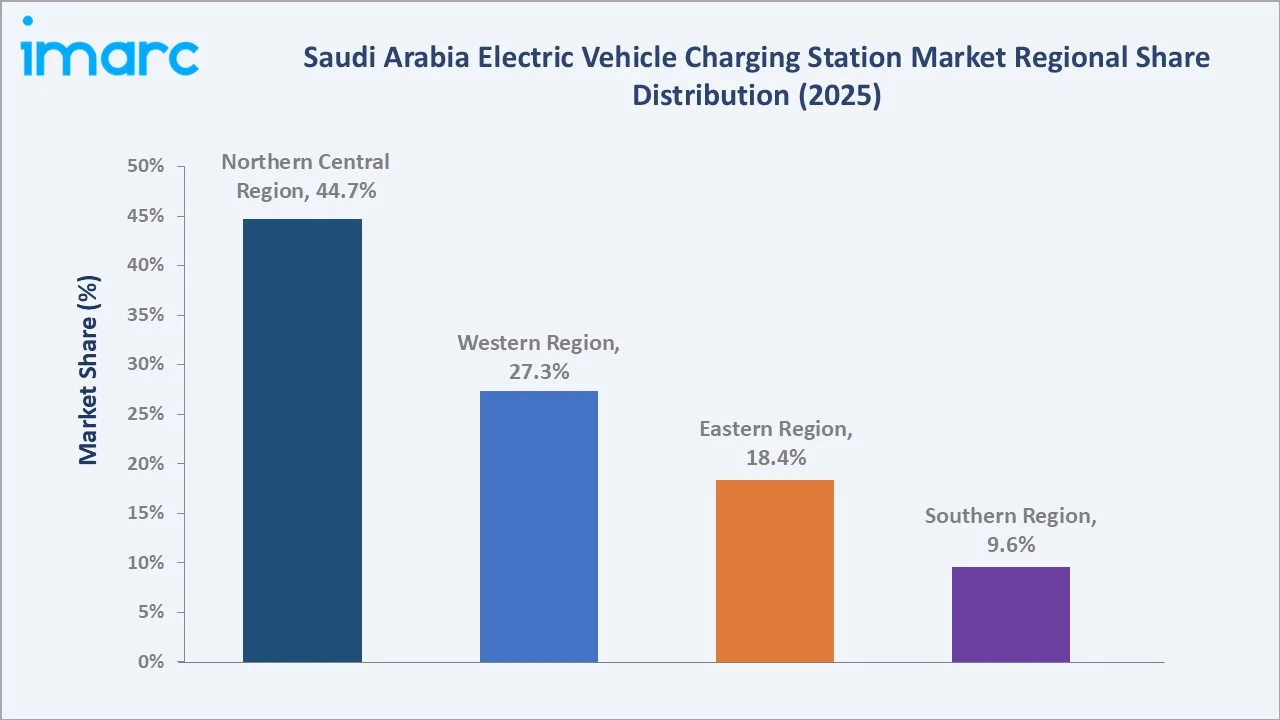
Eastern Region, at 18.4%, is driven by industrial fleet electrification and energy sector EV programs. Southern Region, at 9.6%, represents an early stage but growing market as Vision 2030 infrastructure investment extends to secondary cities and emerging EV adoption outside core urban centers.
Competitive Landscape
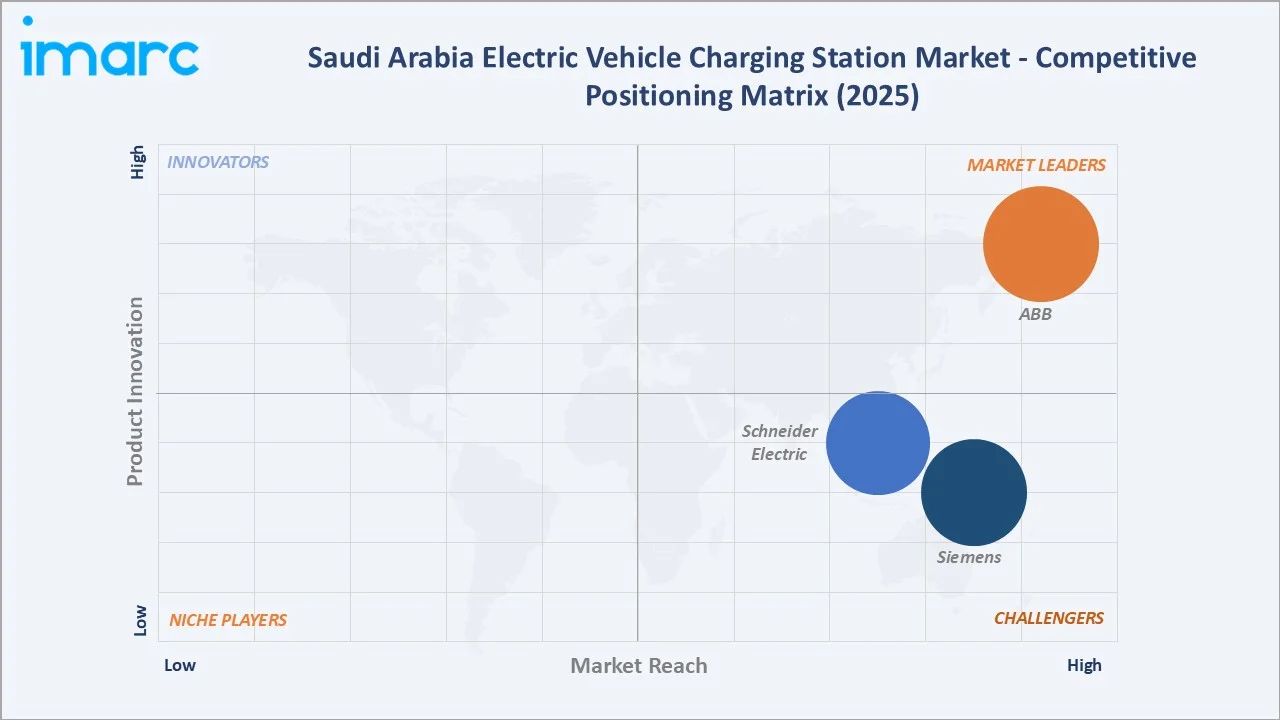
The Saudi Arabia EV charging station competitive landscape is moderately fragmented, with global Tier-1 charging hardware manufacturers, international CPOs, and domestic operators competing across network scale, technology capability, and geographic coverage.
|
Company Name |
Key Products |
Market Position |
Core Strength |
|
ABB |
Terra AC Wallbox, Terra DC Fast Chargers |
Market Leader |
ABB specializes in AC and DC EV charging hardware with a confirmed active presence in Saudi Arabia, including the installation of EV chargers across 100+ Saudi locations since 2022. |
|
Siemens |
SICHARGE D, VersiCharge AC |
Strong Challenger |
Siemens delivers high-power DC chargers and smart grid-integrated charging solutions for commercial and public applications, with active deployment across Saudi Arabia's major cities. |
|
Schneider Electric |
EVlink Smart Wallbox, EVlink Parking |
Strong Challenger |
Schneider Electric integrates EV charging with building energy management systems, enabling smart load balancing and solar integration for commercial properties across Saudi Arabia. |
Key players include ABB, Siemens, Schneider Electric, and others.
Key Company Profiles
ABB
ABB is a Switzerland-based multinational specializing in electrification, automation, and EV charging infrastructure, with a confirmed active presence in Saudi Arabia, including large-scale charging deployments supporting Vision 2030 EV infrastructure programs.
- Key Products: Terra AC Wallbox, Terra DC Fast Chargers
- Recent Developments: In February 2025, ABB partnered with Red Sea Global (RSG) to deploy more than 1,200 electric vehicle charging solutions across 13 locations within the Red Sea and AMAALA destinations in Saudi Arabia. The project represents the Kingdom’s largest e-mobility initiative to date and will support both operational fleets and visitor EV charging requirements.
- Strategic Focus: Expanding integrated DC fast-charging and grid stabilization solutions for highway corridors, commercial destinations, and giga-project sites across Saudi Arabia and the broader GCC market.
Siemens
Siemens is a Germany-based multinational technology company offering comprehensive EV charging hardware, software, and services through its Siemens eMobility division, with active deployments across Saudi Arabia's commercial and public charging locations.
- Key Products: SICHARGE D, VersiCharge AC
- Strategic Focus: Expanding high-power DC charging and smart grid-integrated depot solutions for logistics, transit, and commercial fleet operators across Saudi Arabia, with a focus on integration with Vision 2030 smart city infrastructure.
Market Concentration Analysis
The Saudi Arabia EV charging station market is moderately fragmented, with the top 4-5 players collectively accounting for approximately 45-55% of active public charging capacity. Domestic programs hold an estimated 15-25% share of total active public stations.
Market concentration is declining as Vision 2030 giga-project mandates attract new international entrants and domestic operators expand. Growing government infrastructure programs and PIF investment are accelerating competitive fragmentation across Saudi Arabia's four regional charging markets.
Investment & Growth Opportunities
Highest Growth Segments
DC Charging (~23.5% CAGR), BEV vehicle type (~24.1% CAGR), Northern & Central Region public charging, NEOM and giga-project integrated EV networks, national highway DC fast-charging corridors, and solar-integrated commercial stations represent the highest-growth investment vectors through 2034.
Emerging Investment Opportunities
NEOM and Vision 2030 giga-project integrated EV charging infrastructure represents Saudi Arabia's highest-value emerging investment opportunity. These mandated electric mobility developments create multi-billion-dollar captive charging infrastructure deployment opportunities for hardware manufacturers and CPO operators.
Investment Themes
- Solar-integrated charging station development leveraging Saudi Arabia's world-class solar irradiation resource: Solar-coupled EV charging reduces operational electricity costs and positions operators for competitive tariff advantages while aligning with the Saudi Green Initiative's renewable energy deployment targets and national sustainability commitments.
- Fleet electrification depot charging investment, capturing Saudi Arabia's large government and commercial fleet electrification wave: Saudi Arabia's government vehicle fleets, logistics operators, and industrial company fleets represent a significant charging infrastructure investment opportunity through 2030 as operators align with Vision 2030 sustainability mandates.
Future Market Outlook (2026-2034)
The Saudi Arabia electric vehicle charging station market is projected to grow from USD 190.95 Million in 2025 to USD 1,078.29 Million by 2034, delivering a 21.21% CAGR. The market's anchor value of USD 499.57 Million in 2030 represents Saudi Arabia's charging infrastructure at a Vision 2030 delivery inflection where giga-project networks, fleet depots, and urban public charging converge.
Three structural forces define growth through 2034 with high confidence. Vision 2030 EV fleet compounding demand creates a government-mandated charging investment cycle. NEOM and giga-project deployments create large-scale captive EV charging demand across multiple regions. Commercial and fleet electrification creates predictable depot charging demand that supports favorable CPO business models through the forecast period.
By 2034, DC fast-charging is expected to narrow the gap with AC charging as highway corridor and giga-project networks mature, while smart grid and V2G technology reaches mainstream adoption in fleet depot and commercial applications across Saudi Arabia's major cities.
Research Methodology
Primary Research
Primary research comprised structured interviews with 40+ industry stakeholders (2025), including EV charging operators, automotive OEM EV program leads, Saudi utility company infrastructure managers, government energy officials, and property developers deploying charging amenities across Saudi Arabia.
Secondary Research
Secondary research encompassed company annual reports; ECRA and SASO EV infrastructure data; IEA Global EV Outlook 2025; Saudi Arabia Ministry of Energy EV data; industry association publications; and operator press releases. Over 50 secondary sources were reviewed.
Forecasting Models
Market revenue forecasts developed using EV fleet-based bottom-up model: (i) Saudi Arabia EV fleet projection by vehicle type; (ii) average charger-to-vehicle ratio by charging type; (iii) average charging station revenue by type and utilization rate; (iv) technology and geographic mix adjustment for network expansion pricing.
Saudi Arabia Electric Vehicle Charging Station Market Report Coverage:
| Report Features | Details |
|---|---|
| Base Year of the Analysis | 2025 |
| Historical Period | 2020-2025 |
| Forecast Period | 2026-2034 |
| Units | Million USD |
| Scope of the Report | Exploration of Historical and Forecast Trends, Industry Catalysts and Challenges, Segment-Wise Historical and Predictive Market Assessment:
|
| Charging Station Types Covered | AC Charging, DC Charging |
| Vehicle Types Covered | Battery Electric Vehicle (BEV), Plug-in Hybrid Electric Vehicle (PHEV), Hybrid Electric Vehicle (HEV) |
| Installation Types Covered | Portable Charger, Fixed Charger |
| Charging Levels Covered | Level 1, Level 2, Level 3 |
| Connector Types Covered | Combines Charging Station (CCS), CHAdeMO, Type-1 (SAE J1772), Tesla Supercharger, Type-2 (IEC 62196-2), Others |
| Applications Covered | Residential, Commercial |
| Regions Covered | Northern and Central Region, Western Region, Eastern Region, Southern Region |
| Companies Covered | ABB, Siemens, Schneider Electric, etc. |
| Customization Scope | 10% Free Customization |
| Post-Sale Analyst Support | 10-12 Weeks |
| Delivery Format | PDF and Excel through Email (We can also provide the editable version of the report in PPT/Word format on special request) |
Key Benefits for Stakeholders:
- IMARC’s industry report offers a comprehensive quantitative analysis of various market segments, historical and current market trends, market forecasts, and dynamics of the Saudi Arabia electric vehicle charging station market from 2020-2034.
- The research report provides the latest information on the market drivers, challenges, and opportunities in the Saudi Arabia electric vehicle charging station market.
- Porter's five forces analysis assist stakeholders in assessing the impact of new entrants, competitive rivalry, supplier power, buyer power, and the threat of substitution. It helps stakeholders to analyze the level of competition within the Saudi Arabia electric vehicle charging station industry and its attractiveness.
- Competitive landscape allows stakeholders to understand their competitive environment and provides an insight into the current positions of key players in the market.
Frequently Asked Questions About the Saudi Arabia Electric Vehicle Charging Station Market Report
The Saudi Arabia EV charging station market reached USD 190.95 Million in 2025, driven by AC Charging dominance at 58.4%, BEV leadership at 57.9%, Northern & Central Region commanding 44.7% regional share.
The market grows at 21.21% CAGR during 2026-2034, reaching USD 1,078.29 Million by 2034. This reflects Vision 2030 EV fleet expansion, government infrastructure investment, DC fast-charging corridor rollout, and giga-project integrated EV network deployment across Saudi Arabia.
AC Charging leads at 58.4% through residential and commercial deployment at lower cost. DC Charging at 41.6% grows fastest at ~23.5% CAGR through highway fast-charging investment and NEOM giga-project ultra-fast charging network deployment across Saudi Arabia.
BEV leads at 57.9% through Vision 2030 fleet electrification mandates and government BEV purchase incentives. PHEV at 24.6% serves dual-mode transition consumers, while HEV at 17.5% represents the most limited charging demand segment growing at ~17.6% CAGR.
Northern & Central Region leads at 44.7% through Riyadh's EV fleet concentration, NEOM investment, and government EV program density. Western Region at 27.3% follows, driven by commercial charging demand and expanding highway corridor infrastructure.
Leading companies include ABB, Siemens, Schneider Electric, and others.
The Saudi Arabia EV charging station market is projected to reach USD 499.57 Million by 2030, with NEOM and giga-project charging networks maturing, solar-integrated station deployment scaling, and fleet electrification depot charging creating large-scale demand concentrations across all four regions.
Top investment opportunities include NEOM and giga-project EV charging network deployment, national highway DC fast-charging corridor development, solar-integrated commercial charging station development, and fleet electrification depot infrastructure across the Northern & Central and Western regions.
Need more help?
- Speak to our experienced analysts for insights on the current market scenarios.
- Include additional segments and countries to customize the report as per your requirement.
- Gain an unparalleled competitive advantage in your domain by understanding how to utilize the report and positively impacting your operations and revenue.
- For further assistance, please connect with our analysts.
 Request Customization
 Speak to an Analyst
 Request Brochure
 Inquire Before Buying
Benefits of Customization
- Personalize this research
- Triangulate with your data
- Get data as per your format and definition
- Gain a deeper dive into a specific application, geography, customer, or competitor
- Any level of personalization
Get in Touch With Us
UNITED STATES
Phone: +1-201-971-6302
INDIA
Phone: +91-120-433-0800
UNITED KINGDOM
Phone: +44-753-714-6104
Email: [email protected]
Client Testimonials




.webp)




.webp)













Related Reports

Choose your plan
*Please note that the prices mentioned below are starting prices for each bundle type. Kindly contact our team for further details.*
Single User License
- 1 User License, Access on 2 Devices
- PDF Report + Excel Dataset (Password Protected)
- Lifetime Access
- No Printing Rights
- 10% Free Report Customization
- 10–12 Weeks of Analyst Support
Five User License
- Access for 5 Users, 2 Devices per User
- PDF Report + Excel Dataset (Password Protected)
- Lifetime Access
- Dedicated Account Manager
- 12–14 Weeks of Analyst Support
- No Printing Rights
- 15% Free Report Customization
- 25% Discount on Your Next Purchase
Corporate User License
- Unlimited User Access (Within Your Organization)
- PDF Report + Excel Dataset
- Lifetime Access
- Dedicated Account Manager
- 14–20 Weeks of Analyst Support
- No Printing Rights
- 20% Free Report Customization
- 30% Discount on Your Next Purchase
Essential Insights
What's included:
3 reports
- Lifetime Access
- PDF Reports
- Excel Datasets
- 2 Weeks of Free Analyst Support
- 2 User Licenses
- Access on 2 Devices
- Printing Rights
- Complimentary PowerPoint (PPT) Version
- Complimentary License Upgrade
Professional Access
What's included:
5 reports
- Lifetime Access
- PDF Reports
- Excel Datasets
- 8 Weeks of Free Analyst Support
- 2 User Licenses
- Access on 2 Devices
- Printing Rights
- Complimentary PowerPoint (PPT) Version
- Complimentary License Upgrade
Business Advantage
What's included:
8 reports
- Lifetime Access
- PDF Reports
- Excel Datasets
- 14 Weeks of Free Analyst Support
- 2 User Licenses
- Access on 2 Devices
- Printing Rights
- Complimentary PowerPoint (PPT) Version
- Complimentary License Upgrade
Enterprise Intelligence
What's included:
10 reports
- Lifetime Access
- PDF Reports
- Excel Datasets
- 20 Weeks of Free Analyst Support
- 2 User Licenses
- Access on 2 Devices
- Printing Rights
- Complimentary PowerPoint (PPT) Version
- Complimentary License Upgrade