
Philippines Animal Feed Market Size, Share, Trends and Forecast by Form, Animal Type, Ingredient, and Region, 2026-2034
Philippines Animal Feed Market Size, Share, Trends & Forecast (2026-2034)
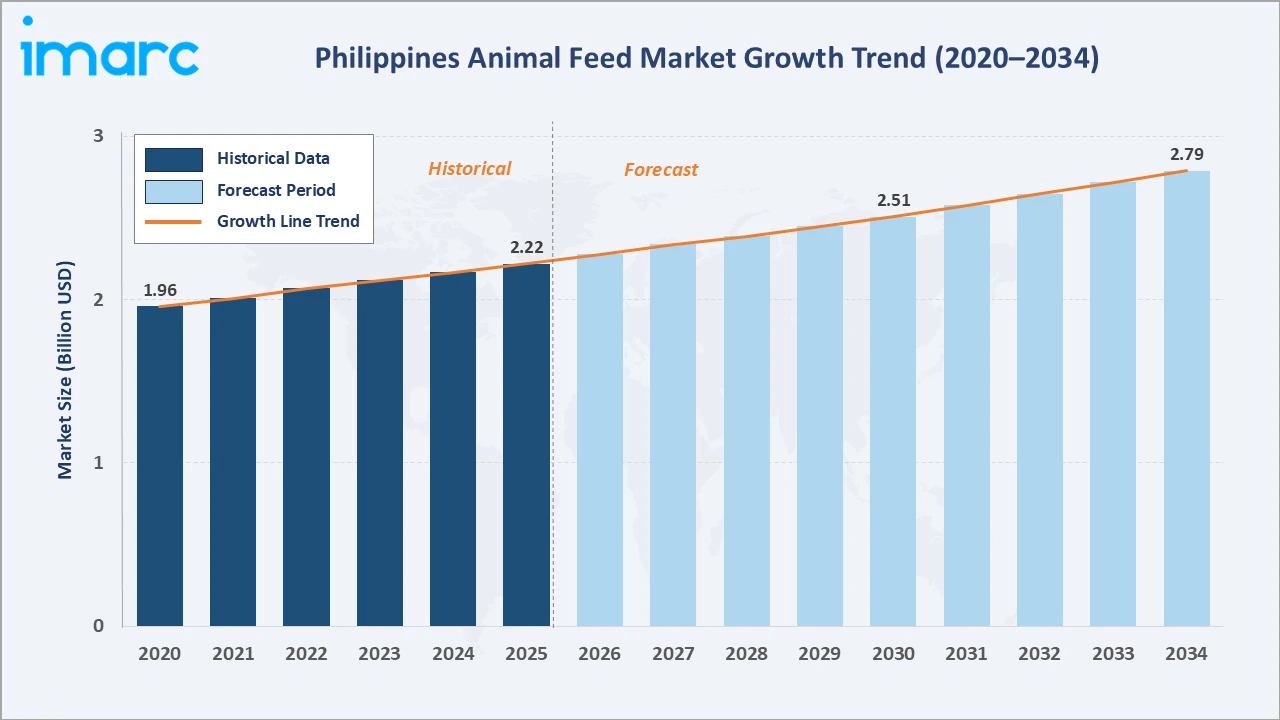
The Philippines animal feed market was valued at USD 2.22 Billion in 2025 and is projected to expand from USD 2.28 Billion in 2026 to USD 2.79 Billion by 2034, registering a CAGR of 2.50% during 2026-2034. The market is driven by rising commercial poultry and livestock production, expanding aquaculture operations, and growing per-capita protein consumption across the archipelago.
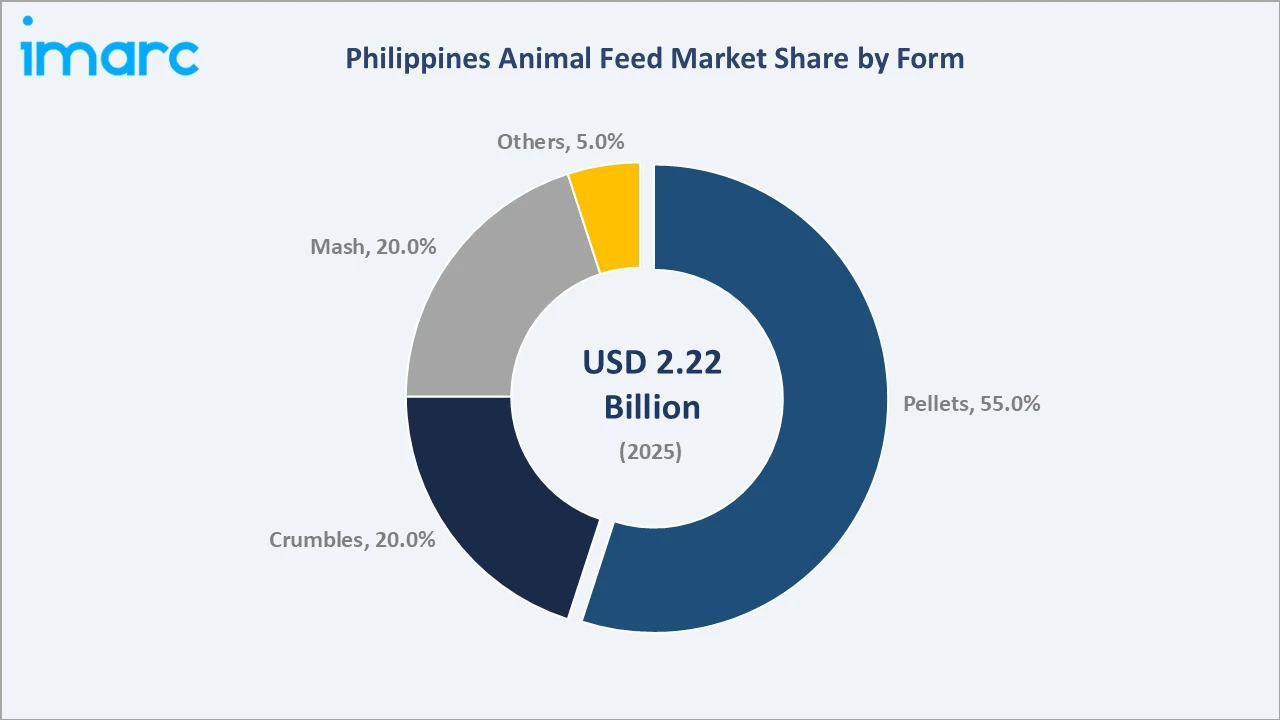
Pellets dominate the form segment at 55.0% in 2025, driven by superior feed conversion efficiency in commercial poultry and swine operations. Cereals lead the ingredient segment at 35.0%, with corn forming the energy backbone of Philippine feed rations. Luzon commands 45.0% of the regional market, anchored by high-density commercial farms and accredited feed mills.
Market Snapshot
|
Metric |
Details |
|
Market Size (2025) |
USD 2.22 Billion |
|
Market Size (2026) |
USD 2.28 Billion |
|
Forecast Market Size (2034) |
USD 2.79 Billion |
|
CAGR (2026-2034) |
2.50% |
|
Historical Period |
2020-2025 |
|
Forecast Period |
2026-2034 |
|
Leading Form Segment |
Pellets (55.0%) |
|
Dominant Ingredient |
Cereals (35.0%) |
|
Leading Region |
Luzon (45.0%) |
|
Market Opportunity |
Premium feed additives; aquafeed expansion; integrated poultry-feed value chains; sustainable ingredient sourcing |
The Philippines animal feed market grew from USD 1.96 Billion in 2020 to USD 2.22 Billion in 2025, reflecting consistent compound growth driven by commercial poultry expansion and rising domestic protein demand. The forecast period 2026–2034 projects continued expansion, reaching USD 2.28 Billion in 2026, USD 2.51 Billion in 2030, and USD 2.79 Billion by 2034. Aquaculture feed demand and feed additive premiumization are emerging as above-market growth drivers reinforcing the long-term trajectory.
To get more information on this market, Request Sample
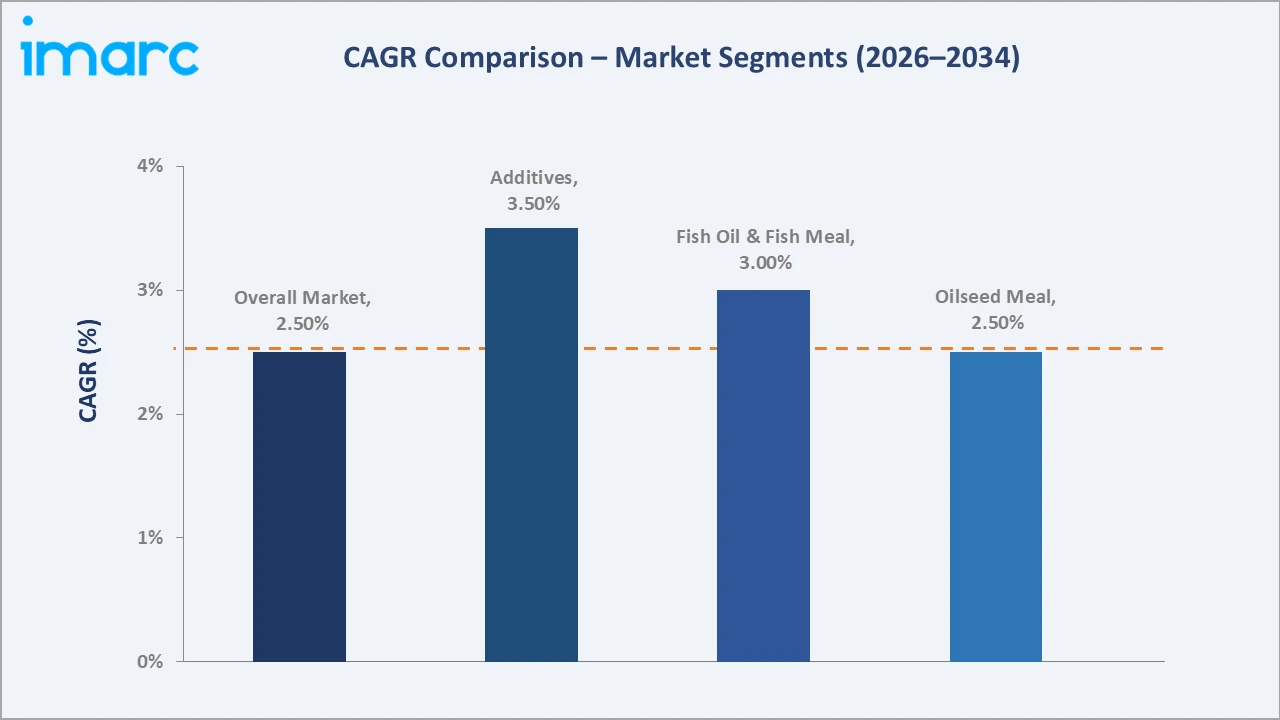
Among ingredient segments, additives register the highest CAGR at 3.5%, followed by fish oil and fish meal at 3.0% and oilseed meal at 2.5%. Molasses records the lowest growth at 1.8%. The overall market CAGR of 2.50% reflects a stable baseline growth sustained by structural livestock production expansion across Luzon, Visayas, and Mindanao.
Executive Summary
The Philippines animal feed market was valued at USD 2.22 Billion in 2025 and is projected to expand from USD 2.28 Billion in 2026 to USD 2.79 Billion by 2034. Commercial poultry, particularly broiler and layer operations, along with swine farming and pond aquaculture, generate primary feed demand.
Feed additive adoption is accelerating, with the segment growing at approximately 3.5% CAGR, the highest among all ingredient categories. Aquaculture feed presents the highest sub-sector growth potential through 2034, supported by Mindanao's rapidly expanding fishery production base and government development programs.
Key Market Insights
|
Insight |
Data |
|
Leading Form Segment |
Pellets – 55.0% market share (2025) |
|
Dominant Ingredient |
Cereals – 35.0% market share (2025) |
|
Leading Region |
Luzon – 45.0% share (2025) |
|
Market Opportunity |
Premium feed additives; aquafeed expansion; integrated poultry-feed value chains; sustainable ingredient sourcing |
Key Analytical Observations Supporting the Above Data:
- Pellets at 55.0%: The pelleted feed segment dominates because pelleting improves nutrient bioavailability, reduces feed wastage, and supports better feed conversion ratios in commercial poultry and swine operations. Pelletized feed is the standard form in large integrated farms across the Philippines.
- Cereals at 35.0%: Cereals, led by corn and wheat, form the energy backbone of Philippine animal feed rations. Their high starch content and wide availability make them the most commercially dominant ingredient, despite periodic import dependence on global commodity markets.
- Luzon at 45.0%: Luzon leads regionally due to its concentration of large commercial poultry and swine farms, higher density of accredited feed mills, and proximity to major ingredient import ports in Metro Manila and Central Luzon.
Philippines Animal Feed Market Overview
The Philippines animal feed industry is deeply integrated with the livestock and aquaculture sectors. Commercial poultry, particularly broiler and layer operations, along with swine farming and fishpond aquaculture, generate primary demand. The industry is characterized by large integrated conglomerates and regional producers that serve commercial farms across Luzon, Visayas, and Mindanao, with feed manufacturing concentrated in Metro Manila, Central Luzon, and selected Mindanao processing zones.
The Philippines feed ecosystem encompasses domestic grain sourcing, ingredient importation, compound feed manufacturing, distribution, and integrated farm-to-fork operations. The Government of the Philippines through the Bureau of Animal Industry (BAI) plays a regulatory role, providing accreditation frameworks for feed mills and quality standards for manufactured compound feeds. Commodity groups and industry associations support sector-specific standards that drive consistent quality across the value chain.
Market Dynamics
To evaluate market opportunities, Request Sample
Market Drivers
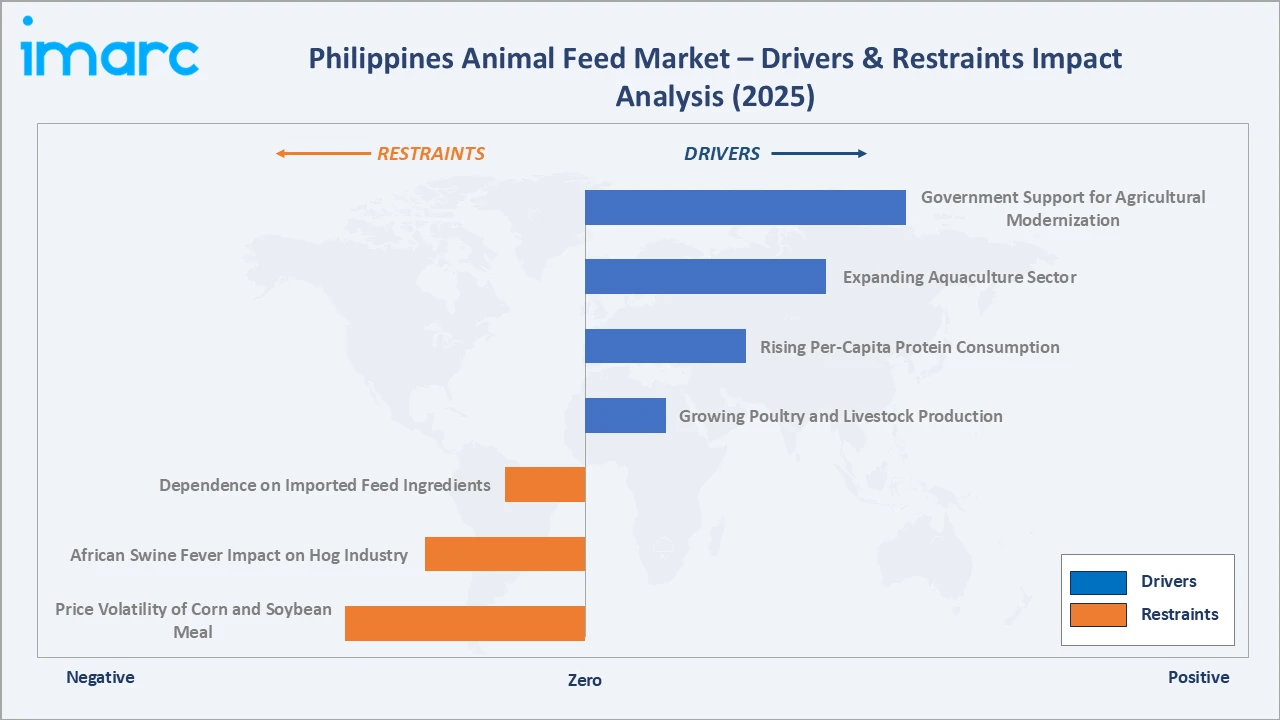
- Growing Poultry and Livestock Production: Rising commercial poultry and livestock output is directly expanding compound feed demand. Broiler inventory reached 77.1 million birds in April 2026, with chicken output forecast to rise 6.5% in 2026, while egg production grew 8.3% in 2025. This expanding production base sustains consistent volume demand for pelletized poultry feed, reinforcing the pellets segment's 55.0% dominance. Integrated commercial farms continue to replace traditional backyard production systems, increasing the share of commercially formulated feeds in total animal nutrition. Large integrated agribusiness conglomerates are building additional production capacity, reinforcing sustained feed demand growth through 2034.
- Rising Per-Capita Protein Consumption: Rising per-capita income and growing consumer preference for protein-rich diets are increasing demand for poultry, pork, and fish, thereby sustaining upstream feed demand. The Philippines' young and growing population, urbanization, and rising middle-class expenditure on food are driving structural growth in animal protein consumption, expanding commercial feed requirements across poultry, swine, and aquaculture value chains. Government programs promoting protein accessibility in lower-income households further support the commercial livestock sector.
- Expanding Aquaculture Sector: The Philippines aquaculture sector recorded 5.6% output growth in 2025, driven by milkfish, shrimp, and tilapia production. Aquafeed demand is rising as commercial fish pen and fishpond operators shift toward scientifically formulated feeds to improve survival rates and harvest quality. The aquafeed segment is growing driven by premiumization of fish nutrition inputs. Government-supported aquaculture development zones in Mindanao and Visayas are expanding production capacity, and commercial fish pen operators are transitioning from traditional feeding to formulated aquafeeds, driving premiumization within the feed additives segment.
- Government Support for Agricultural Modernization: Government programs under the Department of Agriculture support livestock and aquaculture sector modernization, providing subsidies, technical assistance, and infrastructure that expand the commercial farming base. These programs encourage adoption of scientifically formulated compound feeds over traditional grain-based feeding, driving higher-value feed consumption and supporting overall market growth. Department of Agriculture initiatives provide direct incentives for feed mill modernization and accreditation, improving the formalization of the Philippine feed sector. Regulatory frameworks from the Bureau of Animal Industry provide a stable institutional environment that sustains long-term market growth.
Market Restraints
- Dependence on Imported Feed Ingredients: The Philippines relies heavily on imported corn, soybean meal, and wheat as primary feed ingredients. Domestic corn production is forecast to drop to 8.1 million tons in 2026 due to reduced harvested area, higher input costs, and tighter irrigation supply, while import demand remains at approximately 2.3 million tons. This dependence exposes the feed industry to global commodity price volatility, currency fluctuations, and supply disruption risks, creating pricing pressure on feed manufacturers and farmers. Currency depreciation further amplifies the import cost burden, as the Philippine peso weakens against the US dollar, making corn and soybean meal imports progressively more expensive for local feed mills.
- African Swine Fever Impact on Hog Industry: African Swine Fever (ASF) outbreaks have significantly depleted commercial hog inventories across the Philippines, reducing swine feed demand. ASF-related depopulation programs have constrained hog numbers and restrained feed consumption growth in the swine segment. Recovery has been gradual, and recurring ASF risks continue to limit the sector's contribution to overall feed market expansion. The loss of backyard pig inventory has disproportionately reduced low-margin feed consumption, while the commercial swine segment recovery has been slower due to biosecurity requirements. Continued ASF-related herd thinning in key producing regions constrains the overall swine feed market below pre-ASF peak levels.
- Price Volatility of Corn and Soybean Meal: Price volatility of corn and soybean meal, the two dominant raw materials in Philippine compound feed, creates operational and financial uncertainty for feed manufacturers. El Niño weather events, global supply disruptions, and currency pressures can sharply increase ingredient procurement costs, compressing feed mill margins and leading to pass-through price increases that reduce smaller farm operators' ability to afford commercially formulated feeds. Feed mills with limited hedging capabilities face significant earnings volatility during commodity price spikes, reducing capital availability for expansion. Small-scale feed operators are particularly vulnerable to cost pressure, accelerating market consolidation among large integrated producers.
Market Opportunities
- Premiumization of Feed Additives: Rising demand for natural, antibiotic-free, and performance-enhancing feed additives represents a high-growth opportunity. Rising consumer awareness of food safety and antibiotic residue risks is driving demand for antibiotic-free meat and seafood, creating premium pricing opportunities for natural additive-formulated feeds. Filipino food service and retail channels are increasingly certifying antibiotic-free animal products, providing commercial incentive for farmers to upgrade to premium feed formulations.
- Aquafeed Expansion in Mindanao: Mindanao's rapidly growing aquaculture production base offers significant aquafeed market expansion opportunities. New feed production investments in Mindanao reflect increasing commercial interest in serving this geographically distinct aquaculture zone with locally produced feeds. Freshwater and coastal aquaculture zones in Agusan del Norte, Lanao del Norte, and Davao del Sur are emerging as high-potential markets for commercial aquafeed distribution. Government-backed fish corridor development programs create stable institutional demand that reduces commercial risk for feed mill investment in Mindanao's aquafeed segment.
Market Challenges
- Climate Change and El Niño Risks: Recurring El Niño events and climate variability reduce domestic corn harvests, tighten feed grain supplies, and drive ingredient costs higher, creating structural margin pressure for feed manufacturers and farm operators across the Philippines. Flooding and drought affect the availability and quality of domestically sourced feed ingredients, creating operational uncertainty for feed mills dependent on local grain supply. Prolonged dry spells reduce corn yields and elevate aflatoxin contamination risks in stored grains, imposing quality management costs on feed manufacturers. Philippine livestock producers in drought-affected regions face compound pressures of higher feed costs and lower animal performance.
- Price Sensitivity of Small-Scale Farmers: Price sensitivity among small-scale backyard farmers limits adoption of commercial compound feeds. A large proportion of Philippine livestock producers remain backyard operators who rely on low-cost traditional feeding methods, constraining addressable market size for premium compound feeds. Market fragmentation due to the large share of backyard producers limits aggregate demand for commercially formulated feeds, keeping the organized market below the theoretical total livestock inventory potential. Extension services and demonstration programs showing the cost-efficiency benefits of formulated feeds over raw grain feeding are needed to convert traditional farmers into commercial feed buyers.
Emerging Market Trends
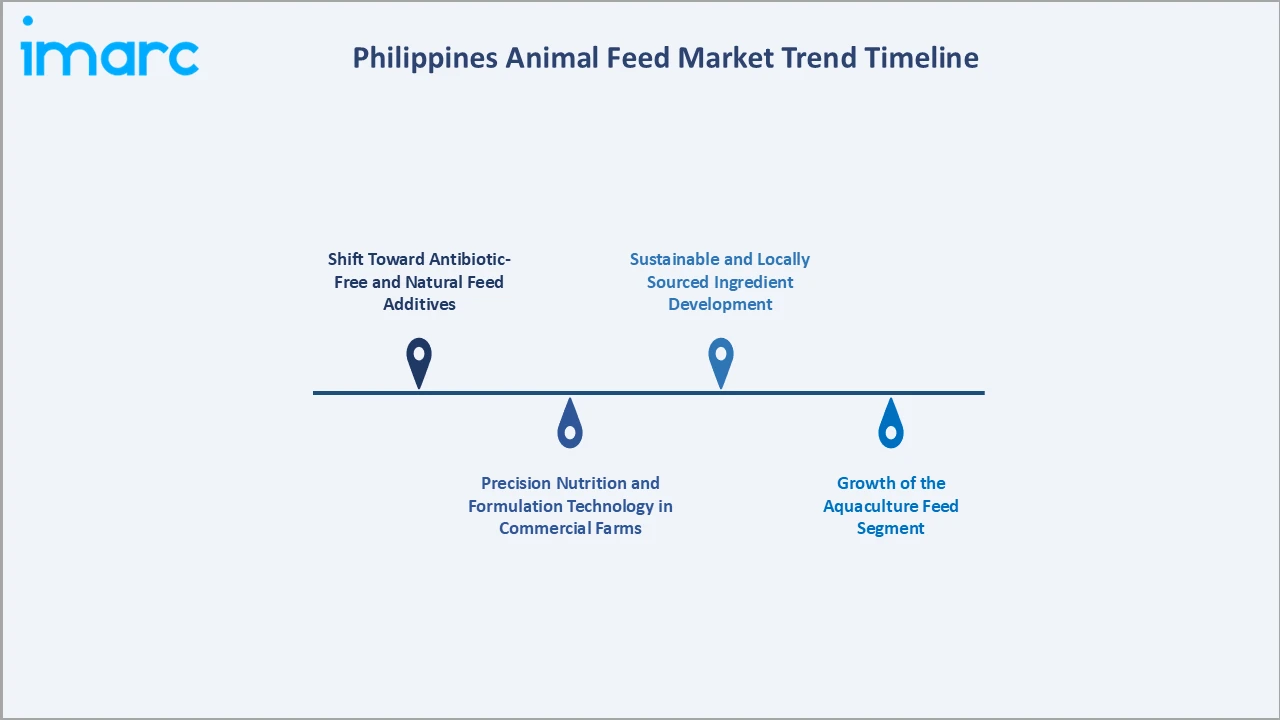
1. Shift Toward Antibiotic-Free and Natural Feed Additives
Growing regulatory pressure and consumer demand for safer animal products are driving adoption of natural feed additives as antibiotic alternatives. Products such as plant-based anticoccidials, phytogenic compounds, and organic acids are being introduced by global additive suppliers into the Philippine market, reshaping the additives segment and creating above-market growth opportunities for specialty nutrition companies.
2. Precision Nutrition and Formulation Technology in Commercial Farms
Large integrated poultry and swine operators are adopting precision feed formulation, using nutritional modeling software and real-time ingredient pricing systems to optimize feed rations for cost efficiency and performance. This trend is driving demand for technically superior feed ingredients and customized ingredient blends that improve feed conversion ratios and reduce overall cost per unit of animal output.
3. Growth of the Aquaculture Feed Segment
Philippine aquaculture output growth in milkfish, shrimp, and tilapia is expanding commercial aquafeed demand. Feed mills are increasingly investing in aquafeed production lines, and the segment is growing at a pace above the overall market CAGR, driven by intensified pond production, government aquaculture development programs, and rising commercial feed adoption among fishpond operators.
4. Sustainable and Locally Sourced Ingredient Development
Feed manufacturers and research institutions are investing in locally sourced alternative ingredients such as cassava, copra meal, and rice bran to reduce dependence on imported cereals and oilseed meals. Sustainable ingredient development supports feed cost stabilization and aligns with emerging ESG considerations for the Philippine agribusiness sector, driving innovation in feed formulation and ingredient supply chains.
Industry Value Chain Analysis
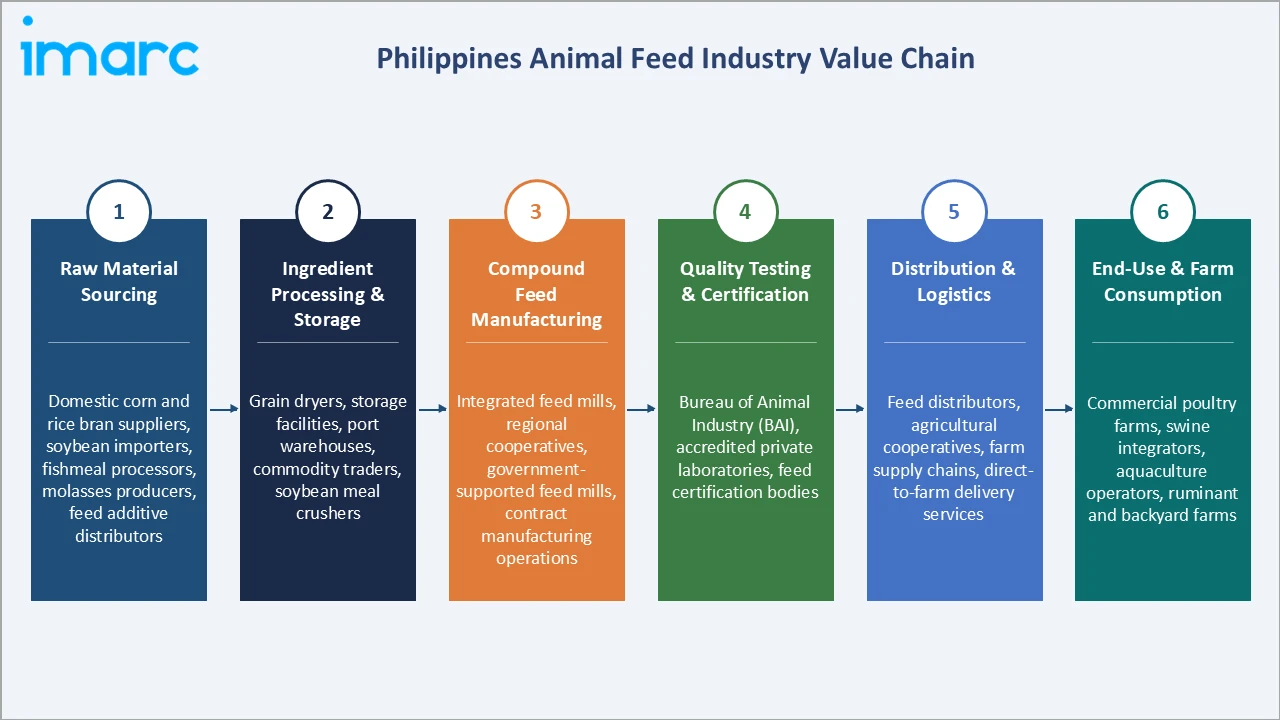
The Philippine animal feed value chain spans raw material sourcing, ingredient processing, compound feed manufacturing, distribution, and end-use on-farm consumption. The chain integrates both domestic agricultural inputs and imported commodity ingredients through a network of accredited importers, ports, and feed mills.
| Stage | Key Participants |
|---|---|
| Raw Material Sourcing | Domestic corn and rice bran suppliers, soybean importers, fishmeal processors, molasses producers, feed additive distributors |
| Ingredient Processing & Storage | Grain dryers, storage facilities, port warehouses, commodity traders, soybean meal crushers |
| Compound Feed Manufacturing | Integrated feed mills, regional cooperatives, government-supported feed mills, contract manufacturing operations |
| Quality Testing & Certification | Bureau of Animal Industry (BAI), accredited private laboratories, feed certification bodies |
| Distribution & Logistics | Feed distributors, agricultural cooperatives, farm supply chains, direct-to-farm delivery services |
| End-Use & Farm Consumption | Commercial poultry farms, swine integrators, aquaculture operators, ruminant and backyard farms |
Technology Landscape in the Philippines Animal Feed Industry
Feed Processing and Pelleting Technology
Modern pelleting systems using high-temperature, short-time (HTST) conditioning improve feed hygiene and nutrient bioavailability. Large commercial mills in the Philippines are adopting twin-screw expanders, counter-current coolers, and online pellet quality monitoring to improve feed conversion ratios and reduce energy consumption per ton of compound feed produced.
Feed Formulation Software and Precision Nutrition
Philippine commercial farms and integrated agribusiness operators are adopting least-cost formulation software that incorporates real-time commodity prices and nutrient specifications. This enables dynamic ration optimization that reduces feed cost per unit of animal output, drives adoption of custom ingredient blends, and supports technical differentiation among competing feed manufacturers.
Quality Management and Mycotoxin Control
Feed safety technology investments include mycotoxin binders, near-infrared spectroscopy (NIRS) for ingredient quality verification, and HACCP-compliant production systems. BAI accreditation requirements drive adoption of laboratory testing and quality assurance protocols across both large and mid-size feed mills, improving overall feed safety standards and reducing contamination risk across the supply chain.
Market Segmentation Analysis
The report covers the following segments:
| Segment Category | Leading Segment | Market Share | Year |
|---|---|---|---|
| Form | Pellets | 55.0% | 2025 |
| Ingredient | Cereals | 35.0% | 2025 |
| Animal Type | 🔒 | 🔒 | 2025 |
| Region | Luzon | 45.0% | 2025 |

By Form
Pellets lead at 55.0% of the market due to superior feed conversion efficiency, reduced wastage, and structural suitability for large-scale commercial poultry and swine operations. The pelletized form is the standard in large integrated farms across the Philippines, supported by significant pelleting machinery investment. Crumbles and mash account for 20.0% each, serving layer poultry and starter animal nutrition where smaller particle size improves feed intake and digestibility.
To access detailed market analysis, Request Sample
The form segment distribution reflects the Philippines' predominantly commercial integrated farm model, where pelletized feed offers the lowest cost of production per unit of animal output. Mash feeding retains relevance in smaller operations and in broiler starter programs. Others, at 5.0%, include expanded pellets and extruded products primarily used in specialty aquafeed and pet food manufacturing.
By Ingredient
Cereals dominate at 35.0%, with corn and wheat providing the energy backbone of Philippine animal feed rations. High starch content and wide availability make cereals the most commercially dominant ingredient category, despite periodic import dependence. Oilseed meal at 25.0%, primarily soybean meal, provides the protein backbone. Additives at 15.0% are the fastest-growing segment, reflecting rising adoption of vitamins, amino acids, feed enzymes, feed acidifiers, and antibiotic alternatives.
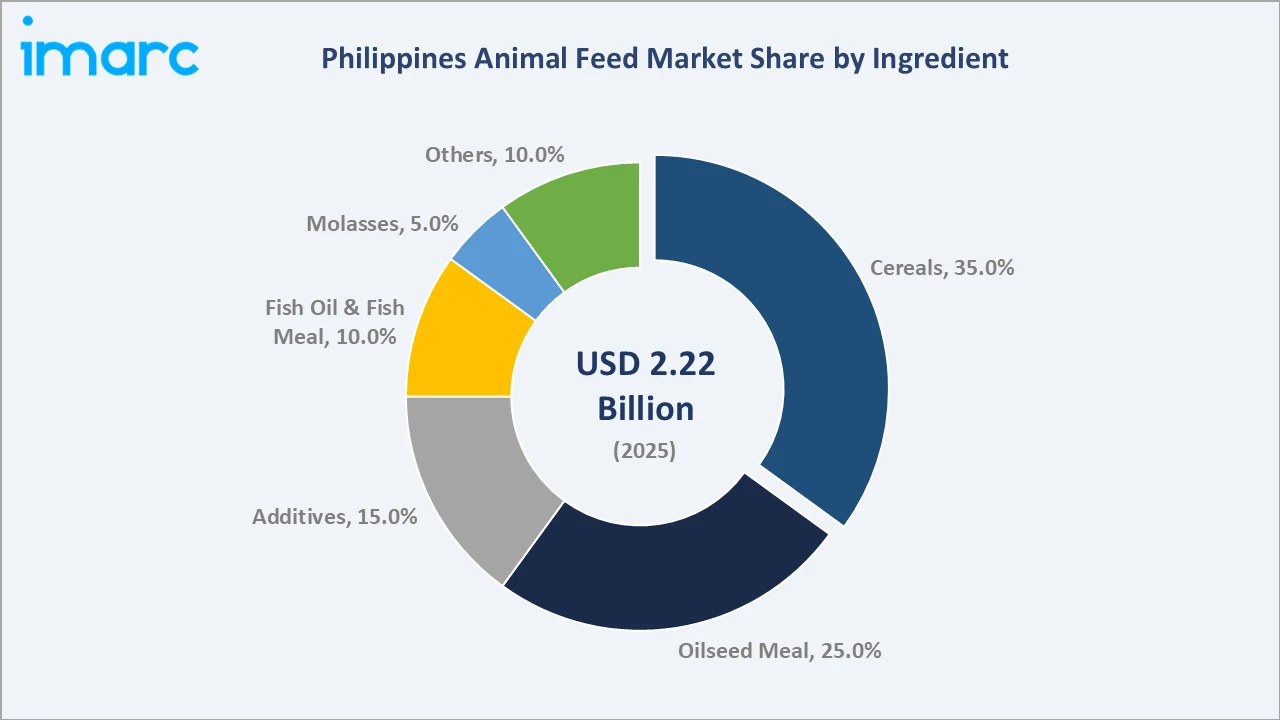
Fish oil and fish meal account for 10.0%, supporting the aquaculture feed segment with marine-derived protein and omega-3 fatty acids. Molasses at 5.0% serves as a palatability enhancer and energy supplement primarily in ruminant feed.
Regional Market Insights
| Region | Share (2025) | Key Philippines Animal Feed Market Drivers & Characteristics |
|---|---|---|
| Luzon | 45.0% | Home to the majority of commercial poultry and swine farms, feed mills, and ingredient import ports. Metro Manila and Central Luzon host the highest concentration of accredited feed manufacturers and distribution infrastructure. |
| Mindanao | 35.0% | Driven by expanding aquaculture, corn production, and growing commercial poultry operations. New feed production investments reflect increasing commercial feed demand in this rapidly growing southern region. |
| Visayas | 20.0% | A mix of commercial and backyard farming operations, with notable aquaculture activity in Cebu and Leyte. Feed demand is supported by poultry, swine, and marine fish production. |
Luzon dominates with 45.0% market share, supported by proximity to ingredient import logistics and the highest density of large integrated commercial farms. Mindanao at 35.0% is the fastest-growing region, driven by aquaculture expansion and growing commercial poultry operations.
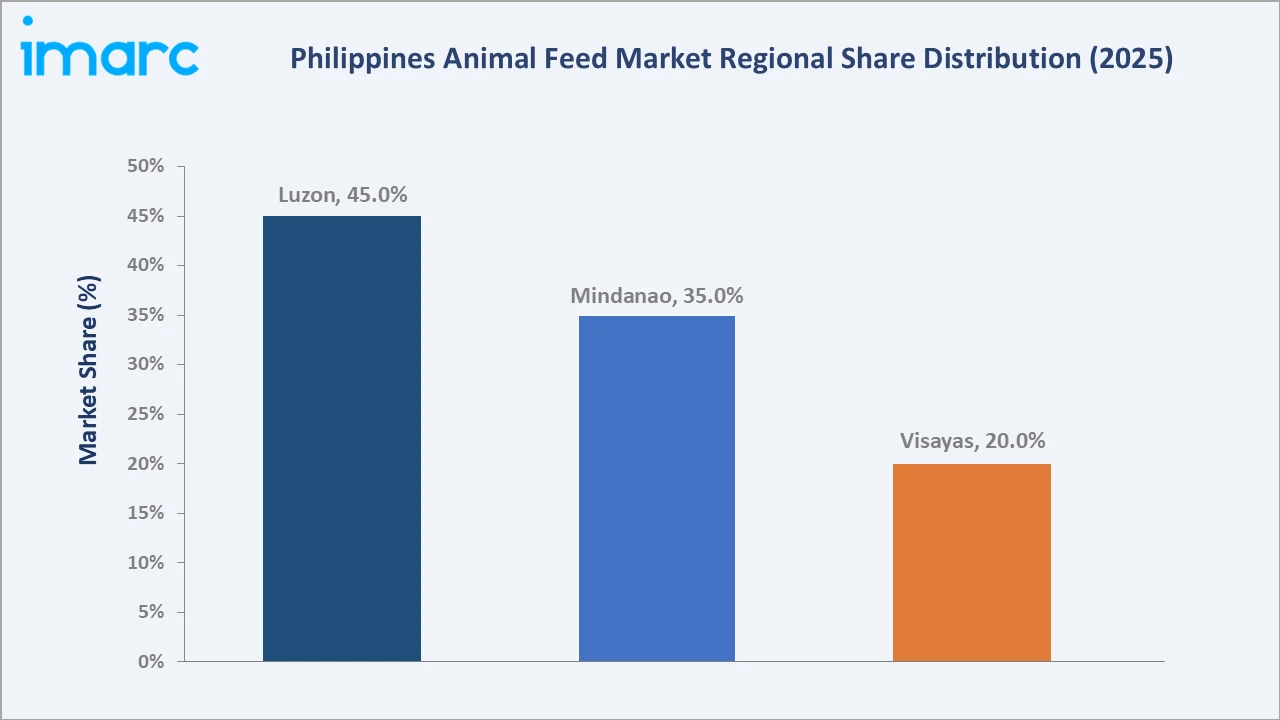
Visayas accounts for 20.0%, with a balanced mix of commercial and small-scale farming operations. Cebu and Leyte host growing aquaculture operations that support demand for marine protein-based aquafeeds.
Competitive Landscape
The Philippines animal feed market is moderately concentrated, with major integrated agribusiness conglomerates holding dominant positions in the organized commercial segment. The market is characterized by vertically integrated players combining feed manufacturing with upstream ingredient processing and downstream animal production.
| Company | Key Brands | Market Position | Core Strength |
|---|---|---|---|
| San Miguel Corporation | B-MEG | Market Leader | Philippines' largest integrated agribusiness and animal feed operations, leveraging integrated grain processing and distribution infrastructure. |
| Cargill, Incorporated | Provimi | Challenger | Global agribusiness subsidiary with aquaculture and poultry feed expertise, expanding Mindanao production capacity. |
| Universal Robina Corporation | UNO+, Infinity, Stargain, StarBro, StarLayer, StarDuck, StarQuail | Challenger | Diversified agribusiness integrating flour milling, animal feed manufacturing, and processed food operations. |
| Charoen Pokphand Foods PCL | Chicken Feeds, Swine Feeds, Duck Feed, Shrimp Feed, Herbivorous Feed, Catfish Feed, Sea Bass Feed | Innovator | Thai-based integrated agribusiness with Philippine operations spanning feed manufacturing, contract farming, and processed food, bringing global feed nutrition expertise. |
| Biotech Farms, Inc | Biotech Feeds | Emerging Player | Mindanao-based feed producer and poultry integrator, expanding aquaculture and poultry feed production through regional investment partnerships. |
Key players include San Miguel Corporation, Cargill, Incorporated, Universal Robina Corporation, Charoen Pokphand Foods PCL, Biotech Farms, Inc, and others.
Key Company Profiles
San Miguel Corporation
San Miguel Corporation is the Philippines' largest integrated agribusiness conglomerate and the dominant player in the domestic animal feed market through its B-MEG brand. B-MEG is the Philippines' most recognized compound feed brand, serving commercial poultry, swine, and aquaculture producers nationwide through a national distribution network.
- Key Brands: B-MEG
- Strategic Focus: Maintaining market leadership through national feed distribution, integrated farm-to-fork value chain control, and continued investment in feed formulation technology and production capacity. B-MEG is investing in precision feed formulation capabilities to develop customized rations for specific production performance targets across its commercial poultry and swine contract farming base.
Cargill, Incorporated
Cargill, Incorporated is one of the world's largest agribusiness companies. In the Philippines, Cargill operates feed production facilities serving commercial poultry, swine, and aquaculture farmers and is actively expanding production capacity.
- Key Brands: Provimi
- Recent Developments: In June 2025, Cargill has partnered with Biotech Farms to establish a dedicated animal feed production line at the Biotech Agro-Industrial Complex in Tantangan, South Cotabato, Mindanao, Philippines. The collaboration aims to strengthen Cargill's regional presence and improve the availability, quality, and reliability of animal nutrition solutions for local farmers and agribusinesses.
- Strategic Focus: Expanding aquaculture and poultry feed production in Mindanao, leveraging global nutrition expertise and ingredient sourcing capabilities to offer technically superior compound feeds. Global ingredient procurement through Cargill's integrated commodity trading infrastructure provides Philippine feed operations with cost-competitive access to corn, soybean meal, and specialty additives.
Market Concentration Analysis
The Philippines animal feed market is moderately concentrated, with a leading integrated conglomerate holding the largest single-company market share in the organized compound feed segment, supported by captive integrated farm demand and a national distribution network. Key challengers compete in specific geographic markets through technical formulation expertise, regional production capacity, and integrated animal production models.
Concentration is expected to increase moderately over the forecast period as large integrated conglomerates expand production capacity, vertical integration deepens, and smaller regional feed mills face cost pressure from commodity price volatility. International players continue to compete through technical feed formulation and integrated farming models, maintaining a competitive multi-player market structure with differentiated positioning.
Investment & Growth Opportunities
Highest Growth Segments
Additives represent the fastest-growing ingredient segment at 3.5% CAGR, followed by fish oil and fish meal at 3.0% and oilseed meal at 2.5%. Cereals are projected to grow at 2.2%, while molasses records comparatively slower growth at 1.8%.
Emerging Investment Opportunities
Aquaculture feed production in Mindanao is the fastest-growing feed market segment, driven by milkfish, shrimp, and tilapia production growth. Natural feed additive distribution partnerships offer high-margin revenue streams as Philippine feed operators transition toward antibiotic-free production. Premium feed formulation capability development targeting large-scale commercial integrators provides opportunities for technically differentiated market positioning.
Investment Themes
- Aquafeed production capacity investment in Mindanao to serve the Philippines' fastest-growing livestock sub-sector: commercial aquaculture expansion is creating structural demand for high-quality pelleted aquafeeds, supporting feed mill investment in strategically located Mindanao production facilities close to expanding fish farm zones.
- Natural and functional feed additive distribution to serve rising antibiotic-alternative demand: Philippine feed operators face increasing consumer and regulatory pressure to reduce antibiotic use, creating a growing commercial market for natural additives, phytogenic compounds, and probiotics that support animal health and performance.
Future Market Outlook (2026-2034)
The Philippines animal feed market is projected to grow from USD 2.22 Billion in 2025 to USD 2.28 Billion in 2026, reaching USD 2.79 Billion by 2034, registering a CAGR of 2.50% during 2026-2034. The market anchor value of USD 2.51 Billion in 2030 reflects continued structural growth driven by poultry and aquaculture expansion, ingredient import rationalization, and feed formulation premiumization. Growth momentum through 2034 will be reinforced by expanding aquaculture feed demand and rising adoption of functional feed additives.
Three structural forces define the Philippines animal feed market through 2034: expanding commercial poultry and aquaculture production, increasing adoption of high-performance feed additives and formulation innovations, and Mindanao's emergence as a major feed production and consumption hub driven by regional agricultural development. The transition from backyard to commercial farming, supported by government modernization programs, will progressively expand the addressable organized feed market.
Research Methodology
Primary Research
Primary research comprised structured interviews with Philippines animal feed industry stakeholders, including feed mill operations managers, commercial farm purchasing directors, BAI-accredited nutritionists, commodity traders, and aquaculture sector representatives across Luzon, Visayas, and Mindanao. Industry expert consultations and commercial farm visits provided primary validation of market sizing assumptions, growth drivers, and competitive dynamics.
Secondary Research
Secondary research encompassed Philippines Bureau of Animal Industry feed production data, PSA agricultural statistics, USDA GAIN Philippines agricultural reports, industry association publications, company annual reports, and over 40 secondary sources covering livestock, aquaculture, and agribusiness developments. International commodity price databases and trade statistics were used to validate ingredient market assessments.
Forecasting Models
Market revenue forecasts were developed using a sectoral animal inventory model: commercial animal population by species multiplied by average feed intake, feed conversion efficiency, and compound feed penetration rate, aggregated across poultry, swine, aquaculture, and ruminant sectors with a price-volume reconciliation at feed mill gate.
Philippines Animal Feed Market Report Coverage:
| Report Features | Details |
|---|---|
| Base Year of the Analysis | 2025 |
| Historical Period | 2020-2025 |
| Forecast Period | 2026-2034 |
| Units | Billion USD |
| Scope of the Report |
Exploration of Historical Trends and Market Outlook, Industry Catalysts and Challenges, Segment-Wise Historical and Future Market Assessment:
|
| Forms Covered | Pellets, Crumbles, Mash, Others |
| Animal Types Covered |
|
| Ingredients Covered |
|
| Regions Covered | Luzon, Visayas, Mindanao |
| Companies Covered | San Miguel Corporation, Cargill, Incorporated, Universal Robina Corporation, Charoen Pokphand Foods PCL, Biotech Farms, Inc, etc. |
| Customization Scope | 10% Free Customization |
| Post-Sale Analyst Support | 10-12 Weeks |
| Delivery Format | PDF and Excel through Email (We can also provide the editable version of the report in PPT/Word format on special request) |
Key Benefits for Stakeholders:
- IMARC’s industry report offers a comprehensive quantitative analysis of various market segments, historical and current market trends, market forecasts, and dynamics of the Philippines animal feed market from 2020-2034.
- The research report provides the latest information on the market drivers, challenges, and opportunities in the Philippines animal feed market.
- Porter's Five Forces analysis assists stakeholders in assessing the impact of new entrants, competitive rivalry, supplier power, buyer power, and the threat of substitution. It helps stakeholders to analyze the level of competition within the Philippines animal feed industry and its attractiveness.
- Competitive landscape allows stakeholders to understand their competitive environment and provides an insight into the current positions of key players in the market.
Frequently Asked Questions About the Philippines Animal Feed Market Report
The Philippines animal feed market size is estimated at USD 2.28 Billion in 2026, driven by expanding commercial poultry, swine, and aquaculture production and rising per-capita protein consumption. Growing demand for compound feeds in commercial operations and increasing feed additive adoption further support market expansion.
The Philippines animal feed market grows at a CAGR of 2.50% during 2026-2034, reaching USD 2.79 Billion by 2034. Growth is sustained by poultry and aquaculture expansion, rising protein consumption, and increasing premiumization of feed additives and nutritional supplements.
Pellets lead at 55.0% through superior feed conversion efficiency, reduced wastage, and structural suitability for large-scale commercial poultry and swine operations that represent the primary demand base for compound feeds in the Philippines.
Cereals lead at 35.0% through corn's central role as the primary energy ingredient in Philippine feed rations. Domestic corn production and imports together supply the Philippines' feed grain requirements, with corn forming the foundational carbohydrate and energy source across poultry, swine, and aquaculture rations.
Luzon leads at 45.0% through its concentration of commercial poultry and swine farms, feed mill infrastructure, and ingredient import logistics centered around Manila Bay and Central Luzon agricultural zones.
Leading companies include San Miguel Corporation, Cargill, Incorporated, Universal Robina Corporation, Charoen Pokphand Foods PCL, Biotech Farms, Inc, and others.
The Philippines animal feed market is projected to reach approximately USD 2.51 Billion by 2030, with aquafeed and feed additives growing above the overall market rate as Mindanao's aquaculture expansion and natural additive adoption advance.
Need more help?
- Speak to our experienced analysts for insights on the current market scenarios.
- Include additional segments and countries to customize the report as per your requirement.
- Gain an unparalleled competitive advantage in your domain by understanding how to utilize the report and positively impacting your operations and revenue.
- For further assistance, please connect with our analysts.
 Request Customization
 Speak to an Analyst
 Request Brochure
 Inquire Before Buying
Benefits of Customization
- Personalize this research
- Triangulate with your data
- Get data as per your format and definition
- Gain a deeper dive into a specific application, geography, customer, or competitor
- Any level of personalization
Get in Touch With Us
UNITED STATES
Phone: +1-201-971-6302
INDIA
Phone: +91-120-433-0800
UNITED KINGDOM
Phone: +44-753-714-6104
Email: [email protected]
Client Testimonials



















Related Reports

Choose your plan
*Please note that the prices mentioned below are starting prices for each bundle type. Kindly contact our team for further details.*
Single User License
- 1 User License, Access on 2 Devices
- PDF Report + Excel Dataset (Password Protected)
- Lifetime Access
- No Printing Rights
- 10% Free Report Customization
- 10–12 Weeks of Analyst Support
Five User License
- Access for 5 Users, 2 Devices per User
- PDF Report + Excel Dataset (Password Protected)
- Lifetime Access
- Dedicated Account Manager
- 12–14 Weeks of Analyst Support
- No Printing Rights
- 15% Free Report Customization
- 25% Discount on Your Next Purchase
Corporate User License
- Unlimited User Access (Within Your Organization)
- PDF Report + Excel Dataset
- Lifetime Access
- Dedicated Account Manager
- 14–20 Weeks of Analyst Support
- No Printing Rights
- 20% Free Report Customization
- 30% Discount on Your Next Purchase
Essential Insights
What's included:
3 reports
- Lifetime Access
- PDF Reports
- Excel Datasets
- 2 Weeks of Free Analyst Support
- 2 User Licenses
- Access on 2 Devices
- Printing Rights
- Complimentary PowerPoint (PPT) Version
- Complimentary License Upgrade
Professional Access
What's included:
5 reports
- Lifetime Access
- PDF Reports
- Excel Datasets
- 8 Weeks of Free Analyst Support
- 2 User Licenses
- Access on 2 Devices
- Printing Rights
- Complimentary PowerPoint (PPT) Version
- Complimentary License Upgrade
Business Advantage
What's included:
8 reports
- Lifetime Access
- PDF Reports
- Excel Datasets
- 14 Weeks of Free Analyst Support
- 2 User Licenses
- Access on 2 Devices
- Printing Rights
- Complimentary PowerPoint (PPT) Version
- Complimentary License Upgrade
Enterprise Intelligence
What's included:
10 reports
- Lifetime Access
- PDF Reports
- Excel Datasets
- 20 Weeks of Free Analyst Support
- 2 User Licenses
- Access on 2 Devices
- Printing Rights
- Complimentary PowerPoint (PPT) Version
- Complimentary License Upgrade