
North America Sodium Chlorate Market Size, Share, Trends and Forecast by Form, Application, and Country, 2026-2034
North America Sodium Chlorate Market Summary:
The North America sodium chlorate market size reached 2.57 Million Tons in 2025 and is projected to reach 2.95 Million Tons by 2034, growing at a compound annual growth rate of 1.54% from 2026-2034.
In North America, the market is experiencing steady expansion, driven by the region’s well-established pulp and paper industry, which remains the primary consumer of sodium chlorate for chlorine dioxide-based bleaching. The increasing adoption of elemental chlorine-free bleaching processes across North American pulp mills is reinforcing consistent demand for this essential industrial chemical. The growing emphasis on sustainable packaging solutions, driven by both consumer preferences and regulatory mandates, is encouraging greater production of bleached pulp for eco-friendly paper products.
Key Takeaways and Insights:
- By Form: Crystalline dominates the market with a share of 68% in 2025, owing to its superior purity and stability that make it highly suitable for industrial-scale pulp bleaching and water treatment applications. Its ease of storage and consistent quality further reinforce its preference among large-scale manufacturers across North America.
- By Application: Pulp and bleaching industry leads the market with a share of 60% in 2025, driven by the extensive use of sodium chlorate as a precursor for chlorine dioxide in elemental chlorine-free bleaching processes. Sustained demand from packaging and tissue paper production continues to reinforce this segment’s leadership.
- By Country: United States represents the largest country with 78% share in 2025, supported by its substantial pulp and paper production capacity, stringent water treatment regulations, and diversified industrial applications, spanning chemical manufacturing and textile processing.
- Key Players: Key players drive the North America sodium chlorate market by investing in energy-efficient production technologies, expanding manufacturing capacities, strengthening distribution networks, and forming long-term supply agreements with pulp mills to ensure reliable availability and meet growing regional demand.
The North America sodium chlorate market is advancing, as the region’s industrial sector increasingly relies on efficient and environmentally compliant chemical processes. A major catalyst shaping this growth is the continued dominance of elemental chlorine-free bleaching technology in the pulp and paper industry, which depends on sodium chlorate for on-site chlorine dioxide generation. In September 2025, Georgia-Pacific announced a USD 800 Million capital project to modernize and expand its Alabama River Cellulose mill in Perdue Hill, Alabama, increasing production capacity by approximately 300 Tons per day to nearly 1 Million Tons of fluff and market pulps annually. Such large-scale investments in pulp infrastructure are reinforcing demand for sodium chlorate-based bleaching chemicals. Expanding applications in municipal water disinfection, metal chlorate production, and dye manufacturing are further diversifying the consumption base and supporting long-term market resilience across the region.
North America Sodium Chlorate Market Trends:
Rising Demand for Sustainable Packaging Solutions
North America is witnessing an accelerating shift towards eco-friendly packaging, driving increased demand for bleached pulp produced using sodium chlorate-derived chlorine dioxide. Regulatory mandates restricting single-use plastics and growing consumer preferences for recyclable paper-based packaging are encouraging pulp producers to expand output. For instance, the American Forest and Paper Association reported that United States packaging paper capacity expanded by 4.6% in 2024, reflecting strong investment momentum in sustainable packaging grades. This trend is creating sustained consumption of sodium chlorate as mills scale up elemental chlorine-free bleaching operations to meet rising packaging demand.
Energy-Efficient Manufacturing and Green Production Initiatives
Sodium chlorate producers across North America are increasingly investing in energy-efficient electrolysis technologies and renewable energy integration to reduce production costs and carbon emissions. Advanced membrane cell technology is enhancing yield rates while lowering electricity consumption, a critical factor given that energy constitutes a major share of production costs. These green production initiatives are positioning manufacturers to meet evolving sustainability benchmarks and maintain competitive advantages, supporting the North America sodium chlorate market growth across the forecast period.
Expanding Water Treatment Applications
The use of sodium chlorate as a precursor for chlorine dioxide in municipal and industrial water treatment is gaining traction in North America. Stricter water quality regulations and growing public health concerns are driving utilities to adopt chlorine dioxide-based disinfection, which offers superior pathogen control without forming harmful trihalomethane byproducts. The increasing need to treat complex contaminants, such as biofilms, iron, and manganese, is further supporting the use of chlorine dioxide systems. Industrial sectors, including food manufacturing and cooling water treatment, are also expanding adoption to improve operational efficiency and hygiene standards.
Market Outlook 2026-2034:
The North America sodium chlorate market is poised for steady growth over the forecast period, supported by resilient demand from the pulp and paper industry, expanding water treatment applications, and increasing adoption of sustainable manufacturing practices. The market size was estimated at 2.57 Million Tons in 2025 and is expected to reach 2.95 Million Tons by 2034, reflecting a compound annual growth rate of 1.54% over the forecast period 2026-2034. Ongoing investments in pulp mill modernization and capacity expansion across the United States and Canada are expected to sustain sodium chlorate consumption. The continued transition towards elemental chlorine-free bleaching processes, combined with broadening applications in water disinfection and specialty chemical manufacturing, will further strengthen demand.
North America Sodium Chlorate Market Report Segmentation:
|
Segment Category |
Leading Segment |
Market Share |
|
Form |
Crystalline |
68% |
|
Application |
Pulp and Bleaching Industry |
60% |
|
Country |
United States |
78% |
Form Insights:
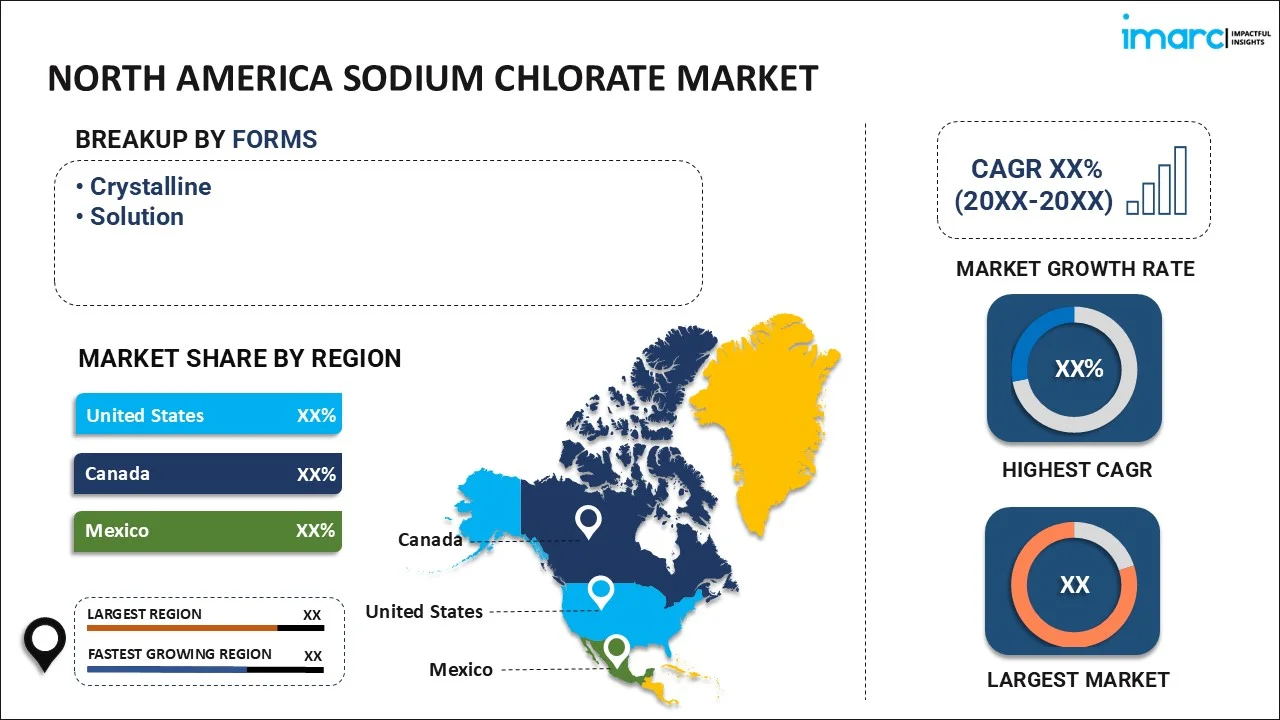
To detailed segment analysis of this market, Request Sample
- Crystalline
- Solution
Crystalline dominates with a market share of 68% of the total North America sodium chlorate market in 2025.
The crystalline form of sodium chlorate holds the dominant position in the North America market, valued for its high purity, excellent stability, and superior handling characteristics that make it particularly suitable for large-scale industrial operations. In the pulp and paper industry, where consistent quality and dependable performance are essential, crystalline sodium chlorate is widely used for on-site chlorine dioxide generation. Its granular form makes safe long-distance transportation, effective storage, and accurate dosage possible.
Ongoing developments in crystallization technology, which have increased yield rates, decreased manufacturing costs and allowed producers to offer reasonable prices without sacrificing quality, further support the demand for crystalline sodium chlorate. The crystalline form is preferred by industrial end users in the mining, chemical production, and water treatment industries because of its adaptability and compatibility with different dissolution methods. Furthermore, crystalline sodium chlorate's extended shelf life lowers the possibility of material deterioration, enabling continuous operations in high-throughput facilities.
Application Insights:
- Pulp and Bleaching Industry
- Chlorates of Other Metals
- Leather Tanning
- Dyes
- Others
Pulp and bleaching industry leads with a share of 60% of the total North America sodium chlorate market in 2025.
The pulp and bleaching industry represents the largest application segment for sodium chlorate in North America, driven by the extensive use of chlorine dioxide as the primary bleaching agent in elemental chlorine-free pulp production. North America’s pulp and paper sector is among the most mature globally. This substantial production base creates consistent and sizeable demand for sodium chlorate, which serves as the essential precursor for chlorine dioxide generated on-site at pulp mills. Environmental regulations mandating cleaner bleaching processes further solidify this segment’s leadership position.
The demand for bleached pulp is rising throughout the region as a result of the packaging and tissue paper industries' steady expansion. The pulp and bleaching industries are using sodium chlorate as a result of investments in mill modernization and capacity growth. The industry gains from the region's well-established supply chain infrastructure, which links pulp mills in the United States with Canadian chlorate producers via effective rail and truck distribution networks. Stable demand and continuous operations are further guaranteed by long-term supply agreements between manufacturers and mills.
Country Insights:
- United States
- Canada
- Mexico
United States represents the largest region with a 78% share of the total North America sodium chlorate market in 2025.
The United States commands the dominant position in the North America sodium chlorate market, supported by its extensive pulp and paper production infrastructure, stringent environmental regulations, and diversified industrial applications. Beyond pulp and paper, the United States benefits from expanding water treatment chemicals demand. As per IMARC Group, the United States water treatment chemicals market size reached USD 10,157.2 Million in 2025. Municipal water utilities are increasingly adopting chlorine dioxide-based disinfection systems, creating additional demand channels. The country’s significant investments in pulp mill modernization are further strengthening consumption patterns.
Large-scale sodium chlorate production and distribution are supported by the nation's dependable domestic supply chains and well-established chemical manufacturing base. Consistent availability and cost effectiveness are guaranteed by robust logistical connectivity between producers and end-use sectors. Additionally, the application area is expanding due to the increasing focus on water reuse and hygiene standards in municipalities and industrial institutions. The United States' dominant position in the North America sodium chlorate market is further supported by stable regulatory monitoring and long-term infrastructure spending, which incentivize companies to increase capacity.
Market Dynamics:
Growth Drivers:
Why is the North America Sodium Chlorate Market Growing?
Sustained Demand from the Pulp and Paper Industry
In North America, the pulp and paper sector remains one of the biggest users of sodium chlorate since it is necessary for the on-site production of chlorine dioxide, which is utilized in elemental chlorine-free pulp bleaching. For suppliers of sodium chlorate, the region's established pulp and paper production base, especially in the United States and Canada, offers a steady and dependable demand environment. As mills raise output to meet expanding end user demands, the production of tissue, packaging, and specialty paper continues to grow, further boosting consumption. Steady production momentum is reflected in high operating activity across paper mills, which directly supports the continued use of sodium chlorate in bleaching operations. In parallel, the shift towards sustainable and recyclable packaging solutions is encouraging greater reliance on high-quality bleached pulp, especially for food packaging, hygiene products, and premium paper grades.
Expanding Applications in Water Treatment and Disinfection
In water treatment applications, sodium chlorate is becoming more popular as a precursor chemical for the production of chlorine dioxide. Chlorine dioxide-based disinfection systems are gaining traction among industrial sites and municipal water utilities because they effectively eradicate infections without generating the hazardous trihalomethane and haloacetic acid byproducts that are often associated with traditional chlorination. The Environmental Protection Agency's stricter drinking water quality regulations are driving utilities to modernize their disinfection systems, opening up new markets for goods made from sodium chlorate. The market's revenue base is expanding and reliance on a single industry is decreasing, as a result of diversification outside pulp and paper applications. As aging water infrastructure across major United States and Canadian municipalities undergoes modernization, the adoption of advanced disinfection technologies utilizing sodium chlorate is expected to accelerate, supporting incremental market expansion. In May 2024, the United States Environmental Protection Agency emphasized the more than USD 11.5 Billion amount allocated for water infrastructure funding available to states via the FY24 State Revolving Fund programs, part of President Biden’s Investing in America initiative.
Rising Demand from Chemical Manufacturing and Specialty Applications
Beyond traditional uses, sodium chlorate is seeing growing demand from chemical manufacturing and niche industrial applications across North America. It is used as an oxidizing agent in the production of dyes, pigments, explosives, and certain specialty chemicals where controlled oxidation reactions are essential. As specialty chemical producers expand capacity to serve the pharmaceutical, electronic, and advanced material industries, sodium chlorate consumption is rising in parallel. Manufacturers value its consistent performance, predictable reaction behavior, and compatibility with modern automated processing systems. The shift towards higher-value specialty chemicals, rather than bulk commodities alone, is creating more stable and margin-supportive demand for sodium chlorate. Additionally, research-driven industries are increasingly adopting chlorine dioxide–based processes derived from sodium chlorate for controlled oxidation and sanitation, further broadening its industrial relevance. This diversification strengthens overall market resilience and reduces dependency on a single end-use sector.
Market Restraints:
What Challenges the North America Sodium Chlorate Market is Facing?
Volatility in Electricity Costs
Sodium chlorate production is an energy-intensive electrolytic process, making electricity costs a critical factor influencing manufacturing economics. Fluctuations in regional electricity prices across North America directly impact production margins and pricing competitiveness. Rising energy costs can erode profitability, particularly for facilities operating in provinces or states with unfavorable power rate structures. This volatility creates uncertainty for producers in long-term capacity planning and investment decisions, potentially constraining supply expansion.
Declining Demand from Graphic Paper Segment
The ongoing contraction of the printing and writing paper segment in North America is partially offsetting sodium chlorate demand growth from packaging and tissue sectors. Digital transformation and declining print media consumption continue to reduce graphic paper production. As mills producing graphic papers close or convert to other grades, the associated sodium chlorate consumption is permanently lost, creating a structural headwind for market growth.
Transportation and Regulatory Compliance Challenges
Sodium chlorate is classified as an oxidizer under transportation regulations, requiring specialized handling, packaging, and documentation for shipment by rail, truck, and sea. These stringent safety requirements increase logistics costs and complexity, particularly for cross-border shipments between Canada and the United States. Additionally, evolving trade policies and potential tariff implications on Canadian exports to the United States create uncertainty in supply chain economics, potentially disrupting established distribution patterns and increasing costs for downstream consumers.
Competitive Landscape:
The North America sodium chlorate market features a concentrated competitive landscape, characterized by a limited number of large-scale producers with vertically integrated operations. Key manufacturers compete primarily on the basis of production efficiency, supply reliability, product quality, and proximity to major pulp mill clusters. Companies are investing in energy-efficient electrolysis technologies, capacity expansions, and long-term supply agreements to strengthen their market positions. Strategic partnerships with pulp and paper mills for on-site or near-site chlorine dioxide generation facilities are becoming increasingly common, enhancing customer retention and operational integration. Competition is also shaped by geographic advantages, as producers located near low-cost electricity sources and major transportation corridors benefit from reduced operating and logistics costs that enable more competitive pricing.
North America Sodium Chlorate Market Report Coverage:
| Report Features | Details |
|---|---|
| Base Year of the Analysis | 2025 |
| Historical Period | 2020-2025 |
| Forecast Period | 2026-2034 |
| Units | Million Tons |
| Scope of the Report |
Exploration of Historical Trends and Market Outlook, Industry Catalysts and Challenges, Segment-Wise Historical and Future Market Assessment:
|
| Applications Covered | Crystalline, Solution |
| Forms Covered | Pulp and Bleaching Industry, Chlorates of Other Metals, Leather Tanning, Dyes, Others |
| Countries Covered | United States, Canada, Mexico |
| Customization Scope | 10% Free Customization |
| Post-Sale Analyst Support | 10-12 Weeks |
| Delivery Format | PDF and Excel through Email (We can also provide the editable version of the report in PPT/Word format on special request) |
Key Questions Answered in This Report
The North America sodium chlorate market reached a volume of 2.57 Million Tons in 2025.
The North America sodium chlorate market is expected to grow at a compound annual growth rate of 1.54% from 2026-2034 to reach 2.95 Million Tons by 2034.
Crystalline dominated the market with a share of 68%, owing to its high purity, excellent stability, and suitability for industrial-scale bleaching and water treatment applications across the region.
Key factors driving the North America sodium chlorate market include sustained demand from the pulp and paper industry, expanding water treatment applications, investments in pulp mill modernization, and the growing shift towards sustainable packaging solutions.
Major challenges include volatility in electricity costs affecting production economics, declining demand from the graphic paper segment, transportation regulatory complexities for oxidizer chemicals, and potential trade policy uncertainties impacting cross-border supply chains.
Need more help?
- Speak to our experienced analysts for insights on the current market scenarios.
- Include additional segments and countries to customize the report as per your requirement.
- Gain an unparalleled competitive advantage in your domain by understanding how to utilize the report and positively impacting your operations and revenue.
- For further assistance, please connect with our analysts.
 Request Customization
 Speak to an Analyst
 Request Brochure
 Inquire Before Buying
Benefits of Customization
- Personalize this research
- Triangulate with your data
- Get data as per your format and definition
- Gain a deeper dive into a specific application, geography, customer, or competitor
- Any level of personalization
Get in Touch With Us
UNITED STATES
Phone: +1-201-971-6302
INDIA
Phone: +91-120-433-0800
UNITED KINGDOM
Phone: +44-753-714-6104
Email: sales@imarcgroup.com
Client Testimonials




.webp)




.webp)












