
North America Scientific Instruments Market Size, Share, Trends and Forecast by End-Use, Type, and Country, 2026-2034
North America Scientific Instruments Market Summary:
The North America scientific instruments market size was valued at USD 14,922.45 Billion in 2025 and is projected to reach USD 18,071.78 Billion by 2034, growing at a compound annual growth rate of 2.15% from 2026-2034.
The North America scientific instruments market is experiencing notable growth driven by robust investments in pharmaceutical and biotechnology research and development (R&D), advancements in precision medicine, and expanding applications across industrial quality control and environmental monitoring. The convergence of laboratory automation technologies, artificial intelligence (AI) integration, and increasing regulatory requirements for analytical testing is creating significant opportunities for market participants across the value chain, thereby contributing to the North America scientific instruments market share.
Key Takeaways and Insights:
- By End-Use: Industrial represents the largest segment with a market share of 52% in 2025, driven by extensive utilization in pharmaceutical manufacturing quality control, chemical processing analysis, and biotechnology research applications requiring high-precision analytical instrumentation.
- By Type: Scientific analytical instruments dominate the market with a share of 60% in 2025, owing to increasing demand for high-resolution spectrometers, chromatography systems, and mass spectrometry instruments across drug discovery and quality assurance applications.
- By Country: United States leads the market with a share of 79% in 2025, supported by substantial federal research funding, concentration of pharmaceutical companies, and advanced research infrastructure across academic and industrial settings.
- Key Players: The North America scientific instruments market exhibits moderate to highly competitive intensity, with established multinational corporations competing alongside specialized instrument manufacturers across technology segments and application areas.
The North American scientific instruments market is experiencing growth, driven by various factors, including advancements in technology, increased research funding, and broader industrial applications. A major driver of this growth is the heightened emphasis on precision medicine, biotechnology, and environmental research, all of which depend on highly accurate and reliable scientific tools. Ongoing investments in R&D, particularly in the pharmaceutical and biotechnology sectors, are catalyzing the demand for cutting-edge technologies, such as mass spectrometers, chromatographs, and diagnostic instruments. Additionally, the rapid integration of automation, AI, and machine learning (ML) is improving the performance of these instruments, enabling faster and more accurate data collection and analysis. For instance, in 2025, Sandia National Laboratories advanced the U.S. Department of Energy’s Genesis Mission, utilizing AI and advanced computing to enhance national security and promote scientific breakthroughs. This collaboration between industry, academia, and national labs underscores AI's growing role in shaping the future of scientific instrumentation, further contributing to the market growth.
North America Scientific Instruments Market Trends:
Improvements in Automation and Robotics
The growing integration of automation and robotics within research and industrial sectors is catalyzing the demand for specialized scientific instruments. These instruments are required to function autonomously or semi-autonomously while maintaining high levels of accuracy and repeatability. In 2025, for instance, U.S. Secretary of Energy Chris Wright launched the Anaerobic Microbial Phenotyping Platform (AMP2) at the Pacific Northwest National Laboratory (PNNL). Developed in collaboration with Ginkgo Bioworks, AMP2 utilizes AI and automation to accelerate microbial research, supporting advancements in biotech manufacturing and scientific discovery. This trend underscores the increasing necessity for high-throughput and automated systems to meet the demands of modern research and production across industries like biotechnology, pharmaceuticals, and manufacturing.
Growing Focus on Forensic Science and Public Safety
The forensic science sector is experienced significant growth, driven by increasing investments in criminal investigations, law enforcement, and public safety. Scientific instruments play a critical role in analyzing biological samples, forensic DNA, toxicology reports, and other crucial evidence. In 2026, for instance, the Tri-County Biological Science Center in North Charleston, South Carolina, was launched to expedite DNA and drug testing for local law enforcement. This state-of-the-art forensic lab aims to reduce evidence backlogs and improve case resolution times. Such developments highlight the growing demand for advanced instruments in forensic science, further supporting the market for high-precision analytical tools in North America.
Advancements in Mass Spectrometry for Precision Medicine
The scientific instruments market is experiencing growth driven by innovations in mass spectrometry, particularly for precision medicine and biomarker discovery. As the demand for more detailed and accurate analysis increases, advanced technologies like mass spectrometers play a pivotal role. For example, at the 2025 ASMS conference in Baltimore, Thermo Fisher launched two advanced mass spectrometers, the Orbitrap Astral Zoom and Orbitrap Excedion Pro, which were designed to enhance research in proteomics, biopharmaceuticals, and complex disease biology. These instruments underscore the industry's commitment to advancing multi-omics research, ultimately accelerating the development of personalized healthcare.
Market Outlook 2026-2034:
The North America scientific instruments market shows notable growth potential over the forecast period, supported by continued R&D spending and the rising analytical needs across pharmaceutical, biotechnology, and industrial sectors. The demand for advanced testing, monitoring, and precision measurement tools remains strong as industries focus on innovation and compliance. The market generated a revenue of USD 14,922.45 Billion in 2025 and is projected to reach a revenue of USD 18,071.78 Billion by 2034, growing at a compound annual growth rate of 2.15% from 2026-2034.
North America Scientific Instruments Market Report Segmentation:
|
Segment Category |
Leading Segment |
Market Share |
|
End-Use |
Industrial |
52% |
|
Type |
Scientific Analytical Instruments |
60% |
|
Country |
United States |
79% |
End-Use Insights:
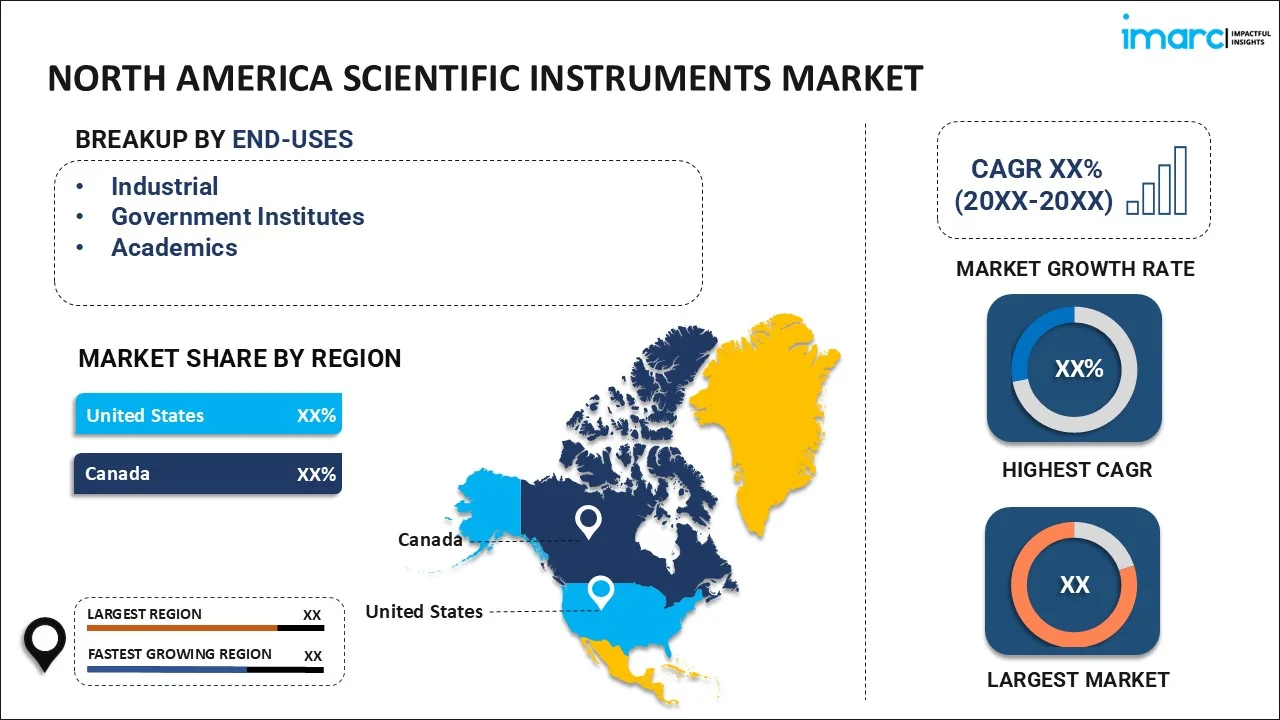
To get detailed segment analysis of this market, Request Sample
- Industrial
- Government Institutes
- Academics
Industrial dominates with a market share of 52% of the total North America scientific instruments market in 2025.
Industrial holds the biggest market share due to the strong presence of manufacturing, energy, chemicals, and aerospace industries requiring advanced measurement and testing solutions. Scientific instruments are widely used for quality control, process monitoring, and research across industrial operations. With increasing automation and precision requirements, companies invest heavily in analytical tools, sensors, and laboratory equipment. The need to meet strict regulatory and safety standards further supports high industrial demand for scientific instrumentation across the region.
The dominance of the industrial segment is also supported by the growing focus on innovation and efficiency in production environments. Industries across the United States and Canada depend on scientific tools for product innovation, environmental assessment, and material analysis. The growth of biotechnology, semiconductor production, and advanced materials research also motivates the use of instruments in industrial environments. Ongoing investments in industrial research and development along with facility upgrades guarantee that industrial users continue to represent the largest market segment.
Type Insights:
- Scientific Clinical Analyzers
- Scientific Analytical Instruments
Scientific analytical instruments lead with a market share of 60% of the total North America scientific instruments market in 2025.
Scientific analytical instruments represent the largest segment owing to their critical role in laboratory testing, research, and industrial quality control. These instruments, including spectrometers, chromatographs, and mass analyzers, are widely used in pharmaceuticals, biotechnology, environmental monitoring, and chemical industries. North America’s strong R&D ecosystem and high investment in scientific innovation drive steady demand. Laboratories and industrial facilities rely on analytical tools for accurate measurement, compliance, and advanced experimentation, supporting their leading market share.
Another factor behind the dominance of scientific analytical instruments is the region’s growing focus on precision diagnostics, drug development, and advanced material research. The United States, in particular, hosts major life sciences companies and research institutions that require cutting-edge analytical equipment. Continuous technological advancements, such as automation and high-throughput analysis, further increase adoption. With expanding applications across healthcare, food safety, and industrial testing, scientific analytical instruments remain the most widely utilized and demanded type in North America.
Country Insights:
- United States
- Canada
United States exhibits a clear dominance with a 79% share of the total North America scientific instruments market in 2025.
United States leads the market attributed to its strong base of research institutions, advanced healthcare infrastructure, and large industrial sector. High spending on R&D across pharmaceuticals, biotechnology, aerospace, and chemicals drives continuous demand for sophisticated scientific instruments. The country is home to many leading instrument manufacturers and laboratories that require high-precision analytical and testing equipment. Government funding and private investment in innovation further strengthen the United States’ leading position in the regional market.
Another reason for the dominance of United States is the rapid adoption of advanced technologies such as automation, AI-enabled diagnostics, and high-throughput analytical systems. A prime example occurred in 2025 when Siemens Healthineers unveiled new AI-enabled radiology services designed to streamline hospital operations from image acquisition to reporting. This innovation is bolstered by a dense network of elite universities and life sciences companies that drive consistent demand for high-throughput analytical systems. Furthermore, stringent regulatory standards mandate investment in precision monitoring tools, cementing the nation’s position as a hub for cutting-edge scientific instrumentation.
Market Dynamics:
Growth Drivers:
Why is the North America Scientific Instruments Market Growing?
Aging Population and Healthcare Demand
The aging population in North America is contributing to the growing demand for scientific instruments in healthcare and medical research. As the proportion of elderly individuals increases, there is a higher focus on age-related diseases, such as Alzheimer's, cardiovascular diseases, and cancer. This demographic shift is becoming more pronounced, as the number of Americans aged 65 and older is projected to rise from 58 million in 2022 to 82 million by 2050, increasing their population share from 17 percent to 23 percent. Scientific instruments play a pivotal role in the early diagnosis, monitoring, and treatment of these conditions. The need for high-precision diagnostic tools and efficient drug development platforms to address these health challenges are catalyzing the demand for medical and healthcare-related scientific instruments.
Rising Complexity of Scientific and Technical Challenges
Scientific and technical challenges faced by organizations are becoming more complex, driving the demand for advanced investigative and analytical tools. Modern research increasingly involves multifactor systems, high-resolution data, and interdisciplinary approaches, all of which depend on precise and reliable instruments. As the tolerance for uncertainty in research and industry decreases, there is a greater emphasis on tools that provide accuracy, reproducibility, and sensitivity. This growing demand for advanced instrumentation is not cyclical but structural, reflecting the evolving nature of scientific inquiry. As a result, the market is seeing notable growth due to the increasing need for instruments capable of supporting rigorous, detailed analysis across various fields of research.
Development of Smart and Connected Instruments
The emergence of smart and connected scientific instruments is significantly reshaping the North American market, driven by the growing integration of the Internet of Things (IoT) technologies. These advanced instruments enable remote monitoring, real-time data collection, and seamless integration with cloud-based platforms, offering enhanced operational efficiency. By allowing data to be tracked and analyzed remotely, they reduce downtime, improve reliability, and ensure timely maintenance. As industries increasingly emphasize connectivity, there is a rise in the demand for smart instruments that provide real-time feedback and support collaborative data-sharing. This shift is transforming traditional scientific workflows into more automated, flexible, and data-driven processes, enhancing productivity across research, healthcare, and industrial sectors.
Market Restraints:
What Challenges the North America Scientific Instruments Market is Facing?
Shortage of Skilled Professionals for Advanced Instrumentation
The lack of skilled professionals who can operate and maintain sophisticated analytical equipment presents a major obstacle to market growth. Numerous laboratories and research organizations encounter challenges in hiring proficient technicians and experts capable of efficiently handling intricate instruments. Restricted knowledge may result in ineffective use of advanced systems, greater downtime, and elevated maintenance expenses, ultimately hindering the uptake of novel analytical technologies.
High Capital Costs for Advanced Instrumentation Systems
Scientific equipment necessitates considerable financial investment for acquisition, setup, and ongoing upkeep, potentially hindering adoption by smaller research entities and financially restricted educational institutions. The elevated expenses linked to advanced technologies, such as high-resolution mass spectrometers and complex imaging systems frequently render them inaccessible to numerous users, limiting market entry and hindering demand expansion within price-sensitive end-user sectors.
Supply Chain Constraints Affecting Equipment Availability
Global supply chain disruptions impacting semiconductor components, specialized materials, and precision manufacturing capabilities create significant procurement challenges for scientific instrumentation. Extended lead times for equipment delivery and shortages of critical replacement parts can disrupt research operations and slow laboratory workflows. These constraints may hinder research continuity, increase maintenance costs, and delay the adoption of advanced analytical technologies across academic, industrial, and healthcare end-user organizations.
Competitive Landscape:
The North America scientific instruments market exhibits moderate to highly competitive intensity characterized by the presence of established multinational corporations alongside specialized instrument manufacturers competing across technology segments and application areas. Market dynamics reflect strategic positioning, ranging from comprehensive platform offerings emphasizing broad analytical capabilities to focused solutions targeting specific research applications. The competitive landscape is increasingly shaped by digital transformation initiatives, artificial intelligence integration capabilities, strategic acquisitions expanding product portfolios, and service-oriented business models providing comprehensive customer support across instrument lifecycles.
Recent Developments:
- January 2026: NASA completed testing for its BADASS mission, a sounding rocket aimed at studying "black auroras." The mission will use two key scientific instruments, icnluding CHIMPS and TIMS. CHIMPS will measure electron populations in the aurora, while TIMS will assist in studying the dynamics of the aurora's formation. These instruments will help unravel the mystery behind the black auroras
- July 2025: NASA selected Firefly Aerospace for a USD 176.7 Million CLPS mission to deliver two rovers and three science instruments to the Moon’s South Pole under the Artemis program. The mission, targeting a 2029 landing, will study lunar composition, resources like water ice, and conditions in permanently shadowed regions.
America Scientific Instruments Market Report Coverage:
| Report Features | Details |
|---|---|
| Base Year of the Analysis | 2025 |
| Historical Period | 2020-2025 |
| Forecast Period | 2026-2034 |
| Units | Billion USD |
| Scope of the Report |
Exploration of Historical and Forecast Trends, Industry Catalysts and Challenges, Segment-Wise Historical and Predictive Market Assessment:
|
| End-Uses Covered | Industrial, Government Institutes, Academics |
| Types Covered | Scientific Clinical Analyzers, Scientific Analytical Instruments |
| Countries Covered | United States, Canada |
| Customization Scope | 10% Free Customization |
| Post-Sale Analyst Support | 10-12 Weeks |
| Delivery Format | PDF and Excel through Email (We can also provide the editable version of the report in PPT/Word format on special request) |
Key Questions Answered in This Report
The North America scientific instruments market size was valued at USD 14,922.45 Billion in 2025.
The North America scientific instruments market is expected to grow at a compound annual growth rate of 2.15% from 2026-2034 to reach USD 18,071.78 Billion by 2034.
Industrial holds the largest revenue share of 52% in 2025, driven by extensive utilization in pharmaceutical manufacturing quality control, biotechnology research, and chemical processing analysis requiring high-precision analytical instrumentation.
Key factors driving the North America scientific instruments market include the significant growth of the forensic science sector, driven by increased investments in criminal investigations, law enforcement, and public safety. For example, in 2026, the Tri-County Biological Science Center in South Carolina was launched to expedite DNA and drug testing for local law enforcement, addressing evidence backlogs and improving case resolution times. Such advancements underscore the rising demand for high-precision instruments in forensic science, supporting the market for advanced analytical tools in North America.
Major challenges include shortage of skilled professionals for operating advanced instruments, high capital costs for sophisticated analytical systems, supply chain constraints affecting equipment availability, and the need for continuous training to keep pace with technological advancements.
Need more help?
- Speak to our experienced analysts for insights on the current market scenarios.
- Include additional segments and countries to customize the report as per your requirement.
- Gain an unparalleled competitive advantage in your domain by understanding how to utilize the report and positively impacting your operations and revenue.
- For further assistance, please connect with our analysts.
 Request Customization
 Speak to an Analyst
 Request Brochure
 Inquire Before Buying
Benefits of Customization
- Personalize this research
- Triangulate with your data
- Get data as per your format and definition
- Gain a deeper dive into a specific application, geography, customer, or competitor
- Any level of personalization
Get in Touch With Us
UNITED STATES
Phone: +1-201-971-6302
INDIA
Phone: +91-120-433-0800
UNITED KINGDOM
Phone: +44-753-714-6104
Email: sales@imarcgroup.com
Client Testimonials




.webp)




.webp)












