
Latin America AI in Healthcare Market Size, Share, Trends and Forecast by Offering, Technology, Application, End User, and Country, 2026-2034
Latin America AI in Healthcare Market Summary:
The Latin America AI in healthcare market size was valued at USD 0.59 Billion in 2025 and is projected to reach USD 4.43 Billion by 2034, growing at a compound annual growth rate of 25.06% from 2026-2034.
The Latin America AI in the healthcare market is registering rapid growth owing to extensive governmental investment and increasing technological adaptation in the region's healthcare infrastructure. Brazil's AI plan for the nation reveals extensive dedication to developing the region's healthcare technologies for a sustained tomorrow in terms of developing AI infrastructure, training, and certification programs for AI developers in the fields of healthcare, education, and technology. The increasing need for telemedicine services in remote and developing countries like Brazil, Mexico, Peru, and Colombia is inducing widespread adoption of AI-powered diagnostic and consultation services. Healthcare organizations are increasingly applying machine learning algorithms and natural language processing functionalities for improving healthcare decision-making, administrative tasks, and personalized patient advice. The increasing adaptation of advanced products in the healthcare sector, in conjunction with strategic collaborations between technological companies and institutions, continues to foster an extensive AI framework in the Latin America AI in healthcare market.
Key Takeaways and Insights:
- By Offering: Software dominates the market with a share of 46% in 2025, owing to the rising deployment of AI-powered platforms for data processing, medical record analytics, and healthcare management systems that enable efficient clinical workflows and enhance patient care delivery across regional healthcare facilities.
- By Technology: Machine learning leads the market with a share of 49% in 2025, driven by its widespread application in predictive analytics, diagnostic imaging interpretation, and automated clinical decision support systems that transform healthcare delivery throughout Latin American medical institutions.
- By Application: Virtual nursing assistant represents the biggest segment with a market share of 18% in 2025, reflecting growing adoption of AI-powered patient engagement tools that provide medication reminders, health monitoring, and personalized care guidance while reducing the burden on healthcare professionals.
- By End User: Pharmaceutical and biotechnology companies exhibit a clear dominance with a 35% share in 2025, leveraging AI technologies for drug discovery acceleration, clinical trial optimization, molecular analysis, and development of precision therapeutics tailored to regional patient populations.
- By Country: Brazil is the largest country with 31% share in 2025, propelled by its significant government investment in AI infrastructure, sophisticated hospital networks, flourishing ecosystem of healthtech startups, and smart alliances between top medical institutions and tech companies.
- Key Players: Key players drive the Latin America AI in healthcare market by developing innovative diagnostic platforms, expanding telemedicine capabilities, and strengthening clinical decision support systems. Their investments in research partnerships, regional infrastructure, and workforce training accelerate adoption across healthcare facilities and pharmaceutical enterprises.
The Latin America AI in healthcare market is witnessing transformative growth as healthcare systems across the region embrace artificial intelligence to address longstanding challenges in care delivery, diagnostic accuracy, and operational efficiency. Regional governments are prioritizing digital health infrastructure development, with national AI strategies directing substantial resources toward building sustainable healthcare technologies and professional training programs. Healthcare institutions are increasingly deploying AI-powered platforms that integrate machine learning algorithms and natural language processing capabilities to analyze patient data, support clinical decision-making, and streamline administrative workflows. The convergence of telemedicine expansion, wearable device integration, and medical record analytics is creating comprehensive digital health ecosystems that extend quality care to previously underserved populations. Strategic collaborations between international technology firms and regional healthcare organizations are accelerating innovation, facilitating knowledge transfer, and positioning Latin America as an emerging hub for healthcare AI development and implementation across diverse clinical applications.
Latin America AI in Healthcare Market Trends:
Expansion of AI-Powered Telemedicine Platforms
The proliferation of AI-integrated telemedicine platforms is transforming healthcare access across Latin America, particularly in underserved rural communities. These advanced systems leverage machine learning algorithms to enable remote patient consultations, real-time diagnostic support, and personalized treatment recommendations. Healthcare providers are increasingly deploying virtual care solutions that combine natural language processing with predictive analytics, allowing physicians to deliver quality medical guidance without geographical constraints. The integration of AI chatbots for initial patient triage and symptom assessment is streamlining clinical workflows, reducing wait times, and extending specialist expertise to populations previously lacking adequate medical resources, thereby strengthening the Latin America AI in healthcare market growth.
Integration of Wearable IoT Devices with Clinical AI Systems
The convergence of wearable Internet of Things devices with clinical artificial intelligence systems is emerging as a significant trend throughout the region's healthcare landscape. These connected health solutions enable continuous monitoring of vital signs, including heart rate, blood pressure, and cardiac rhythms, transmitting real-time data to AI algorithms that identify potential health anomalies. Medical institutions are adopting remote patient monitoring platforms that leverage machine learning for early detection of cardiovascular conditions and post-surgical complications. This technological integration supports proactive healthcare interventions, reduces hospital readmissions, and empowers patients to participate actively in managing their health conditions from home environments.
Advancement of AI-Driven Medical Record Analytics
Healthcare institutions across Latin America are increasingly implementing AI-powered medical record analytics platforms that transform patient data management and clinical documentation. These sophisticated systems utilize natural language processing and big data technologies to scan longitudinal health records, extract clinically relevant information, and generate comprehensive analytical reports within minutes. The advancement supports physicians in making evidence-based treatment decisions by presenting synthesized patient histories and identifying patterns that may indicate emerging health concerns. Medical facilities are recognizing the value of AI-enhanced documentation tools that reduce administrative burdens on healthcare professionals while improving diagnostic accuracy and care coordination.
Market Outlook 2026-2034:
The Latin America AI in healthcare market outlook remains optimistic as regional governments and private enterprises continue investing in digital health infrastructure and workforce development initiatives. Strategic collaborations between international technology firms and local healthcare institutions are accelerating the deployment of advanced AI solutions across clinical environments. The market generated a revenue of USD 0.59 Billion in 2025 and is projected to reach a revenue of USD 4.43 Billion by 2034, growing at a compound annual growth rate of 25.06% from 2026-2034. Expanding telemedicine adoption, increasing chronic disease prevalence requiring advanced diagnostic capabilities, and growing pharmaceutical sector investments in AI-driven drug discovery are expected to sustain market momentum. The continued development of regulatory frameworks supporting responsible AI deployment, combined with infrastructure improvements in connectivity and cloud computing, positions the region for sustained healthcare innovation and improved patient outcomes.
Latin America AI in Healthcare Market Report Segmentation:
|
Segment Category |
Leading Segment |
Market Share |
|
Offering |
Software |
46% |
|
Technology |
Machine Learning |
49% |
|
Application |
Virtual Nursing Assistant |
18% |
|
End User |
Pharmaceutical and Biotechnology Companies |
35% |
|
Country |
Brazil |
31% |
Offering Insights:
To get detailed segment analysis of this market Request Sample
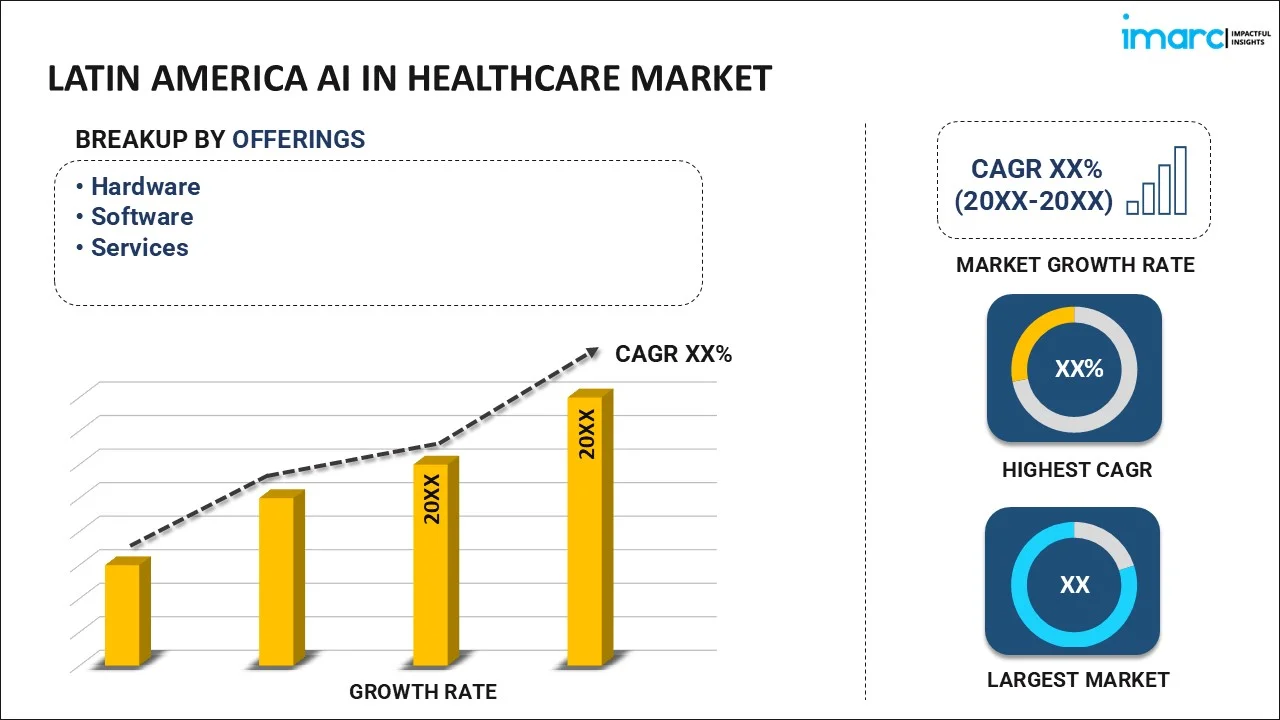
- Hardware
- Software
- Services
Software dominates with a market share of 46% of the total Latin America AI in healthcare market in 2025.
The software segment's commanding position in the Latin America AI in healthcare market reflects the essential role of AI-powered applications in transforming clinical operations and patient data management. Healthcare institutions across the region are increasingly deploying sophisticated platforms that combine machine learning algorithms with natural language processing capabilities to analyze medical records, support diagnostic decision-making, and streamline administrative workflows. In 2024, Brazil's Einstein Hospital launched an AI platform called Hstory, which scans medical records, extracts relevant data, and generates analytical reports within minutes, demonstrating the practical impact of software solutions on direct patient care.
Software solutions encompass a comprehensive range of AI applications designed specifically for healthcare environments, including electronic health record analytics systems, clinical decision support tools, telemedicine platforms, and administrative automation software. These platforms enable healthcare providers to process and interpret vast quantities of patient data with unprecedented efficiency, identifying patterns that support early disease detection and personalized treatment planning. The growing adoption of cloud-based software architectures facilitates seamless integration with existing hospital information systems while enabling real-time data sharing across healthcare networks.
Technology Insights:
- Machine Learning
- Context-Aware Computing
- Natural Language Processing
- Others
Machine learning leads with a share of 49% of the total Latin America AI in healthcare market in 2025.
Machine learning technology has established itself as the foundation of AI-driven healthcare transformation across Latin America, powering applications from diagnostic imaging analysis to predictive patient monitoring. The technology enables algorithms to learn from vast medical datasets, continuously improving their accuracy in identifying disease patterns, predicting treatment outcomes, and supporting clinical decisions. A notable example of machine learning application emerged in October 2024 when Lenovo partnered with Instituto do Coração to launch TRAdA, an AI platform using advanced algorithms for real-time cardiac arrhythmia detection through wearable devices.
The widespread adoption of machine learning in Latin American healthcare stems from its versatility in addressing diverse clinical challenges, from analyzing radiological images to optimizing drug discovery processes. Healthcare providers leverage supervised and unsupervised learning models to develop predictive analytics tools that identify high-risk patients, forecast disease progression, and recommend personalized interventions. The technology's ability to process unstructured medical data, including physician notes and research literature, significantly enhances evidence-based practice and supports informed treatment planning throughout the region's healthcare systems.
Application Insights:
- Robot-Assisted Surgery
- Virtual Nursing Assistant
- Administrative Workflow Assistance
- Fraud Detection
- Dosage Error Reduction
- Clinical Trial Participant Identifier
- Preliminary Diagnosis
- Others
Virtual nursing assistant exhibits a clear dominance with an 18% share of the total Latin America AI in healthcare market in 2025.
Virtual nursing assistants have emerged as the leading application segment, addressing the region's healthcare workforce shortages while enhancing patient engagement and care continuity. These AI-powered systems provide round-the-clock patient support through automated medication reminders, symptom assessments, health education, and appointment scheduling functions. Healthcare facilities are deploying virtual nursing platforms to extend care capabilities beyond hospital walls, supporting chronic disease management and post-discharge monitoring in home environments across Latin American communities. The technology enables patients to receive timely responses to health inquiries and guidance on managing their conditions without requiring immediate physician intervention.
The adoption of virtual nursing assistants reflects a strategic response to increasing patient volumes and rising demand for accessible healthcare services throughout the region. These intelligent systems leverage natural language processing to engage patients in conversational interactions, gathering health information and providing personalized guidance while alleviating administrative burdens on clinical staff. Virtual nursing platforms integrate seamlessly with electronic health records, ensuring that patient interactions contribute to comprehensive medical documentation and support coordinated care delivery across healthcare networks. This integration strengthens continuity of care across multiple touchpoints.
End User Insights:
- Preliminary Diagnosis
- Pharmaceutical and Biotechnology Companies
- Patients
- Others
Pharmaceutical and biotechnology companies represent the leading segment with a 35% share of the total Latin America AI in healthcare market in 2025.
Pharmaceutical and biotechnology companies have emerged as primary adopters of AI technologies in Latin America, integrating machine learning and advanced analytics across drug discovery pipelines and clinical development processes. These enterprises leverage AI-powered platforms to accelerate compound identification, predict molecular interactions, and optimize formulation development, significantly reducing the time and cost associated with bringing new therapeutics to market. The region's pharmaceutical sector recognizes AI as essential for maintaining competitive advantages in the rapidly evolving global healthcare landscape.
The substantial investment by pharmaceutical and biotechnology firms reflects the transformative potential of AI in addressing complex drug development challenges unique to Latin American patient populations. Companies are deploying machine learning algorithms to analyze genomic data, identify biomarkers, and design clinical trials optimized for regional demographics and disease profiles. AI platforms support precision medicine initiatives by enabling the development of targeted therapies tailored to specific genetic characteristics, advancing personalized treatment approaches that promise improved efficacy and reduced adverse effects for patients across the region.
Country Insights:
To get detailed segment analysis of this market Request Sample
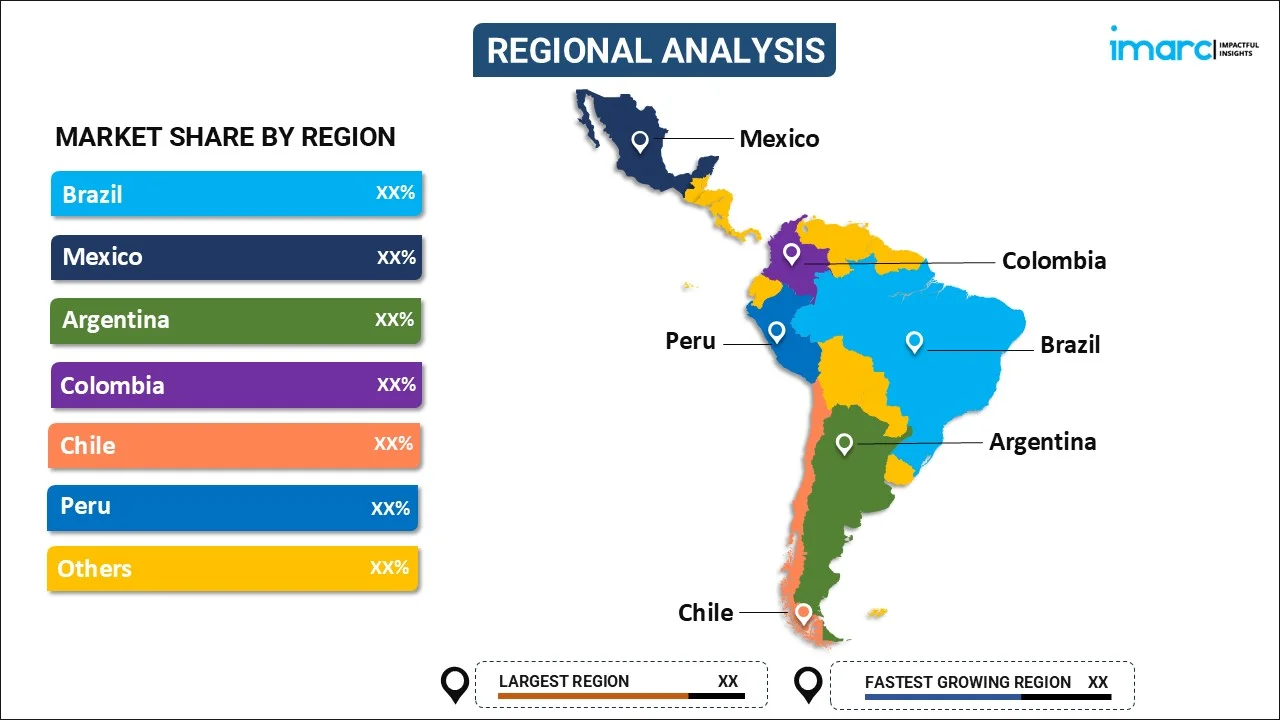
- Brazil
- Mexico
- Argentina
- Columbia
- Chile
- Peru
- Others
Brazil dominates with a market share of 31% of the total Latin America AI in healthcare market in 2025.
Brazil has established itself as the undisputed leader in Latin American healthcare AI adoption, driven by its substantial government commitment and advanced medical infrastructure. The Brazilian Artificial Intelligence Plan directs resources toward developing sustainable AI technologies across multiple sectors, including healthcare. The country hosts leading research institutions and hospitals that actively implement AI solutions for diagnostic imaging, patient care optimization, and clinical decision support. Brazil's thriving healthtech startup ecosystem, concentrated primarily in São Paulo, continues to attract significant venture capital investment.
The dominance of Brazil in the regional market reflects its comprehensive healthcare system serving a substantial population, creating considerable demand for AI-enabled efficiency improvements and care quality enhancements. The country's dual public-private healthcare structure facilitates diverse AI deployment pathways, from sophisticated private hospital networks implementing cutting-edge diagnostic tools to public health initiatives leveraging AI for population health management. Strategic partnerships between Brazilian institutions and international technology companies accelerate knowledge transfer and innovation, positioning Brazil as the regional hub for healthcare AI development and implementation.
Market Dynamics:
Growth Drivers:
Why is the Latin America AI in Healthcare Market Growing?
Accelerating Government Investment in Digital Health Infrastructure
Governments across Latin America are making substantial investments in digital health infrastructure, recognizing artificial intelligence as a strategic priority for transforming healthcare delivery and addressing systemic challenges. National AI strategies and digital health initiatives are allocating significant resources toward building technological foundations, including cloud computing capabilities, data management systems, and specialized training programs for healthcare professionals. Brazil's national artificial intelligence plan exemplifies this commitment, directing resources toward developing sustainable and socially responsible technologies across multiple government ministries including health, education, and technology. These comprehensive investment frameworks are creating favorable conditions for AI adoption by supporting infrastructure development, promoting public-private partnerships, and establishing regulatory environments that balance innovation with patient safety considerations. Government initiatives are particularly focused on extending AI-enabled healthcare services to underserved populations, using telemedicine platforms and remote diagnostic tools to bridge geographical barriers and improve healthcare access in rural and remote communities that previously lacked adequate medical resources.
Rising Demand for Telemedicine and Remote Healthcare Solutions
The escalating demand for telemedicine and remote healthcare solutions across Latin America is significantly propelling AI adoption as healthcare providers seek to extend their reach while maintaining quality care standards. Healthcare systems throughout the region face persistent challenges including physician shortages, geographical barriers to specialist access, and growing chronic disease prevalence that require scalable solutions. AI-powered telemedicine platforms address these challenges by enabling remote consultations, automated patient triage, and real-time diagnostic support that extends specialized medical expertise to patients in rural and underserved communities. The integration of machine learning algorithms into telehealth systems enhances clinical decision-making by analyzing patient data, identifying health patterns, and providing evidence-based treatment recommendations during virtual consultations. Natural language processing capabilities enable AI assistants to gather patient histories, conduct preliminary assessments, and streamline documentation processes, improving efficiency for healthcare providers while enhancing the patient experience. This growing reliance on AI-driven telemedicine solutions continues to drive market expansion as healthcare organizations recognize the technology's potential to democratize access to quality care.
Proliferation of AI-Based Healthcare Products and Strategic Partnerships
The rapid proliferation of AI-based healthcare products and the formation of strategic partnerships between technology companies, research institutions, and healthcare providers are accelerating market growth throughout Latin America. Technology firms are introducing innovative AI platforms designed specifically for regional healthcare needs, encompassing medical record analytics systems, diagnostic imaging tools, and patient monitoring solutions that enhance clinical capabilities and operational efficiency. Research institutions and universities are actively collaborating with industry partners to develop innovative AI applications that address regional disease burdens and healthcare delivery challenges unique to Latin American populations. These collaborations facilitate knowledge transfer, accelerate product development cycles, and ensure that AI solutions are validated and refined for local healthcare contexts. Strategic partnerships between international technology companies and regional healthcare organizations are bringing advanced AI capabilities to the market while building local expertise and infrastructure. The expanding ecosystem of AI healthcare products, combined with growing investment in research and development, creates a virtuous cycle of innovation that drives continued market expansion and positions Latin America as an emerging center for healthcare AI advancement.
Market Restraints:
What Challenges the Latin America AI in Healthcare Market is Facing?
Insufficient Digital Infrastructure and Connectivity Gaps
Latin America faces significant digital infrastructure limitations that constrain AI adoption in healthcare settings, particularly affecting rural and underserved regions. Many healthcare facilities lack access to reliable high-speed internet connectivity, adequate computing resources, and interoperable information systems essential for deploying sophisticated AI solutions. The region possesses limited supercomputing capacity, hindering the development and training of advanced machine learning models locally. These infrastructure gaps create disparities between urban and rural healthcare environments, limiting the transformative potential of AI technologies across the entire population.
Data Quality and Interoperability Challenges
The effectiveness of AI applications in healthcare depends critically on access to large, high-quality, and interoperable health datasets, which remain scarce across Latin America. Many healthcare systems operate with fragmented electronic medical records, inconsistent data standards, and limited information sharing capabilities between institutions. The absence of standardized health data formats and integration protocols hampers the development of AI algorithms trained on diverse and representative patient populations. Data privacy concerns and varying regulatory frameworks across countries further complicate efforts to aggregate health information necessary for developing robust and reliable AI solutions.
Healthcare Workforce Skills Gaps and Training Requirements
The successful implementation of AI in healthcare requires a workforce equipped with appropriate technical skills and understanding of AI capabilities and limitations, creating significant training challenges across Latin America. Healthcare professionals often lack familiarity with AI technologies, creating resistance to adoption and underutilization of available tools. The region experiences ongoing talent migration, depleting the pool of skilled professionals capable of developing, implementing, and maintaining AI healthcare systems. Educational institutions face challenges in adapting curricula to prepare graduates for AI-enhanced healthcare environments, perpetuating skills gaps that slow adoption.
Competitive Landscape:
The Latin America AI in healthcare market exhibits an increasingly competitive landscape characterized by the participation of global technology giants, international pharmaceutical companies, and emerging regional innovators. Market participants are pursuing diverse strategies to strengthen their positions, including investments in research and development, strategic partnerships with healthcare institutions, and expansion of service offerings tailored to regional healthcare needs. Competition is intensifying as companies seek to differentiate through specialized AI applications, localized solutions, and comprehensive ecosystem development. Global technology firms bring substantial resources and advanced AI capabilities while partnering with local organizations to adapt solutions for regional contexts and regulatory requirements. Regional startups contribute innovative approaches and deep understanding of local healthcare challenges, often focusing on specific applications such as telemedicine, diagnostic support, or patient engagement. The competitive dynamics encourage ongoing innovation, technology transfer, and investment in infrastructure development that collectively advance the market's maturation and expansion.
Latin America AI in Healthcare Market Report Coverage:
| Report Features | Details |
|---|---|
| Base Year of the Analysis | 2025 |
| Historical Period | 2020-2025 |
| Forecast Period | 2026-2034 |
| Units | Billion USD |
| Scope of the Report |
Exploration of Historical Trends and Market Outlook, Industry Catalysts and Challenges, Segment-Wise Historical and Future Market Assessment:
|
| Offerings Covered | Hardware, Software, Services |
| Technologies Covered | Machine Learning, Context-Aware Computing, Natural Language Processing, Others |
| Applications Covered | Robot-Assisted Surgery, Virtual Nursing Assistant, Administrative Workflow Assistance, Fraud Detection, Dosage Error Reduction, Clinical Trial Participant Identifier, Preliminary Diagnosis, Others |
| End Users Covered | Preliminary Diagnosis, Pharmaceutical and Biotechnology Companies, Patients, Others |
| Countries Covered | Brazil, Mexico, Argentina, Columbia, Chile, Peru, Others |
| Customization Scope | 10% Free Customization |
| Post-Sale Analyst Support | 10-12 Weeks |
| Delivery Format | PDF and Excel through Email (We can also provide the editable version of the report in PPT/Word format on special request) |
Key Questions Answered in This Report
The Latin America AI in healthcare market size was valued at USD 0.59 Billion in 2025.
The Latin America AI in healthcare market is expected to grow at a compound annual growth rate of 25.06% from 2026-2034 to reach USD 4.43 Billion by 2034.
Software dominated the market with a share of 46%, driven by the essential role of AI-powered platforms in transforming clinical operations, medical record analytics, diagnostic decision support, and administrative workflow automation across regional healthcare institutions.
Key factors driving the Latin America AI in healthcare market include accelerating government investments in digital health infrastructure, rising demand for telemedicine platforms, proliferation of AI-based healthcare products, and strategic partnerships between technology firms and healthcare institutions.
Major challenges include insufficient digital infrastructure and connectivity gaps in rural areas, data quality and interoperability limitations across healthcare systems, workforce skills gaps, regulatory uncertainties, and the significant investment requirements for implementing advanced AI solutions.
Need more help?
- Speak to our experienced analysts for insights on the current market scenarios.
- Include additional segments and countries to customize the report as per your requirement.
- Gain an unparalleled competitive advantage in your domain by understanding how to utilize the report and positively impacting your operations and revenue.
- For further assistance, please connect with our analysts.
 Request Customization
 Speak to an Analyst
 Request Brochure
 Inquire Before Buying
Benefits of Customization
- Personalize this research
- Triangulate with your data
- Get data as per your format and definition
- Gain a deeper dive into a specific application, geography, customer, or competitor
- Any level of personalization
Get in Touch With Us
UNITED STATES
Phone: +1-201-971-6302
INDIA
Phone: +91-120-433-0800
UNITED KINGDOM
Phone: +44-753-714-6104
Email: sales@imarcgroup.com
Client Testimonials




.webp)




.webp)












