
India Luxury Travel Market Size, Share, Trends and Forecast by Type of Tour, Age Group, Type of Traveller, and Region, 2026-2034
India Luxury Travel Market Size, Share, Trends & Forecast (2026-2034)
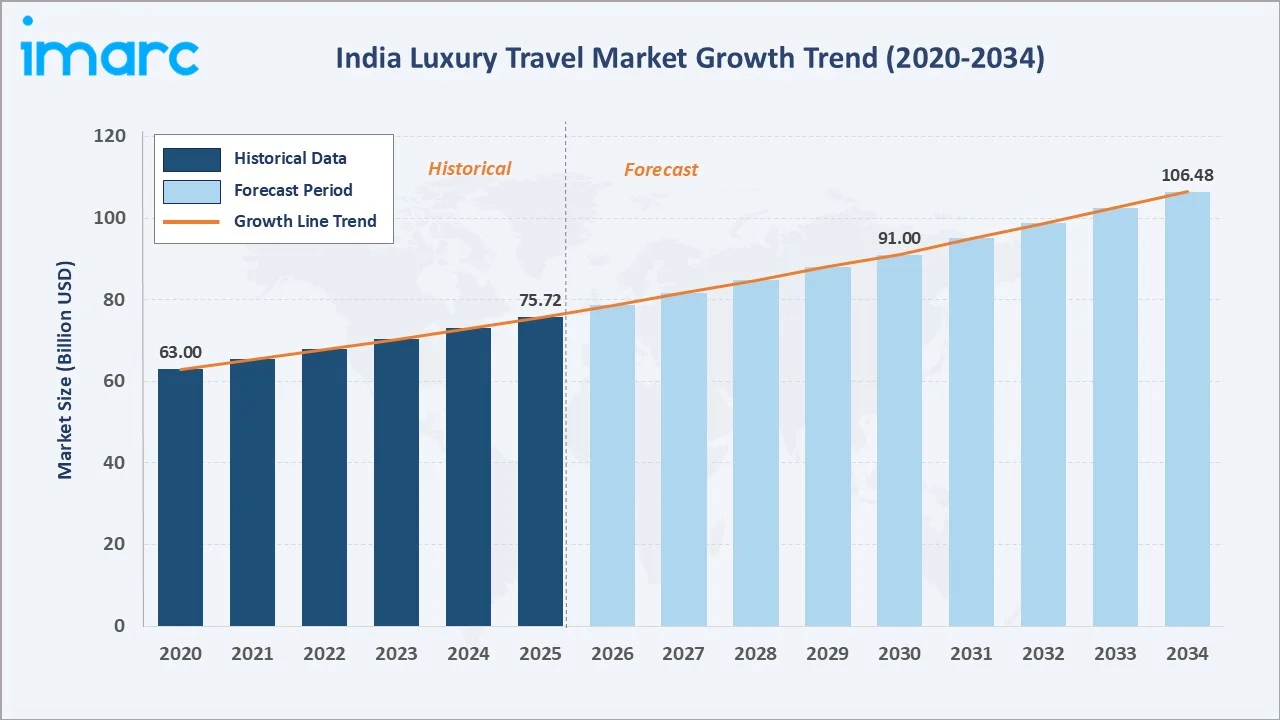
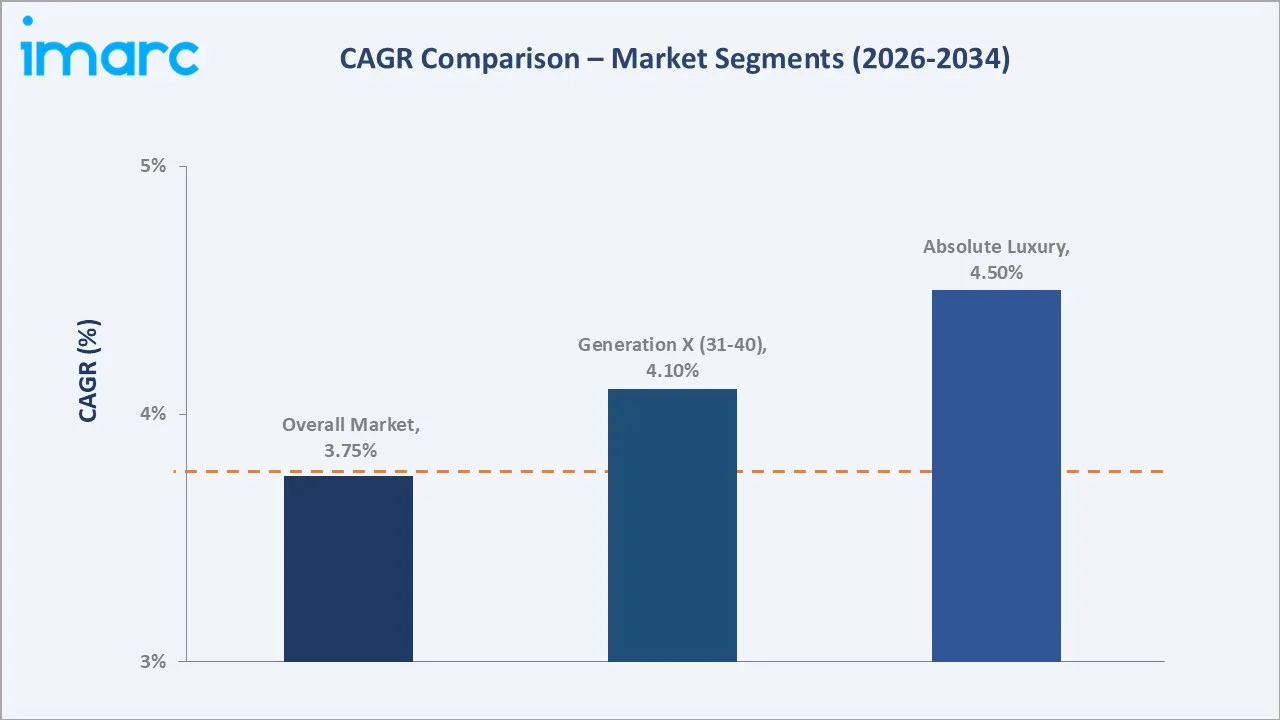
The India luxury travel market reached USD 75.72 Billion in 2025 and is projected to reach USD 106.48 Billion by 2034, growing at a CAGR of 3.75% during 2026-2034. The market is driven by rising disposable incomes, an expanding affluent middle class, increasing demand for personalized experiences, improved air connectivity, expansion of high-end hotels and resorts, government initiatives to boost tourism, and growing interest in wellness and adventure tourism across India.
Market Snapshot
|
Metric |
Value |
|
Market Size (2025) |
USD 75.72 Billion |
|
Forecast Market Size (2034) |
USD 106.48 Billion |
|
CAGR (2026-2034) |
3.75% |
|
Base Year |
2025 |
|
Historical Period |
2020-2025 |
|
Forecast Period |
2026-2034 |
|
Dominant Age Group |
Generation X (31-40) (32.6%, 2025) |
|
Dominant Type of Traveller |
Absolute Luxury (38.7%, 2025) |
|
Leading Region |
West and Central India (34.8%, 2025) |
The market expanded from USD 63.00 Billion in 2020 to USD 75.72 Billion in 2025, anchored at USD 91.00 Billion in 2030, and forecast to reach USD 106.48 Billion by 2034, reflecting sustained premiumization of India's travel sector driven by rising affluence and evolving consumer expectations.
To get more information on this market, Request Sample
West and Central India at 34.8% leads through Mumbai's large HNI outbound base, Goa's luxury coastal tourism, and MICE-driven premium demand. Generation X (31-40) dominates at 32.6% as peak-earning professionals seek curated experiential journeys. Absolute Luxury travellers at 38.7% drive the highest per-trip spend in the market.
Executive Summary
The India luxury travel market reached USD 75.72 Billion in 2025, representing one of South Asia's fastest-growing premium service sectors, driven by rising affluence, evolving consumer priorities, and increasing demand for bespoke, immersive travel experiences among high-net-worth individuals and aspirational travellers.
Generation X (31-40) at 32.6% dominates as peak-earning professionals prioritize curated journeys. Absolute Luxury travellers at 38.7% command the highest per-trip spend. West and Central India at 34.8% leads through Mumbai's HNI concentration and Goa's coastal luxury ecosystem, while North India's heritage circuits and South India's wellness retreats support broad regional growth.
Key Market Insights
|
Insight |
Data |
|
Dominant Age Group |
Generation X (31-40) – 32.6% share (2025) |
|
Dominant Type of Traveller |
Absolute Luxury – 38.7% market share (2025) |
|
Leading Region |
West and Central India – 34.8% market share (2025) |
|
Market Opportunity |
Wellness retreats, heritage circuits, luxury rail, eco-resorts, river cruises |
Key Analytical Observations Supporting the Above Data:
- Generation X (31-40) at 32.6%: The 31-40 cohort dominates as peak-earning professionals prioritize curated, culturally immersive luxury travel that reflects sophistication and personal identity. This cohort commands the highest per-trip luxury spend and drives premium hospitality demand across domestic and international routes.
- Absolute Luxury at 38.7%: The absolute luxury segment leads as ultra-HNI travellers demand bespoke itineraries, private villas, and concierge-level service, commanding the highest per-trip spend, driving premium supplier pricing, and anchoring brand positioning for India's leading luxury travel operators.
- West and Central India at 34.8%: The region dominates through Mumbai's concentration of HNI outbound travellers, Goa's established luxury coastal resort ecosystem, and strong corporate luxury travel demand from India's financial capital, reinforced by a growing affluent professional base in Pune.
India Luxury Travel Market Overview
The India luxury travel market encompasses premium and ultra-premium travel services including bespoke holiday planning, luxury accommodation, private transportation, curated cultural experiences, and exclusive wellness retreats. It caters to HNIs, affluent millennials, and aspirational travellers seeking extraordinary journeys.
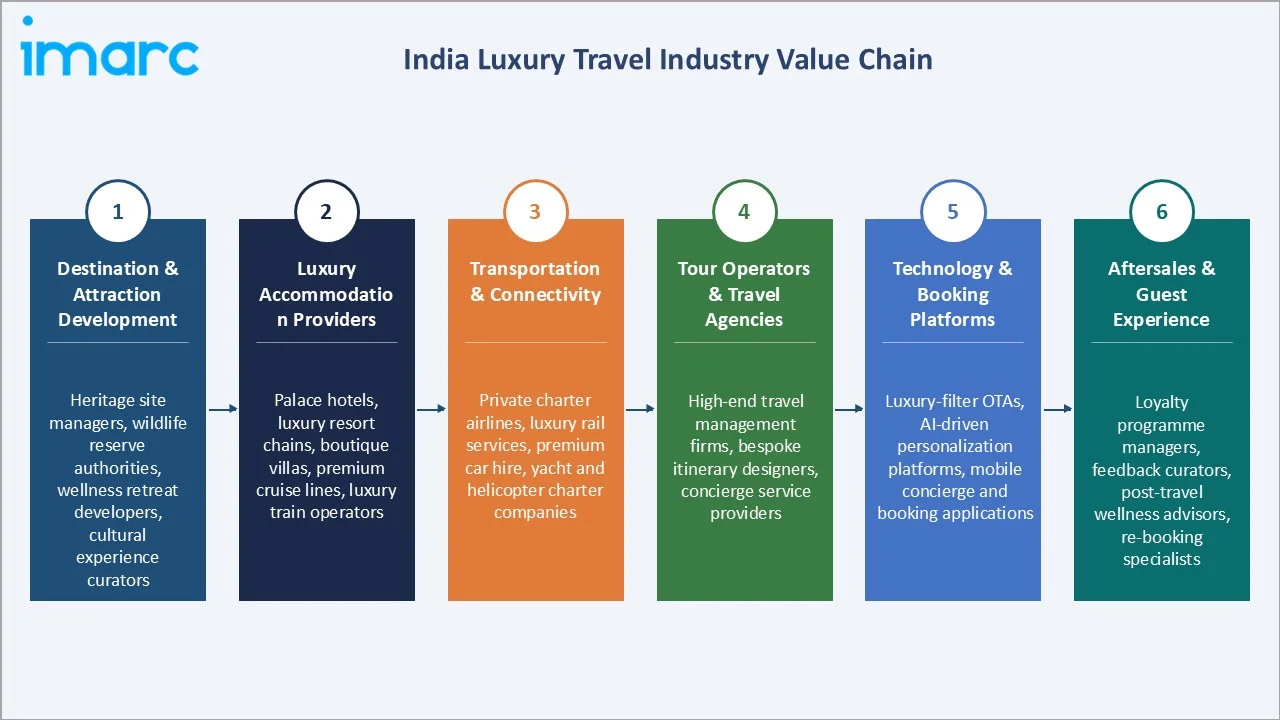
The ecosystem integrates luxury accommodation providers such as palace hotels, boutique resorts, and cruise lines, along with premium tour operators, private transportation companies, AI-driven booking platforms, and personalized concierge services, creating a seamless luxury travel value chain serving affluent consumers across India.
Market Dynamics
To evaluate market opportunities, Request Sample
Market Drivers
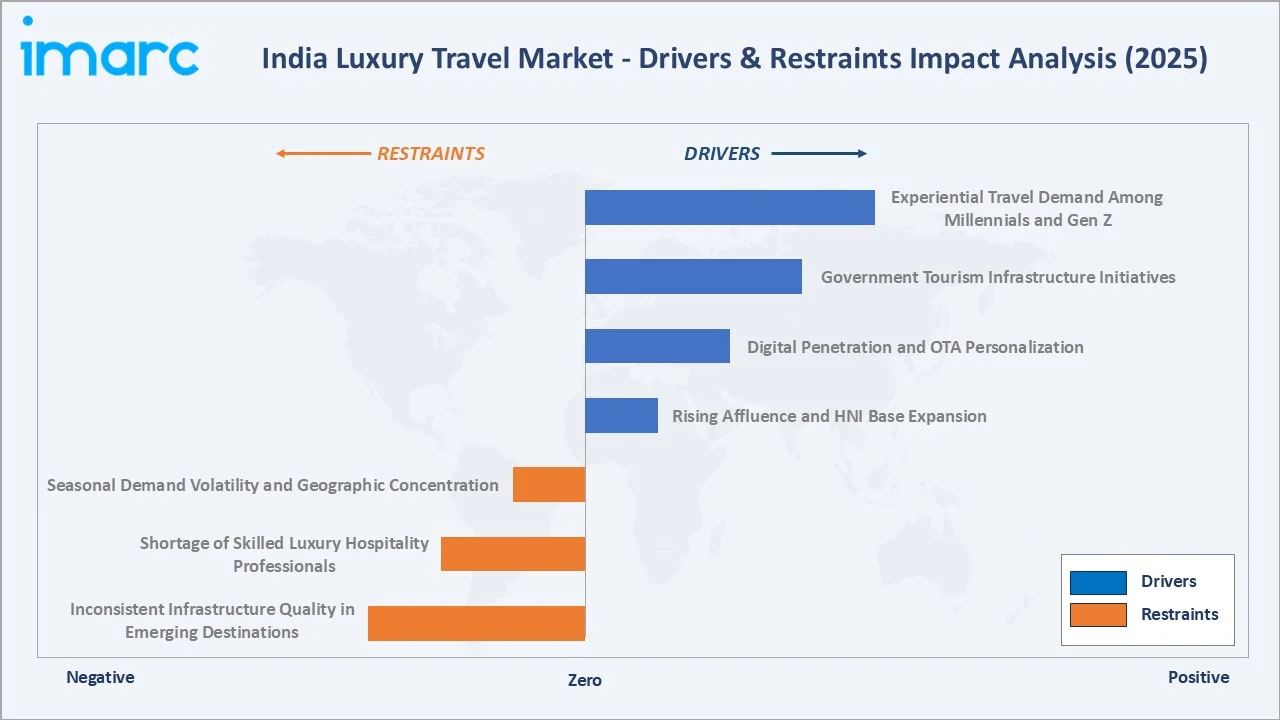
- Rising Affluence and HNI Base Expansion: India's rapidly growing base of high-net-worth individuals, fuelled by wealth creation in technology, finance, and entrepreneurship, is directly expanding the addressable market for luxury travel. The increasing number of dollar millionaires is broadening the target segment for exclusive, high-spend journeys. Luxury operators are responding with dedicated HNI-focused products, private villa packages, and bespoke concierge programmes.
- Digital Penetration and OTA Personalization: Online Travel Agencies with AI-driven personalization engines enable seamless discovery and booking of luxury experiences, boosting market accessibility among digitally engaged affluent consumers. AI-powered concierge tools and virtual destination previews are redefining luxury travel planning, driving significant OTA investment in luxury-filter capabilities and bespoke itinerary platforms.
- Government Tourism Infrastructure Initiatives: Schemes including Swadesh Darshan, PRASAD, and UDAN are enhancing luxury tourism infrastructure, regional connectivity, destination readiness across heritage, wellness, and adventure circuits. UDAN opens premium circuits in lesser-explored destinations, while heritage hotel development programmes catalyse luxury hospitality investment across tier-2 cultural destinations.
- Experiential Travel Demand Among Millennials and Gen Z: Younger affluent cohorts increasingly prioritize unique, purpose-driven, culturally immersive experiences over material possessions, accelerating demand for tailored itineraries, eco-luxury retreats, and philanthropic travel. Digital-native HNIs drive growth in adventure luxury and wildlife conservation travel, while travel agencies develop purpose-travel verticals to capture this emerging high-value segment alongside conventional luxury product lines.
Market Restraints
- Inconsistent Infrastructure Quality in Emerging Destinations: Remote or tier-2 luxury destinations often face inadequate transportation links, connectivity gaps, and limited premium amenities, constraining traveller experience and deterring investment. The disparity between established hotspots like Rajasthan and emerging destinations requires significant public-private investment with long project timelines creating near-term supply constraints.
- Shortage of Skilled Luxury Hospitality Professionals: A limited talent pool trained in delivering high-end, personalized guest experiences restricts service quality consistency, impacting luxury brand perception and limiting scale-up capacity. Indian hospitality institutions have focused on volume-service training rather than ultra-luxury guest management, leaving a significant skill gap as operators expand into new geographies.
- Seasonal Demand Volatility and Geographic Concentration: India's luxury travel market faces pronounced seasonality, with peak demand concentrated in October to March, creating revenue volatility and underutilization of premium assets during monsoon and summer months. Geographic concentration in established luxury circuits such as Rajasthan, Kerala, and Goa limits year-round demand distribution. Luxury operators face the challenge of developing compelling off-season products and diversifying into emerging destinations to stabilize revenues and maximize asset utilization across the full calendar year.
Market Opportunities
- Wellness and Ayurvedic Luxury Tourism: India's heritage of Ayurveda, yoga, and holistic wellness creates a globally differentiated luxury offering. Premium wellness retreats in Kerala, Uttarakhand, and Himachal Pradesh represent a high-growth opportunity as health-conscious HNI travellers proliferate globally, with operators developing certified Ayurvedic retreat products targeting this high-margin, repeat-visit segment.
- Luxury Cruise and River Tourism Expansion: Emerging luxury river cruise offerings on the Brahmaputra and Ganges, combined with growing ocean cruise uptake among Indian HNIs, present significant untapped opportunity. Viking's planned 2027 Brahmaputra launch signals investor confidence in India's river cruise potential, creating opportunity for purpose-built luxury vessels and multi-modal itineraries.
Market Challenges
- Global Luxury Destination Brand Competition: India competes against established luxury destinations such as France, Italy, the Maldives, and Switzerland for the international HNI traveller wallet, requiring sustained marketing investment to elevate India's global luxury brand profile. International luxury travellers have deeply embedded perceptions of alternative destinations built over decades.
- Balancing Luxury with Sustainability Expectations: Eco-conscious luxury travellers demand sustainable, low-footprint experiences, creating operational pressure on premium operators to transition from resource-intensive models while maintaining opulence standards. Meeting sustainability certifications while delivering five-star quality requires significant investment, and failure risks alienating the growing eco-conscious HNI cohort.
Emerging Market Trends
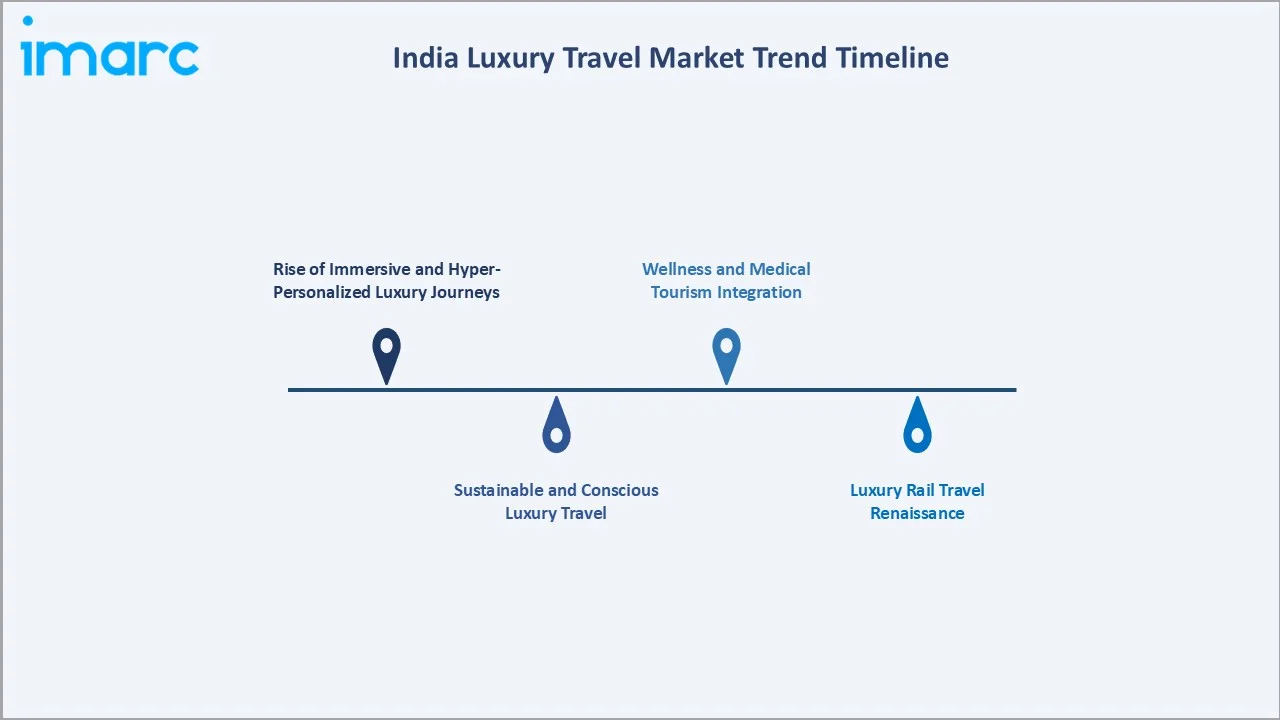
1. Rise of Immersive and Hyper-Personalized Luxury Journeys
Discerning travellers are shifting from standardized luxury packages to deeply personalized, immersive experiences. AI-powered concierge tools, bespoke itinerary designers, and private cultural access programmes are becoming the benchmark for premium Indian travel operators serving HNI clients.
2. Sustainable and Conscious Luxury Travel
Eco-luxury lodges, conservation travel experiences, and carbon-neutral itineraries are gaining traction among environmentally aware HNI travellers. Luxury operators are integrating sustainability credentials into their value proposition as a competitive differentiator in the premium market.
3. Luxury Rail Travel Renaissance
India's iconic luxury trains including the Maharajas' Express and Palace on Wheels are attracting renewed interest from both domestic and international HNI travellers. Dedicated booking platforms and curated multi-city itineraries are modernizing this niche and driving premium rail tourism growth.
4. Wellness and Medical Tourism Integration
The convergence of luxury travel with Ayurveda, yoga retreats, and preventive healthcare programmes is creating a premium wellness tourism sub-segment. Kerala and Uttarakhand are establishing themselves as global wellness tourism hubs, driving sustained year-round luxury demand.
Industry Value Chain Analysis
The India luxury travel value chain integrates destination development, premium accommodation, curated transportation, bespoke tour operations, digital booking platforms, and post-travel engagement into a seamless premium ecosystem serving HNI and aspirational affluent travellers.
|
Stage |
Key Participants |
|
Destination & Attraction Development |
Heritage site managers, wildlife reserve authorities, wellness retreat developers, cultural experience curators |
|
Luxury Accommodation Providers |
Palace hotels, luxury resort chains, boutique villas, premium cruise lines, luxury train operators |
|
Transportation & Connectivity |
Private charter airlines, luxury rail services, premium car hire, yacht and helicopter charter companies |
|
Tour Operators & Travel Agencies |
High-end travel management firms, bespoke itinerary designers, concierge service providers |
|
Technology & Booking Platforms |
Luxury-filter OTAs, AI-driven personalization platforms, mobile concierge and booking applications |
|
Aftersales & Guest Experience |
Loyalty programme managers, feedback curators, post-travel wellness advisors, re-booking specialists |
The accommodation tier is the value chain's most margin-rich stage, with palace hotels, luxury resorts, and boutique properties commanding premium average room rates. The digital platform tier is experiencing the fastest transformation as AI personalization reshapes traveller discovery and booking behaviour.
Technology Landscape in the India Luxury Travel Industry
Digital and AI-Driven Travel Personalization Technology
AI-driven personalization technology is transforming India's luxury travel landscape by enabling hyper-customized itinerary curation, real-time pricing optimization, and predictive guest preference modelling. Machine learning algorithms analyse traveller behavior, booking history, and demographic data to deliver tailored luxury experiences. Luxury OTAs and travel platforms are investing in large language model-powered concierge tools that provide 24/7 bespoke travel assistance, rivalling traditional human concierge services.
Luxury Wellness and Ayurvedic Technology Integration
Advanced wellness technology, including biometric health monitoring, personalized Ayurvedic diagnostic tools, and AI-powered wellness programme design, is being integrated into luxury retreat experiences across Kerala and Uttarakhand. Luxury resorts are adopting telemedicine-linked wellness protocols, wearable health tracking during retreats, and precision nutrition delivery aligned with Ayurvedic body-type assessments.
Sustainable Luxury Infrastructure Technology
In 2025, Miros Hotels & Resorts launched its inaugural luxury property in Central Goa incorporating advanced sustainable infrastructure including solar energy systems, water recycling facilities, and plant-based supply chain management platforms. Luxury operators are adopting carbon footprint tracking software, sustainable procurement technology, and green building management systems to meet the sustainability demands of eco-conscious HNI travellers.
Market Segmentation Analysis
The report covers the following segments:
|
Segment Category |
Leading Segment |
Market Share |
Year |
|
Type of Tour |
🔒 |
🔒 |
2025 |
|
Age Group |
Generation X (31-40) |
32.6% |
2025 |
|
Type of Traveller |
Absolute Luxury |
38.7% |
2025 |
|
Region |
West and Central India |
34.8% |
2025 |

By Age Group
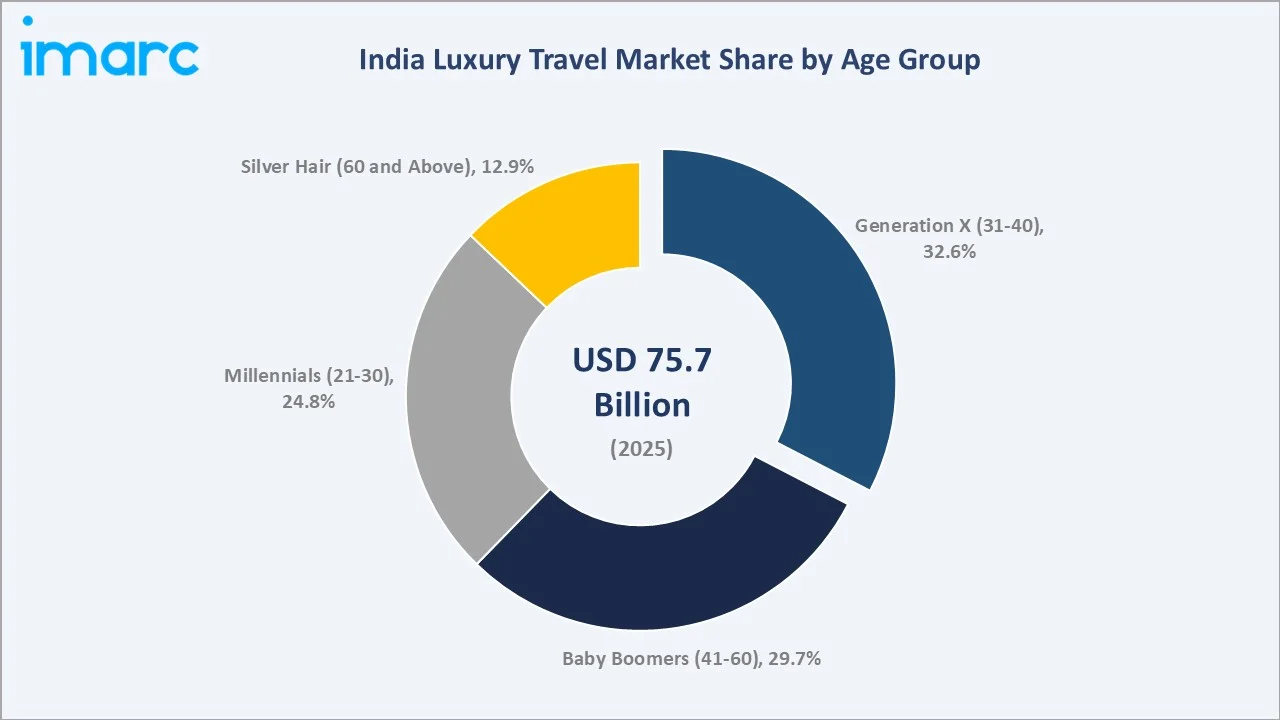
Generation X (31-40) leads at 32.6% in 2025, driven by peak earning capacity and preference for culturally immersive, curated travel that reflects sophistication and personal identity, commanding the highest per-trip luxury spend in the India luxury travel market.
To access detailed market analysis, Request Sample
Baby Boomers (41-60) at 29.7% are the market's second-largest cohort with strong disposable income and preferences for heritage, wellness, and pilgrimage-integrated luxury journeys. Millennials (21-30) at 24.8% are the fastest-growing segment as digital-native HNIs accelerate luxury travel spend. Silver Hair (60 and Above) at 12.9% represent a high-value niche with preference for accessibility-focused luxury and curated wellness-religious circuits.
By Type of Traveller
Absolute Luxury leads at 38.7% through ultra-HNI travellers demanding fully bespoke private itineraries, exclusive access, and the highest service standards across all touchpoints, driving premium supplier pricing and brand positioning across the India luxury travel market.
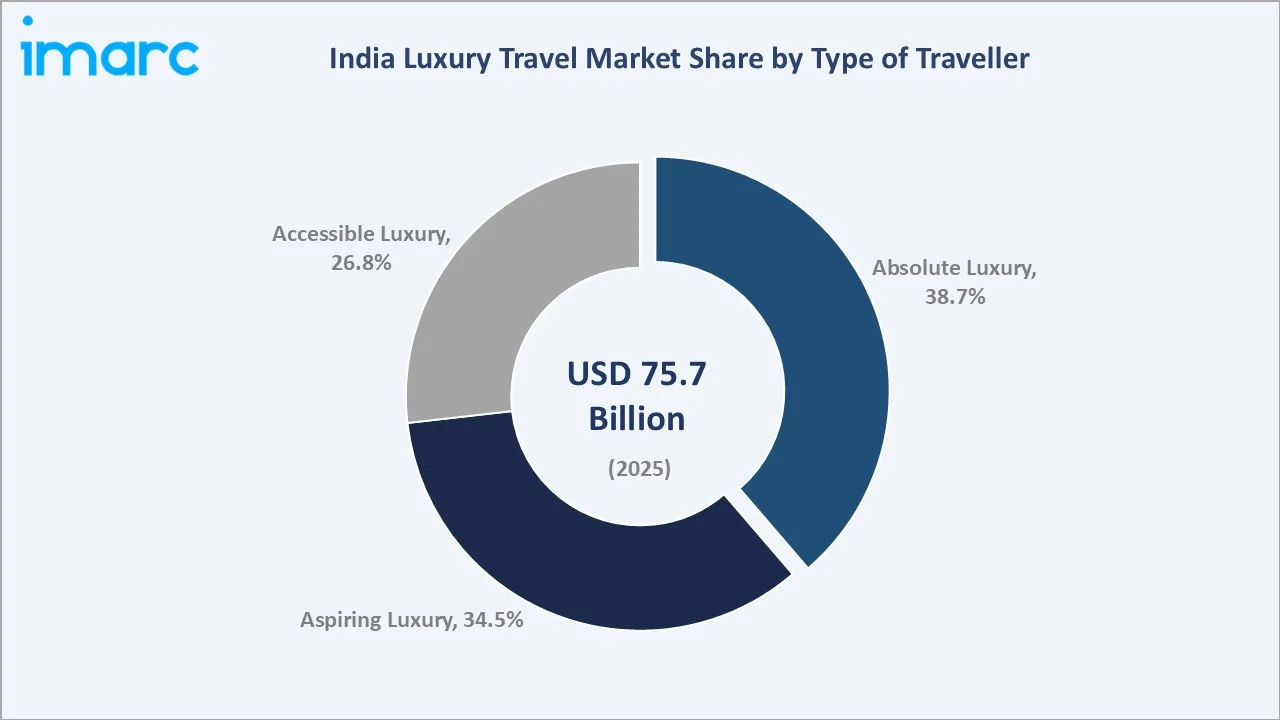
Aspiring Luxury at 34.5% captures upper-middle-class consumers seeking premium-tier experiences within curated packages, representing the market's highest growth potential. Accessible Luxury at 26.8% serves quality-conscious travellers through OTA-enabled premium packages and value-focused luxury itineraries.
Regional Market Insights
|
Region |
Share (2025) |
Key Market Drivers & Characteristics |
|
West and Central India |
34.8% |
Highest HNI concentration, established coastal luxury tourism, and strong corporate travel demand |
|
North India |
27.6% |
Heritage tourism circuits, large HNI outbound base, and Himalayan wellness retreat ecosystem |
|
South India |
24.7% |
Wellness and Ayurvedic tourism leadership, eco-luxury resorts, and rising tech-sector affluent base |
|
East and Northeast India |
12.9% |
Emerging frontier with river cruise potential, eco-boutique properties, and adventure luxury circuits |
West and Central India at 34.8% leads through Mumbai's concentration of HNI outbound travellers, Goa's established luxury coastal resort ecosystem, and Pune's rising affluent professional base driving domestic luxury demand across leisure and MICE segments.
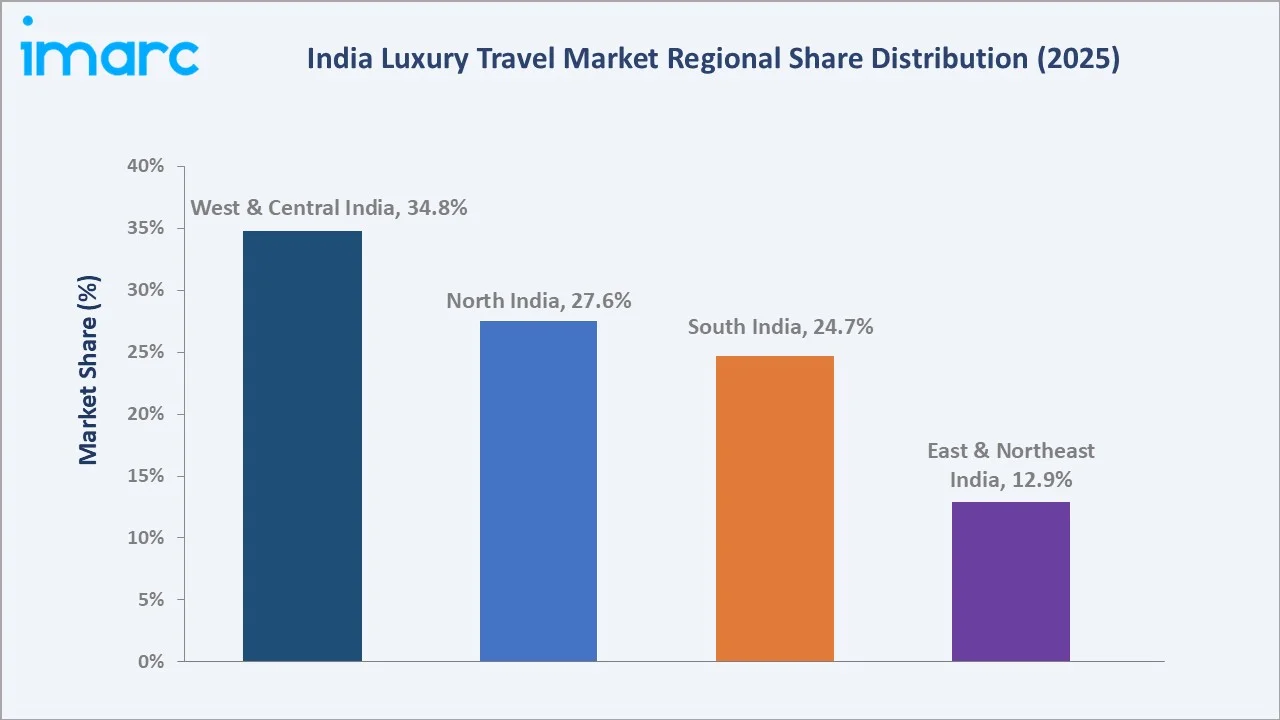
North India at 27.6% reflects the dominance of Rajasthan's heritage palace tourism, Delhi-NCR's large HNI base, and the Himalayan wellness retreat ecosystem. South India at 24.7% is anchored by Kerala's globally recognized wellness tourism. East and Northeast India at 12.9% represents the market's emerging frontier with Assam's luxury river cruise offerings and Bhutan-adjacent luxury circuits.
Competitive Landscape
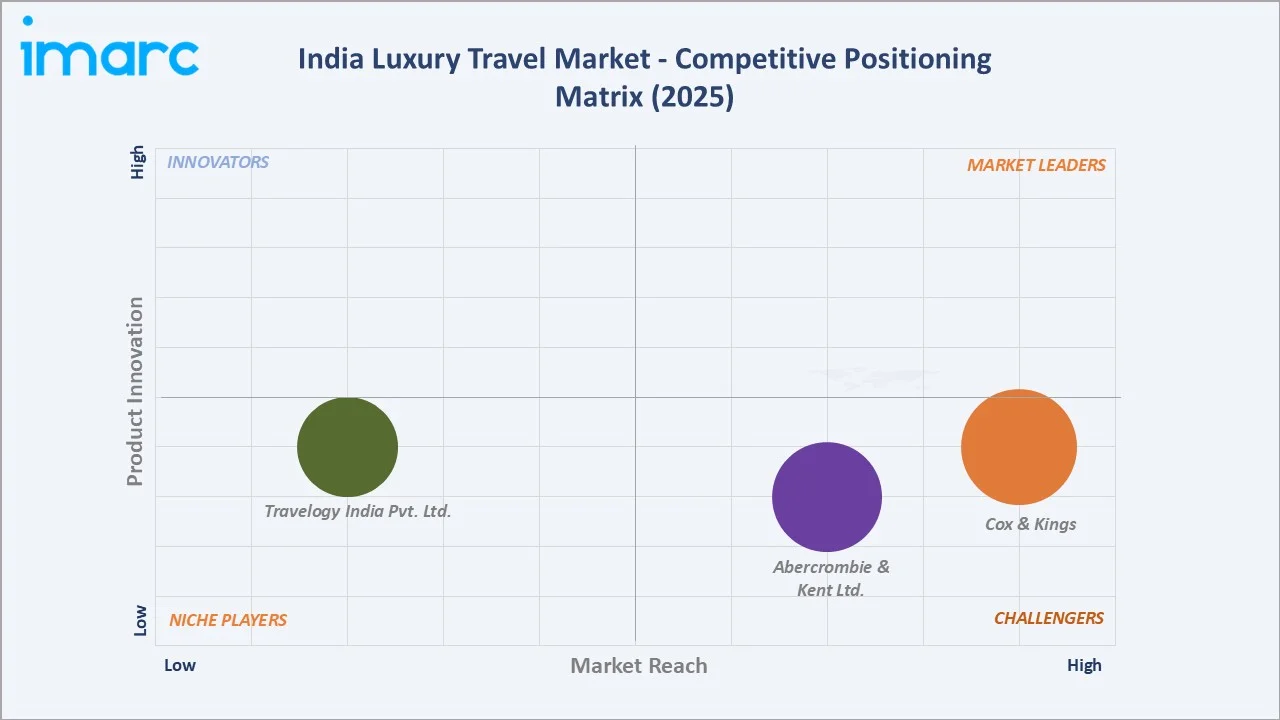
The India luxury travel market competitive landscape is moderately concentrated with two dominant full-service operators, a tier of established international luxury specialists, and a growing cohort of niche boutique operators catering to ultra-premium, wellness, and adventure luxury segments.
|
Company Name |
Key Services |
Market Position |
Core Strength |
|
Abercrombie & Kent Ltd. |
Ultra-luxury bespoke journeys, private safaris, heritage stays |
Strong Challenger |
Ultra-premium positioning; exclusive private guide access and top heritage property partnerships |
|
Cox & Kings |
Premium group tours, customized travel, heritage circuits |
Strong Challenger |
One of the world's oldest travel brands; strong in cultural luxury and small-group heritage journeys |
|
Travelogy India Pvt. Ltd. |
Luxury train bookings, royal rail journeys, portal services |
Niche Player |
Dedicated luxury rail booking portal; specialist in iconic Indian royal train itineraries |
Key players include Abercrombie & Kent Ltd., Cox & Kings, Travelogy India Pvt. Ltd., and others.
Key Company Profiles
Abercrombie & Kent Ltd.
Abercrombie & Kent Ltd. is one of the world's premier ultra-luxury travel companies. The company pioneered luxury small-group journeys and tailor-made travel, offering HNI travellers unmatched access to India's most exclusive heritage, wildlife, and cultural destinations through its Resident Tour Directors and local expert guide network.
- Key Services: Ultra-luxury tailor-made journeys, luxury small group journeys, private jet expeditions, wildlife and tiger tracking safaris, heritage palace stays, private Taj Mahal viewings, and exclusive cultural encounter programmes across India.
- Strategic Focus: Deepening ultra-luxury positioning in India through exclusive-access heritage experiences, wildlife safari partnerships with leading national parks, and expanding its luxury small group journey portfolio with bespoke Southern and Central India circuits. A&K is integrating its AI-powered "Design Your Day" platform into India itineraries, allowing ultra-HNI travellers to customise excursions while maintaining the company's signature on-the-ground expertise and maximum 18-guest group intimacy.
Cox & Kings
Cox & Kings is one of the world's oldest travel brands, relaunched in India under the new ownership of Singapore-based Wilson & Hughes, acquired through a National Company Law Tribunal-supervised process.
- Key Services: Leisure and luxury travel packages, outbound and inbound tour operations, business travel management, specialised heritage and cultural tours, AI-powered itinerary planning, and franchise-based personalised travel consultation across domestic and international markets.
- Recent Developments: In February 2025, Cox & Kings launched 10 new franchise locations across key Indian cities under Wilson & Hughes ownership, announcing a plan to establish 300 franchises, preferred agents, and holiday clubs across India and globally within two years.
- Strategic Focus: Revitalising the Cox & Kings brand through a technology-first approach that integrates AI-powered itinerary building with a growing nationwide franchise network, targeting four core segments: leisure travel, business travel, specialised tours, and travel technology. The company is leveraging Cox & Kings' 260-year legacy brand recognition to attract returning partners and a new generation of digitally engaged Indian luxury travellers seeking curated international and domestic experiences.
Market Concentration Analysis
The India luxury travel market is moderately concentrated at the full-service operator level, with the key players collectively accounting for the largest share of organized luxury travel revenue. Niche ultra-luxury specialists and digital OTA players are progressively fragmenting overall market share.
Investment & Growth Opportunities
Highest Growth Segments
Absolute Luxury traveller segment (~4.5% CAGR), West and Central India region (~3.9% CAGR), wellness and Ayurvedic tourism (~6-8% CAGR), luxury river cruise capacity (~10-12% CAGR from nascent base), and eco-luxury lodge development (~7-9% CAGR) represent the highest-priority investment opportunities through 2034.
Emerging Investment Opportunities
Luxury river cruise infrastructure on India's navigable rivers, particularly the Brahmaputra, represents a multi-operator opportunity following Viking's planned 2027 debut. Heritage property conversion into luxury boutique hotels in tier-2 cultural destinations presents high-IRR investment potential driven by traveller demand for authentic, exclusive luxury stays.
Investment Themes
- Wellness tourism infrastructure investment at premium Ayurvedic retreat destinations in Kerala and Uttarakhand: India's globally differentiated Ayurvedic heritage combined with rising HNI demand for preventive wellness creates a compelling infrastructure investment case for luxury retreat properties catering to both domestic and international health-conscious travellers.
- AI-driven luxury travel platform development targeting affluent digital-native consumers: The growing digital booking preference among Millennial and Gen Z HNIs creates opportunity for AI-personalization-enabled luxury OTA platforms that challenge traditional operator dominance and capture high-value premium travel transactions.
Future Market Outlook (2026-2034)
The India luxury travel market is projected to grow from USD 75.72 Billion in 2025 to USD 106.48 Billion by 2034, delivering a 3.75% CAGR over the forecast period. The market's sustained growth reflects structural demand drivers anchored by wealth creation, demographic shifts, and tourism infrastructure improvements across India.
Three structural forces define India luxury travel market growth through 2034. Continued HNI wealth creation across technology and finance expands the luxury traveller base. Maturing Millennial affluence adds a digitally-engaged, experience-first cohort to demand. And India's improving global tourism infrastructure progressively raises the quality ceiling for domestic and inbound luxury experiences.
Research Methodology
Primary Research
Primary research comprised structured interviews with 50+ industry stakeholders (2025), including luxury hotel general managers, senior executives at premium tour operators, destination wedding planners, wellness retreat directors, luxury cruise representatives, and HNI traveller advisory panels providing demand-side validation of market sizing and trend hypotheses.
Secondary Research
Secondary research encompassed company annual reports, Ministry of Tourism India data, WTTC India Tourism Reports, luxury hospitality brand filings, OTA luxury segment analytics, industry association publications from TAAI and IATO, and macroeconomic data supporting wealth creation and HNI growth projections across India.
Forecasting Models
Market revenue forecasts developed using bottom-up demand modelling: (i) HNI and affluent population projections by age cohort; (ii) average luxury travel spend per trip by traveller type; (iii) trip frequency assumptions by segment; (iv) regional market sizing; validated against top-down industry revenue benchmarks and operator revenue disclosures.
India Luxury Travel Market Report Coverage:
| Report Features | Details |
|---|---|
| Base Year of the Analysis | 2025 |
| Historical Period | 2020-2025 |
| Forecast Period | 2026-2034 |
| Units | Billion USD |
| Scope of the Report |
Exploration of Historical Trends and Market Outlook, Industry Catalysts and Challenges, Segment-Wise Historical and Future Market Assessment:
|
| Types of Tour Covered | Customized and Private Vacation, Adventure and Safari, Cruise and Ship Expedition, Small Group Journey, Celebration and Special Event, Culinary Travel and Shopping |
| Age Groups Covered | Millennial (21-30), Generation X (31-40), Baby Boomers (41-60), Silver Hair (60 and Above) |
| Types of Traveller Covered | Absolute Luxury, Aspiring Luxury, Accessible Luxury |
| Regions Covered | North India, West and Central India, South India, East and Northeast India |
| Companies Covered | Abercrombie & Kent Ltd., Cox & Kings, Travelogy India Pvt. Ltd., etc. |
| Customization Scope | 10% Free Customization |
| Post-Sale Analyst Support | 10-12 Weeks |
| Delivery Format | PDF and Excel through Email (We can also provide the editable version of the report in PPT/Word format on special request) |
Key Benefits for Stakeholders:
- IMARC’s industry report offers a comprehensive quantitative analysis of various market segments, historical and current market trends, market forecasts, and dynamics of the India luxury travel market from 2020-2034.
- The research report provides the latest information on the market drivers, challenges, and opportunities in the India luxury travel market.
- Porter's five forces analysis assist stakeholders in assessing the impact of new entrants, competitive rivalry, supplier power, buyer power, and the threat of substitution. It helps stakeholders to analyze the level of competition within the India luxury travel industry and its attractiveness.
- Competitive landscape allows stakeholders to understand their competitive environment and provides an insight into the current positions of key players in the market.
Frequently Asked Questions About the India Luxury Travel Market Report
The India luxury travel market reached USD 75.72 Billion in 2025, driven by the Generation X (31-40) age group dominant at 32.6%, Absolute Luxury traveller segment leading at 38.7%, and West and Central India region commanding 34.8% market share.
The India luxury travel market grows at 3.75% CAGR during 2026-2034, reaching USD 106.48 Billion by 2034. This reflects HNI population expansion, Millennial affluence maturation, experiential travel demand, and improving premium tourism infrastructure across India.
Generation X (31-40) leads at 32.6%, driven by peak career earnings, preference for curated culturally immersive journeys, and strong aspiration for experiences reflecting sophistication and personal identity. This cohort commands the highest per-trip luxury spend in the market.
Absolute Luxury leads at 38.7% through ultra-HNI clients demanding fully private, bespoke itineraries with exclusive access and personalized concierge service, commanding the highest per-trip spend and driving premium supplier positioning across the India luxury travel market.
West and Central India leads at 34.8% through Mumbai's concentration of HNI outbound travellers, Goa's established luxury coastal tourism ecosystem, and strong corporate luxury travel demand from India's financial capital, reinforced by the rising affluent professional base in Pune.
Leading companies include Abercrombie & Kent Ltd., Cox & Kings, Travelogy India Pvt. Ltd., and others.
Three priority investment opportunities: wellness tourism infrastructure in Kerala and Uttarakhand capturing global Ayurvedic demand; luxury river cruise capacity on the Brahmaputra anchored by Viking's 2027 debut; and AI-driven luxury OTA platforms targeting HNI digital-native consumers to capture the digitally-booked premium travel segment.
Need more help?
- Speak to our experienced analysts for insights on the current market scenarios.
- Include additional segments and countries to customize the report as per your requirement.
- Gain an unparalleled competitive advantage in your domain by understanding how to utilize the report and positively impacting your operations and revenue.
- For further assistance, please connect with our analysts.
 Request Customization
 Speak to an Analyst
 Request Brochure
 Inquire Before Buying
Benefits of Customization
- Personalize this research
- Triangulate with your data
- Get data as per your format and definition
- Gain a deeper dive into a specific application, geography, customer, or competitor
- Any level of personalization
Get in Touch With Us
UNITED STATES
Phone: +1-201-971-6302
INDIA
Phone: +91-120-433-0800
UNITED KINGDOM
Phone: +44-753-714-6104
Email: [email protected]
Client Testimonials




.webp)




.webp)













Related Reports

Choose your plan
*Please note that the prices mentioned below are starting prices for each bundle type. Kindly contact our team for further details.*
Single User License
- 1 User License, Access on 2 Devices
- PDF Report + Excel Dataset (Password Protected)
- Lifetime Access
- No Printing Rights
- 10% Free Report Customization
- 10–12 Weeks of Analyst Support
Five User License
- Access for 5 Users, 2 Devices per User
- PDF Report + Excel Dataset (Password Protected)
- Lifetime Access
- Dedicated Account Manager
- 12–14 Weeks of Analyst Support
- No Printing Rights
- 15% Free Report Customization
- 25% Discount on Your Next Purchase
Corporate User License
- Unlimited User Access (Within Your Organization)
- PDF Report + Excel Dataset
- Lifetime Access
- Dedicated Account Manager
- 14–20 Weeks of Analyst Support
- No Printing Rights
- 20% Free Report Customization
- 30% Discount on Your Next Purchase
Essential Insights
What's included:
3 reports
- Lifetime Access
- PDF Reports
- Excel Datasets
- 2 Weeks of Free Analyst Support
- 2 User Licenses
- Access on 2 Devices
- Printing Rights
- Complimentary PowerPoint (PPT) Version
- Complimentary License Upgrade
Professional Access
What's included:
5 reports
- Lifetime Access
- PDF Reports
- Excel Datasets
- 8 Weeks of Free Analyst Support
- 2 User Licenses
- Access on 2 Devices
- Printing Rights
- Complimentary PowerPoint (PPT) Version
- Complimentary License Upgrade
Business Advantage
What's included:
8 reports
- Lifetime Access
- PDF Reports
- Excel Datasets
- 14 Weeks of Free Analyst Support
- 2 User Licenses
- Access on 2 Devices
- Printing Rights
- Complimentary PowerPoint (PPT) Version
- Complimentary License Upgrade
Enterprise Intelligence
What's included:
10 reports
- Lifetime Access
- PDF Reports
- Excel Datasets
- 20 Weeks of Free Analyst Support
- 2 User Licenses
- Access on 2 Devices
- Printing Rights
- Complimentary PowerPoint (PPT) Version
- Complimentary License Upgrade