
India Home Automation Market Size, Share, Trends and Forecast by Type, Technology, End User, and Region, 2026-2034
India Home Automation Market Summary:
The India home automation market size was valued at USD 4.13 Billion in 2025 and is projected to reach USD 15.07 Billion by 2034, growing at a compound annual growth rate of 15.46% from 2026-2034.
The market is driven by rising urbanization, growing adoption of smart devices, and increasing consumer preference for enhanced security and energy efficiency. Technological advancements in connectivity and integration capabilities are accelerating household automation adoption across metropolitan areas. Government initiatives promoting smart city development and digital infrastructure are further bolstering demand for automated residential solutions, contributing to the expanding India home automation market share.
Key Takeaways and Insights:
-
By Type: Security and safety dominate the market with a share of 42% in 2025, driven by rising property protection concerns, smart locks adoption, mobile monitoring, and integration with comprehensive home management systems.
-
By Technology: Wireless leads the market with a share of 67% in 2025, owing to easy installation, flexible device placement, smartphone compatibility, remote control convenience, and lower infrastructure costs compared to wired solutions.
-
By End User: Residential represents the largest segment with a market share of 60% in 2025, driven by higher urban disposable incomes, growing smart home awareness, affordable entry-level automation, and desire for lifestyle convenience through connected devices.
-
By Region: North India dominates the market with a share of 30% in 2025, driven by metropolitan concentration, rapid technology adoption, strong retail and distribution networks, and real estate projects integrating smart home features.
-
Key Players: The India home automation market shows fragmented competition, with established electronics manufacturers and specialized automation solution providers across diverse price segments. Companies prioritize portfolio diversification, strategic real estate partnerships, and expanding after-sales networks to enhance regional presence.
The India home automation market is witnessing significant growth, propelled by rapid urbanization and the expansion of smart city initiatives in major metropolitan regions. Increasing disposable incomes among middle-class households are driving higher adoption of technology-enabled living spaces that provide convenience, enhanced security, and efficient energy management. The widespread availability of smartphones, coupled with affordable internet connectivity, has created an enabling environment for connected home devices that can be remotely monitored and controlled. According to sources, BuildTrack launched a Smart Automation Experience Centre in Mohali’s Smartest Green Building, showcasing advanced IoT and AI-powered home automation solutions for modern residential adoption. Moreover, rising consumer awareness of energy efficiency and environmental sustainability is further encouraging the uptake of automated solutions designed to optimize electricity usage and reduce utility costs. Real estate developers are increasingly integrating pre-installed automation systems in premium residential projects to appeal to tech-savvy buyers seeking modern, convenient, and sustainable lifestyle amenities, thereby reinforcing market growth across urban centers.
India Home Automation Market Trends:
Voice-Enabled Smart Home Integration
Voice assistant integration is transforming how Indian consumers interact with their automated home systems, enabling hands-free control of lighting, climate settings, entertainment systems, and security features through natural language commands. This trend is particularly gaining momentum among younger demographics who prefer intuitive user interfaces over traditional manual controls. The availability of voice assistants supporting regional Indian languages is expanding accessibility beyond English-speaking urban populations, making smart home technology more inclusive. According to reports, in April 2025, Samsung added AI-powered voice commands in nine Indian languages to its SmartThings platform, aiming for 70% of India sales from AI-enabled appliances. Furthermore, manufacturers are increasingly designing devices with built-in voice recognition capabilities, eliminating the need for separate hub devices and simplifying the overall smart home architecture for mainstream adoption.
Energy Management and Sustainability Focus
Growing environmental consciousness among Indian consumers is driving demand for home automation solutions that provide detailed energy consumption analytics and automated optimization features. Smart thermostats, intelligent lighting systems, and automated appliance controls are gaining popularity for their ability to reduce electricity bills while minimizing environmental impact. Integration with renewable energy systems including rooftop solar installations is becoming increasingly common, allowing homeowners to maximize self-consumption and minimize grid dependency. As per sources, in April 2025, Schneider Electric partnered with Freyr Energy to integrate smart home automation with rooftop solar systems, enabling homeowners to monitor and optimize energy consumption while reducing grid dependency. Further, this sustainability-focused trend aligns with government incentives promoting energy-efficient buildings and is particularly resonating with environmentally aware urban professionals seeking to reduce their carbon footprint.
Modular and Scalable Solution Architectures
The shift toward modular home automation systems is enabling Indian consumers to begin with basic functionalities and gradually expand their smart home ecosystems based on evolving needs and budget availability. In February 2025, ABB India launched its modular ‘LIORA’ switch range at ELECRAMA 2025, enabling seamless integration of smart home automation in residential, commercial, and hospitality spaces. Moreover, this approach eliminates the requirement for substantial upfront investment, making automation accessible to a broader demographic range. Interoperability standards are improving, allowing devices from different manufacturers to communicate seamlessly within unified platforms. The modular trend is particularly appealing to renters and homeowners in existing properties who prefer non-invasive installation options that can be relocated without permanent structural modifications.
Market Outlook 2026-2034:
The India home automation market revenue is anticipated to witness robust expansion throughout the forecast period, supported by continuous technological innovation and declining hardware costs making solutions more accessible. Growing internet penetration in tier-two and tier-three cities is expected to unlock significant growth opportunities beyond established metropolitan markets. The integration of artificial intelligence and machine learning capabilities into automation platforms will enhance predictive functionalities and personalized user experiences. Additionally, increasing collaboration between technology providers and real estate developers is projected to accelerate adoption through pre-integrated smart home offerings in new residential constructions. The market generated a revenue of USD 4.13 Billion in 2025 and is projected to reach a revenue of USD 15.07 Billion by 2034, growing at a compound annual growth rate of 15.46% from 2026-2034.
India Home Automation Market Report Segmentation:
|
Segment Category |
Leading Segment |
Market Share |
|
Type |
Security and Safety |
42% |
|
Technology |
Wireless |
67% |
|
End User |
Residential |
60% |
|
Region |
North India |
30% |
Type Insights:
To get more information on this market, Request Sample
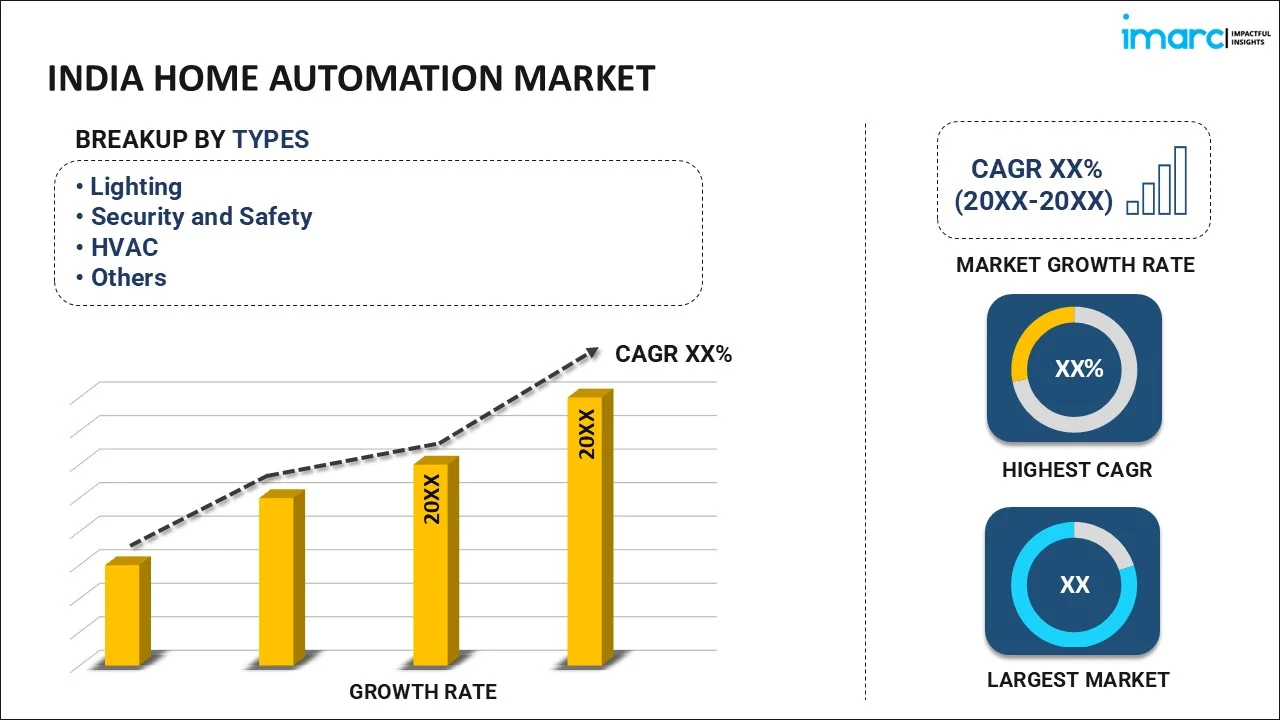
- Lighting
- Relay
- Dimmers
- Switches
- Others
- Security and Safety
- Bells
- Locks
- Security Cameras
- Others
- HVAC
- Thermostats
- Sensors
- Control Valves
- Others
- Entertainment
- Home Theater System
- Audio, Volume, and Multimedia Controls
- Others
- Others
Security and safety dominate with a market share of 42% of the total India home automation market in 2025.
The security and safety maintain its dominant position within the India home automation market due to escalating concerns over residential property protection and personal safety across urban and semi-urban areas. Smart surveillance cameras, video doorbells, motion sensors, and intelligent locking systems are experiencing heightened demand as homeowners seek comprehensive monitoring solutions that provide real-time alerts and remote access capabilities. In August 2025, CP PLUS showcased AI-powered smart locks, video doorphones, and intrusion detection systems at Smart Home Expo 2025, highlighting indigenized, intelligent home security solutions. The integration of artificial intelligence (AI) for facial recognition and anomaly detection is enhancing the effectiveness of security automation beyond traditional alarm systems.
Consumer preference for cloud-based storage solutions enabling historical footage review and evidence preservation is driving the adoption of subscription-based security services. The proliferation of smartphone applications providing instant notifications and live video feeds has made security automation accessible and user-friendly for non-technical consumers. Insurance providers offering premium discounts for homes equipped with verified automation security systems are creating additional incentives for adoption among cost-conscious households seeking both protection and financial benefits.
Technology Insights:
- Wired
- Wireless
Wireless leads with a share of 67% of the total India home automation market in 2025.
Wireless dominates the India home automation market owing to its installation flexibility and compatibility with existing residential infrastructure without requiring extensive renovations or cable routing. The advancement of communication protocols including WiFi, Bluetooth, Zigbee, and Z-Wave has enhanced reliability and range while reducing power consumption for battery-operated devices. According to sources, in 2025, NUOS launched its Zigbee 3.0 smart home series at Smart Home Expo 2025, offering universally compatible, plug-and-play wireless automation solutions for Indian homes and professional integrators. Furthermore, wireless solutions appeal particularly to the rental housing segment and existing homeowners who prefer non-invasive upgrades that can be easily reconfigured or relocated as needed.
The declining costs of wireless components and improved network security protocols have addressed previous concerns about connectivity stability and data protection. Mesh networking capabilities are extending coverage across larger properties without signal degradation, making wireless automation viable for expansive residences and multi-story buildings. The ecosystem compatibility between wireless devices from different manufacturers has improved significantly, enabling consumers to build customized automation setups using preferred brands across various product categories.
End User Insights:
- Residential
- Commercial
- Hospitality
Residential exhibits a clear dominance with a 60% share of the total India home automation market in 2025.
The residential leads the India home automation market as rising disposable incomes and changing lifestyle preferences encourage urban households to invest in smart living solutions. Nuclear family structures and dual-income households are driving demand for automation features that enhance convenience, provide remote monitoring capabilities, and reduce dependency on domestic help for routine tasks. The aspiration for modern, technology-enabled homes among younger homebuyers is influencing real estate developers to incorporate automation infrastructure in new residential projects. As per sources, in May 2025, the Smart Home Expo 2025 in Mumbai showcased 450+ brand, highlighting integrated automation systems and real estate adoption of connected home solutions across India.
Entry-level smart home devices at accessible price points have democratized automation adoption beyond premium housing segments, enabling middle-class households to experience connected living benefits. The growing elderly population living independently is creating demand for automation solutions that enhance safety, provide health monitoring integration, and enable remote family oversight. Social media influence and peer recommendations are accelerating awareness and adoption among residential consumers who observe practical benefits demonstrated by early adopters in their networks.
Regional Insights:
- North India
- South India
- East India
- West India
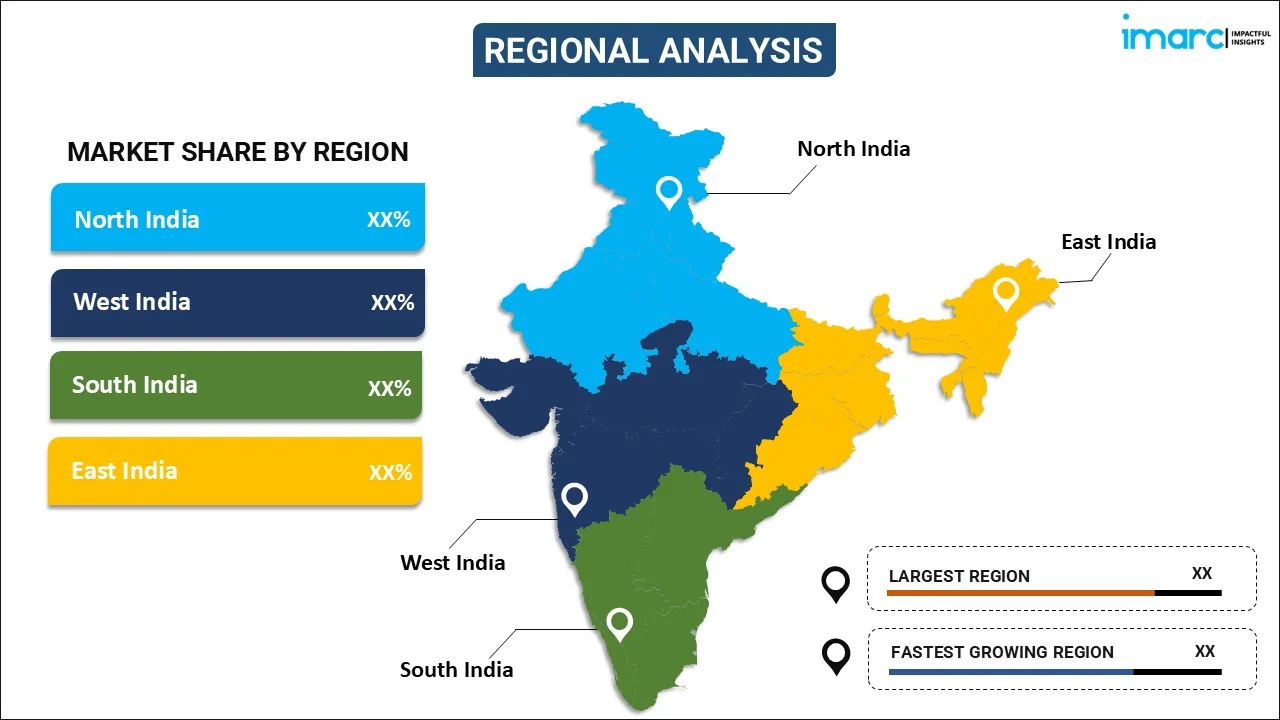
North India dominates with a market share of 30% of the total India home automation market in 2025.
North India commands the largest regional share in the home automation market, driven primarily by the Delhi-National Capital Region which represents one of the country's most significant technology adoption hubs. The concentration of corporate headquarters, multinational operations, and high-income professional populations in this region creates a substantial consumer base with both purchasing power and technology awareness necessary for automation adoption. Extensive real estate development in satellite cities and planned townships is incorporating smart home features as standard offerings.
The established retail infrastructure and presence of major electronics distributors in North India ensures product availability and after-sales support that enhances consumer confidence in automation investments. Extreme weather conditions during summer and winter months are driving demand for climate control automation solutions that optimize comfort while managing energy costs. Government smart city initiatives in the region are creating awareness and infrastructure support that indirectly benefits residential automation adoption through improved connectivity and digital ecosystem development.
Market Dynamics:
Growth Drivers:
Why is the India Home Automation Market Growing?
Accelerating Urbanization and Smart City Development
India's rapid urbanization trajectory is creating concentrated population centers where home automation solutions address specific urban living requirements including space optimization, security concerns, and energy management. The government's ambitious smart city mission encompassing numerous cities across the country is establishing digital infrastructure foundations that support advanced home automation ecosystems. As per sources, the Government of India extended the Smart Cities Mission deadline to March 31, 2025 to complete ongoing digital and urban infrastructure projects across 100 cities, further strengthening foundations for connected living ecosystems. Furthermore, urban planning initiatives incorporating integrated technology frameworks are encouraging residential developers to include automation provisions in building designs from initial construction phases. The migration of working professionals to metropolitan areas is expanding the target demographic for smart home solutions that enhance quality of life in compact urban dwellings.
Rising Disposable Income and Lifestyle Aspirations
The expanding middle class with increasing purchasing power is demonstrating willingness to invest in home improvement technologies that deliver convenience, status, and long-term value. Exposure to global lifestyle trends through digital media and international travel is shaping consumer aspirations toward modernized living environments featuring automated controls and connected devices. The growing prevalence of dual-income households creates demand for time-saving automation solutions that reduce domestic task burdens and enable better work-life balance. Premium residential developments are marketing automation features as differentiating amenities, normalizing smart home expectations among property buyers across various price segments. According to reports, in November 2025, Godrej Properties announced plans to launch ₹22,000 Crore worth of housing units, reflecting robust consumer demand for modern, technology-enabled residential projects.
Enhanced Internet Connectivity and Smartphone Penetration
The dramatic expansion of affordable mobile internet access has created the connectivity foundation essential for cloud-based home automation platforms that rely on continuous data exchange. Smartphone ubiquity provides the primary control interface through which consumers interact with their automated home systems, making adoption intuitive for digitally comfortable populations. The improvement in mobile network reliability and speed enables real-time video streaming, instant notifications, and responsive device control that meets user expectations for seamless performance. Competition among internet service providers has resulted in attractive pricing for high-speed home broadband connections that support bandwidth-intensive automation applications.
Market Restraints:
What Challenges the India Home Automation Market is Facing?
High Initial Investment Requirements
The upfront costs associated with comprehensive home automation installations remain prohibitive for significant portions of the population, limiting market penetration beyond affluent urban segments. The requirement for multiple compatible devices to create functional automated ecosystems increases total investment compared to standalone smart device purchases. Professional installation services add expense for consumers lacking technical confidence to self-configure complex automation networks.
Interoperability and Standardization Concerns
The fragmented ecosystem with multiple competing communication protocols creates compatibility concerns among consumers uncertain about future-proofing their automation investments. The risk of vendor lock-in discourages adoption among buyers wary of being constrained to specific brand ecosystems for future expansion. Limited interoperability between devices from different manufacturers complicates the creation of unified smart home experiences using preferred products across categories.
Privacy and Data Security Apprehensions
Consumer hesitation regarding data collection practices and potential misuse of personal information gathered by connected home devices restrains adoption among privacy-conscious segments. Publicized security vulnerabilities in smart home products raise concerns about unauthorized access to home networks and surveillance systems. The lack of comprehensive regulatory frameworks governing home automation data practices creates uncertainty about protection standards and recourse mechanisms.
Competitive Landscape:
The India home automation market exhibits a fragmented competitive structure characterized by the presence of multinational technology corporations, established consumer electronics manufacturers, specialized automation solution providers, and emerging domestic startups competing across diverse product categories and price segments. Market participants are pursuing differentiated strategies including product innovation, ecosystem development, strategic distribution partnerships, and after-sales service network expansion to establish sustainable competitive positions. The integration of artificial intelligence capabilities and voice assistant compatibility has become a key differentiator influencing consumer preference and brand selection. Collaboration with real estate developers for pre-installation partnerships represents an increasingly important go-to-market channel, particularly for comprehensive automation solution providers targeting the new construction segment.
Recent Developments:
-
In June 2025, Schneider Electric India expanded its home electrical portfolio, introducing Miluz Zeta switches with AQI indicators, motion-sensing LED foot lamps, and Wiser Smart Home automation. Through the “Bring Home the Smart” campaign, the company aims to enhance consumer engagement, promote intuitive smart living, and cater to India’s increasing demand for connected home solutions.
India Home Automation Market Report Coverage:
| Report Features | Details |
|---|---|
| Base Year of the Analysis | 2025 |
| Historical Period | 2020-2025 |
| Forecast Period | 2026-2034 |
| Units | Billion USD |
| Scope of the Report |
Exploration of Historical Trends and Market Outlook, Industry Catalysts and Challenges, Segment-Wise Historical and Future Market Assessment:
|
| Types Covered |
|
| Technologies Covered | Wired, Wireless |
| End Users Covered | Residential, Commercial, Hospitality |
| Regions Covered | North India, South India, East India, West India |
| Customization Scope | 10% Free Customization |
| Post-Sale Analyst Support | 10-12 Weeks |
| Delivery Format | PDF and Excel through Email (We can also provide the editable version of the report in PPT/Word format on special request) |
Key Questions Answered in This Report
The India home automation market size was valued at USD 4.13 Billion in 2025.
The India home automation market is expected to grow at a compound annual growth rate of 15.46% from 2026-2034 to reach USD 15.07 Billion by 2034.
The security and safety held the largest market share, driven by increasing consumer focus on property protection, adoption of smart surveillance systems and intelligent locks, and integration capabilities with comprehensive home management platforms.
Key factors driving the India home automation market include rapid urbanization and smart city initiatives, rising disposable incomes and lifestyle aspirations, enhanced internet connectivity and smartphone penetration, growing security consciousness, and increasing energy efficiency awareness.
Major challenges include high initial investment requirements, interoperability issues between different protocols and manufacturers, data privacy and security concerns, limited technical awareness in rural areas, and inconsistent after-sales support infrastructure.
Need more help?
- Speak to our experienced analysts for insights on the current market scenarios.
- Include additional segments and countries to customize the report as per your requirement.
- Gain an unparalleled competitive advantage in your domain by understanding how to utilize the report and positively impacting your operations and revenue.
- For further assistance, please connect with our analysts.
 Request Customization
 Speak to an Analyst
 Request Brochure
 Inquire Before Buying
Benefits of Customization
- Personalize this research
- Triangulate with your data
- Get data as per your format and definition
- Gain a deeper dive into a specific application, geography, customer, or competitor
- Any level of personalization
Get in Touch With Us
UNITED STATES
Phone: +1-201-971-6302
INDIA
Phone: +91-120-433-0800
UNITED KINGDOM
Phone: +44-753-714-6104
Email: sales@imarcgroup.com
Client Testimonials




.webp)




.webp)












