
India Biotechnology Market Size, Share, Trends and Forecast by Product Type, Technology, Application, and Region, 2026-2034
India Biotechnology Market Summary:
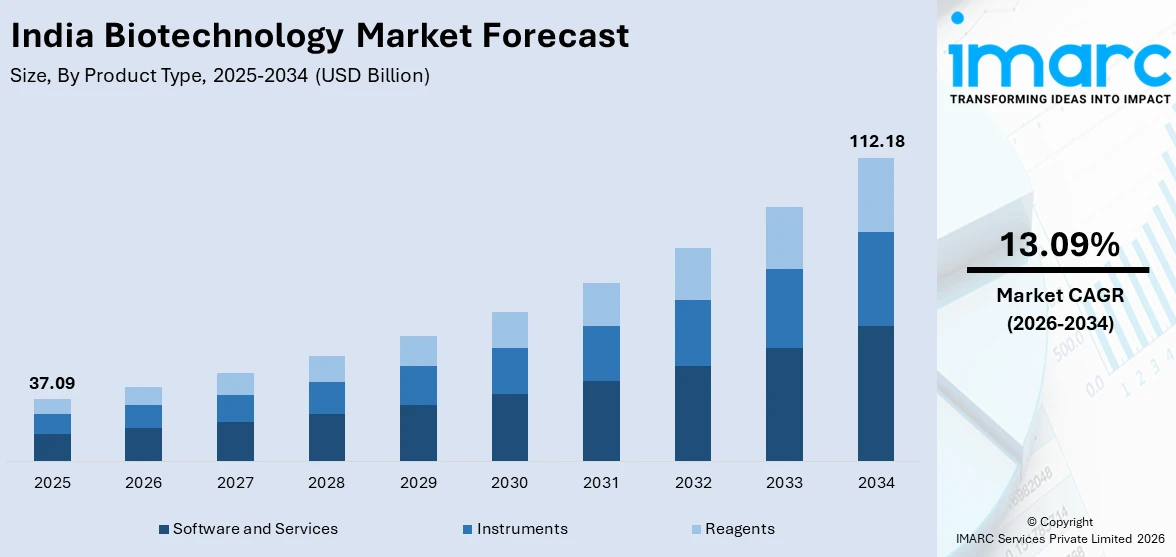
The India biotechnology market size was valued at USD 37.09 Billion in 2025 and is projected to reach USD 112.18 Billion by 2034, growing at a compound annual growth rate of 13.09% from 2026-2034.
The India biotechnology market is witnessing growth driven by the rising demand for advanced biopharmaceuticals, genomics-based diagnostics, and precision medicine solutions. Increasing government investments in research infrastructure, the rapid growth of biotech startups, and the integration of artificial intelligence (AI) with biotechnology are propelling the market development. Expanding applications across healthcare, agriculture, industrial processing, and environmental management are reshaping the competitive landscape and creating substantial opportunities for market participants.
Key Takeaways and Insights:
- By Product Type: Software and services lead the market with a share of 42% in 2025, supported by the rising use of bioinformatics platforms, cloud-based laboratory management solutions, and AI-driven data analytics tools that facilitate effective biotechnological research.
- By Technology: DNA sequencing represents the largest segment with a market share of 18% in 2025, driven by the growing genomics research efforts, reducing sequencing costs, and the rising use of next-generation sequencing platforms for clinical diagnostics and precision medicine.
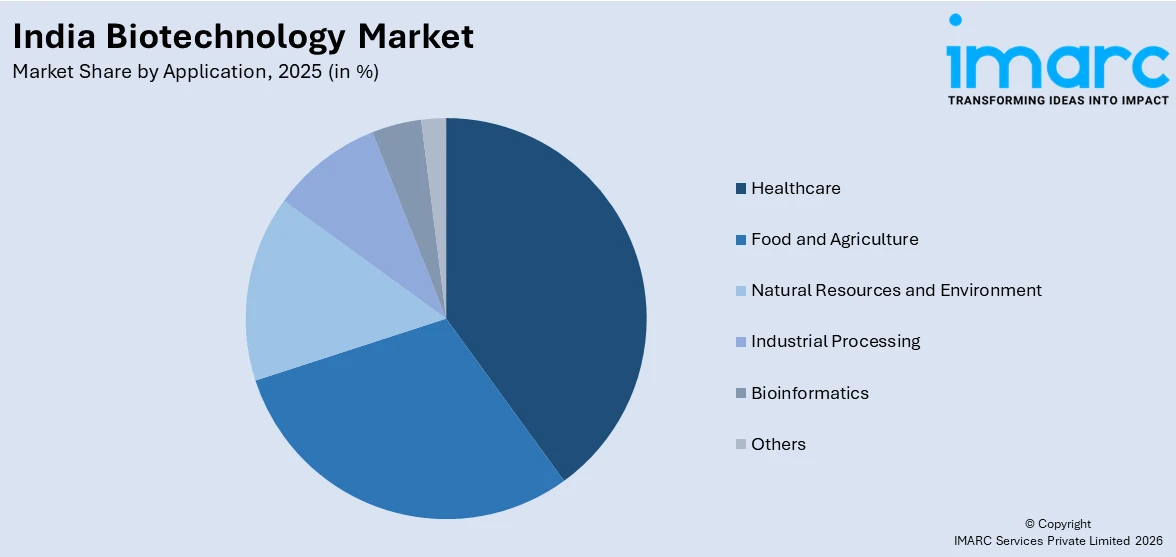
- By Application: Healthcare dominates the market with a share of 40% in 2025, owing to rising incidence of chronic illnesses, heightened demand for biosimilars and biologics, and the growth of biopharmaceutical manufacturing capabilities nationwide.
- By Region: North India leads the market with a share of 30% in 2025, bolstered by the presence of biotech research facilities, pharmaceutical manufacturing centers, and government-supported innovation hubs throughout Delhi-NCR and its surrounding states.
- Key Players: The India biotechnology market features intense competition among established biopharmaceutical companies, emerging biotech startups, and global technology providers competing across diverse therapeutic areas, research services, and agricultural biotechnology segments.
To get more information on this market Request Sample
The biotechnology sector in India is propelled by robust policy backing, increasing research facilities, heightened healthcare needs, and swift advancements in innovation-driven companies. Enhanced investment in biopharmaceuticals, biosimilars, diagnostics, and agricultural biotechnology is bolstering domestic production abilities and export competitiveness. Developments in genomics, bioinformatics, and data-oriented drug discovery are speeding up research results, whereas enhanced regulatory transparency and intellectual property systems boost investor trust. The increasing partnership among academia, industry, and government entities enhances the commercialization of scientific innovations. A key indicator of this momentum is the sharp rise in entrepreneurial activity, with the number of biotech startups increasing from just 50 in 2014 to nearly 11,000 by 2025, according to IBEF, positioning India among the fastest-growing global biotech hubs. Moreover, increasing demand for cost-effective healthcare solutions, growth of contract research services, and establishment of specialized biotech parks are supporting the market growth across various segments.
India Biotechnology Market Trends:
Rise of National Biofoundry Networks for Indigenous Biomanufacturing
A significant trend influencing the India biotechnology market is the development of integrated biofoundry networks to accelerate indigenous biomanufacturing and product innovation. These networks connect leading research institutions with shared infrastructure, automation platforms, and standardized biological engineering tools to shorten development timelines. The emphasis is on translating laboratory research into scalable, commercially viable products through coordinated collaboration. This direction was reinforced in 2025 when the National Biofoundry Network was launched in New Delhi, linking six major biotech institutions under the BioE3 Policy framework. Such coordinated national platforms strengthen innovation capacity, enhance domestic production capabilities, and promote technology-led competitiveness in the biotechnology sector.
Expansion of Marine Biotechnology and Blue Economy Initiatives
The strategic focus on marine biotechnology to support the blue economy and sustainable coastal development is impelling the market growth. Increasing attention is being given to ocean-based bioresources for applications in pharmaceuticals, nutraceuticals, environmental solutions, and industrial biotechnology. This shift reflects broader efforts to diversify biotechnology research beyond traditional healthcare domains. In 2025, the launch of the Odisha Marine Biotechnology Research & Innovation Corridor, involving collaboration with NIOT and premier academic institutions, highlighted the push toward marine bioresource mapping and bioactive compound discovery. Such initiatives are strengthening regional innovation ecosystems and expanding biotechnology’s role in sustainable economic growth.
Emergence of Biotechnology Startups and Innovation Ecosystems
The rapid growth of biotechnology startups is strengthening innovation and accelerating the commercialization of research outcomes in India. Incubation support, venture funding, and partnerships with academic and industry institutions enable early-stage companies to scale product development across diagnostics, therapeutics, and bioinformatics. This momentum was reinforced in 2025 when Thermo Fisher Scientific and DPIIT, in collaboration with Startup India, launched the BioVerse Challenge to support 500 biotech start-ups over three years through mentoring, training, and access to advanced facilities in Genome Valley, Hyderabad. Such initiatives enhance technology transfer, encourage entrepreneurship, and sustain growth across multiple biotechnology application areas.
Market Outlook 2026-2034:
The biotechnology market in India shows significant growth potential during the forecast period, fueled by steadfast policy commitments, increased research capabilities, and growing healthcare demand. The market generated a revenue of USD 37.09 Billion in 2025 and is projected to reach a revenue of USD 112.18 Billion by 2034, growing at a compound annual growth rate of 13.09% from 2026-2034. Revenue growth will mainly stem from speeding up biopharmaceutical development, broadening genomics and precision medicine applications, increasing biotechnology usage in agriculture and industrial processing, and creating advanced biomanufacturing infrastructure within the government's policy framework.
India Biotechnology Market Report Segmentation:
|
Segment Category |
Leading Segment |
Market Share |
|
Product Type |
Software and Services |
42% |
|
Technology |
DNA Sequencing |
18% |
|
Application |
Healthcare |
40% |
|
Region |
North India |
30% |
Product Type Insights:
- Instruments
- Reagents
- Software and Services
Software and services dominate with a market share of 42% of the total India biotechnology market in 2025.
Software and services lead the market due to the growing reliance on data analytics, bioinformatics, and digital research platforms. Biotechnology research generates vast volumes of genomic, clinical, and laboratory data that require advanced software tools for interpretation and management. According to the Department of Biotechnology, India had over 1,547 ongoing biotechnology projects as of October 2024, generating significant demand for specialized software tools and analytical services supporting research outcomes. Indian research institutions and pharmaceutical companies increasingly adopt specialized platforms to accelerate drug discovery and improve research accuracy.
Another factor supporting the dominance of software and services is the rapid expansion of contract research and outsourcing activities in India. Biotechnology firms prefer flexible service models that reduce infrastructure investment while ensuring access to advanced computational tools. Cloud based solutions, AI integration, and laboratory information management systems enhance operational efficiency. Government initiatives promoting digital transformation in healthcare and life sciences also encourage adoption of technology driven solutions. As research complexity increases and collaboration expands, software and services remain the largest segment in the market.
Technology Insights:
- Nanobiotechnology
- Tissue Engineering and Regeneration
- DNA Sequencing
- Cell-Based Assays
- Fermentation
- PCR Technology
- Chromatography
- Others
DNA sequencing leads with a market share of 18% of the total India biotechnology market in 2025.
DNA sequencing commands the largest market segment owing to its essential role in genomic research, disease detection, and the advancement of personalized medicine. The technology allows for in-depth examination of genetic data, aiding progress in cancer studies, rare disease identification, and infectious disease surveillance. Indian research institutes, pharmaceutical firms, and diagnostic labs are increasingly dependent on sequencing technologies to speed up innovation. The increasing understanding of genetic testing and tailored healthcare boosts the demand, establishing DNA sequencing as a core technology in the biotechnology industry.
Another reason for its leadership is the declining cost of sequencing and improved accessibility of advanced platforms across research and clinical settings. Government initiatives promoting genomic research and large-scale population studies encourage wider adoption. DNA sequencing also supports agricultural biotechnology, vaccine development, and microbial research, expanding its application scope. Integration with bioinformatics tools enhances data interpretation and speeds up discovery processes. As India strengthens its capabilities in life sciences and translational research, DNA sequencing continues to command the largest share in biotechnology technologies.
Application Insights:
Access the comprehensive market breakdown Request Sample
- Healthcare
- Food and Agriculture
- Natural Resources and Environment
- Industrial Processing
- Bioinformatics
- Others
Healthcare exhibits a clear dominance with a 40% share of the total India biotechnology market in 2025.
Healthcare represents the largest segment because of the rising demand for advanced therapies, vaccines, and diagnostic solutions. Biotechnology is critical in addressing chronic illnesses, infectious diseases, and unmet medical needs through biologics development and innovative treatment approaches. Market potential is strongly supported by India’s vast and growing healthcare requirements, with the population estimated at 1.44 billion according to UNFPA’s “State of World Population 2024” report. Increasing investment from pharmaceutical companies and research institutions continues to strengthen healthcare-focused biotechnology, reinforcing its dominance as the most significant application area in the sector.
Another significant factor is the increasing emphasis on affordable healthcare advancements and enhanced access to care. Biotechnology facilitates the creation of biosimilars, gene therapies, and precision medicine strategies that improve patient results. The growth of hospitals, diagnostic labs, and healthcare facilities also enhances the need for biotech applications. Government backing for vaccine production and healthcare research boosts industry progress. As India advances its healthcare framework and adapts to changing disease trends, healthcare continues to be the leading segment in biotechnology applications.
Regional Insights:
- North India
- West and Central India
- South India
- East and Northeast India
North India dominates with a market share of 30% of the total India biotechnology market in 2025.
North India leads the market driven by the existence of significant research institutions, biotechnology parks, and pharmaceutical production centers. The area boasts a significant density of public research institutions and universities involved in life sciences advancements. Access to qualified experts, developed industrial hubs, and robust infrastructure enhances regional capacities. Considerable investment in vaccine production, biologics manufacturing, and clinical research initiatives propels growth. This ecosystem fosters ongoing advancement and marketing of biotechnology products.
Another factor contributing to North India's dominance is the proactive engagement of government bodies and policy backing for the growth of biotechnology. The area gains from specialized biotech hubs, financial support programs, and startup incubation efforts that promote innovation. Closeness to regulatory bodies and central entities also enables cooperation and quicker project approvals. The increasing collaborations between academia and industry speed up the conversion of research into market-ready solutions. With the growing healthcare needs and continuous funding in research infrastructure, North India holds a prominent status in the biotechnology sector.
Market Dynamics:
Growth Drivers:
Why is the India Biotechnology Market Growing?
Rising Burden of Lifestyle Diseases
The rising prevalence of lifestyle-related and age-associated diseases is significantly driving biotechnology innovation in India. Conditions, such as diabetes, cardiovascular disorders, cancer, and autoimmune diseases, require advanced biologics, precision diagnostics, and targeted therapeutic solutions. This growing health burden is reflected in data from the International Diabetes Federation, which reported that India’s adult diabetic population reached 89.8 million in 2024. In response, biotechnology companies are expanding research pipelines and investing in novel drug development platforms to address complex chronic conditions. Increasing demand for long-term disease management and personalized treatment approaches continues to create strong growth opportunities within the biotechnology sector.
Growing Geriatric Population
As India’s population continues to age and healthcare needs become more complex, biotechnology is playing an increasingly vital role in developing effective, affordable, and advanced medical interventions. The rising burden of age-related diseases is strengthening the demand for biologics, precision diagnostics, and innovative therapeutic solutions tailored to older populations. This demographic shift is expected to intensify, with government data projecting that India’s senior citizen population will increase to around 230 million by 2036, accounting for nearly 15% of the total population. Such trends are reinforcing biotechnology’s importance in supporting long-term healthcare delivery and chronic disease management.
Acceleration of Bioeconomy and Carbon Utilization Initiatives
A growing focus on sustainable biomanufacturing and carbon utilization is emerging as a significant factor influencing the India biotechnology market. Increasing alignment between biotechnology innovation and climate objectives is encouraging the development of circular bioeconomy solutions that convert industrial emissions into value-added products. This direction was reinforced in 2026 when the Department of Biotechnology launched a new cohort of carbon capture and utilization biomanufacturing projects under the BioE3 Policy, supported by DBT and BIRAC. By promoting industry–academia collaboration and scaling lab-to-field bio-solutions aligned with India’s Net Zero 2070 target, such initiatives expand biotechnology applications beyond healthcare into environmental sustainability.

Market Restraints:
What Challenges the India Biotechnology Market is Facing?
Regulatory Complexity and Prolonged Approval Timelines
The Indian biotechnology market faces significant challenges arising from the complex regulatory frameworks that often result in prolonged product approval timelines, particularly for genetically modified organisms and biopharmaceuticals. Furthermore, multiple regulatory authorities with overlapping jurisdictions create compliance uncertainties that increase operational costs and delay market entry for innovative biotechnology products.
Infrastructure and Skilled Workforce Gaps in Emerging Regions
Despite substantial investments in major biotechnology hubs, significant infrastructure disparities persist between established clusters in southern and western India and emerging regions in the northeast and east. Limited access to advanced laboratory equipment, specialized research facilities, and trained bioinformatics professionals in underserved areas constrains nationwide biotechnology adoption and market growth.
High Research and Development Costs with Uncertain Commercial Outcomes
Biotechnology research activities involve substantial capital investment, extended development timelines, and inherently uncertain commercial outcomes that create financial barriers for market participants. The gap between laboratory-scale innovation and commercial-scale biomanufacturing remains a critical bottleneck, particularly for startups and small enterprises lacking resources for pilot-scale validation.
Competitive Landscape:
The India biotechnology market exhibits a highly dynamic competitive environment characterized by the coexistence of established biopharmaceutical corporations, government-backed research institutions, and a rapidly expanding cohort of innovative startups competing across diverse therapeutic areas and technology platforms. Market dynamics reflect strategic positioning, ranging from large-scale vaccine and biosimilar manufacturing to specialized niche applications in genomics, cell therapy, and bioinformatics. The competitive landscape is increasingly shaped by strategic alliances between domestic companies and global biotechnology leaders, the growing venture capital investments in emerging therapeutic modalities, and government initiatives fostering public-private partnerships that accelerate technology commercialization and market penetration.
Recent Developments:
- December 2025: The Government of Telangana inaugurated Telangana 1 Bio at Genome Valley, marking India’s first single-use bioprocess design and scale-up facility. The two-acre hub included 500 L bioreactors, upstream and downstream processing infrastructure, plug-and-play labs, and a Bioprocess Design Centre developed with Thermo Fisher Scientific. The initiative aimed to accelerate biologics development, reduce scale-up costs for startups and established firms, and strengthen Telangana’s position as a global life sciences and vaccine manufacturing hub.
- October 2025: The Union Minister Dr. Jitendra Singh launched the BioNEST Incubator at the Industrial Biotech Park in Kathua. Funded by BIRAC-DBT and set up by CSIR-IIIM Jammu, the incubator supported innovators, startups, farmers, and youth with incubation and skill development facilities. The center focused on areas like agri-aroma products, phytopharmaceuticals, and natural bio-based innovations, strengthening regional bioentrepreneurship under the BioE3 Policy.
India Biotechnology Market Report Coverage:
| Report Features | Details |
|---|---|
| Base Year of the Analysis | 2025 |
| Historical Period | 2020-2025 |
| Forecast Period | 2026-2034 |
| Units | Billion USD |
| Scope of the Report | Exploration of Historical Trends and Market Outlook, Industry Catalysts and Challenges, Segment-Wise Historical and Future Market Assessment:
|
| Product Types Covered | Instruments, Reagents, Software and Services |
| Technologies Covered | Nanobiotechnology, Tissue Engineering and Regeneration, DNA Sequencing, Cell-Based Assays, Fermentation, PCR Technology, Chromatography, Others |
| Applications Covered | Healthcare, Food and Agriculture, Natural Resources and Environment, Industrial Processing, Bioinformatics, Others |
| Regions Covered | North India, West and Central India, South India, East and Northeast India |
| Customization Scope | 10% Free Customization |
| Post-Sale Analyst Support | 10-12 Weeks |
| Delivery Format | PDF and Excel through Email (We can also provide the editable version of the report in PPT/Word format on special request) |
Frequently Asked Questions About the India Biotechnology Market Report
The India biotechnology market size was valued at USD 37.09 Billion in 2025.
The India biotechnology market is expected to grow at a compound annual growth rate of 13.09% from 2026-2034 to reach USD 112.18 Billion by 2034.
Software and services hold the largest revenue share of 42% in 2025, driven by increasing adoption of bioinformatics platforms, AI-powered analytics, and contract research services supporting biotechnology R&D operations.
Key factors driving the India biotechnology market include the rapid startup growth supported by incubation, funding, and institutional partnerships. This trend was reinforced in 2025 when Thermo Fisher Scientific and DPIIT launched the BioVerse Challenge to support 500 biotech start-ups with mentoring and facilities in Hyderabad.
Major challenges include regulatory complexity and prolonged approval timelines, infrastructure and skilled workforce gaps in emerging regions, high research and development costs, limited pilot-scale biomanufacturing facilities, and disparities in biotechnology access across geographic regions.
Need more help?
- Speak to our experienced analysts for insights on the current market scenarios.
- Include additional segments and countries to customize the report as per your requirement.
- Gain an unparalleled competitive advantage in your domain by understanding how to utilize the report and positively impacting your operations and revenue.
- For further assistance, please connect with our analysts.
 Request Customization
 Speak to an Analyst
 Request Brochure
 Inquire Before Buying
Benefits of Customization
- Personalize this research
- Triangulate with your data
- Get data as per your format and definition
- Gain a deeper dive into a specific application, geography, customer, or competitor
- Any level of personalization
Get in Touch With Us
UNITED STATES
Phone: +1-201-971-6302
INDIA
Phone: +91-120-433-0800
UNITED KINGDOM
Phone: +44-753-714-6104
Email: [email protected]
Client Testimonials




.webp)




.webp)













Related Reports

Choose your plan
*Please note that the prices mentioned below are starting prices for each bundle type. Kindly contact our team for further details.*
Single User License
- 1 User License, Access on 2 Devices
- PDF Report + Excel Dataset (Password Protected)
- Lifetime Access
- No Printing Rights
- 10% Free Report Customization
- 10–12 Weeks of Analyst Support
Five User License
- Access for 5 Users, 2 Devices per User
- PDF Report + Excel Dataset (Password Protected)
- Lifetime Access
- Dedicated Account Manager
- 12–14 Weeks of Analyst Support
- No Printing Rights
- 15% Free Report Customization
- 25% Discount on Your Next Purchase
Corporate User License
- Unlimited User Access (Within Your Organization)
- PDF Report + Excel Dataset
- Lifetime Access
- Dedicated Account Manager
- 14–20 Weeks of Analyst Support
- No Printing Rights
- 20% Free Report Customization
- 30% Discount on Your Next Purchase
Essential Insights
What's included:
3 reports
- Lifetime Access
- PDF Reports
- Excel Datasets
- 2 Weeks of Free Analyst Support
- 2 User Licenses
- Access on 2 Devices
- Printing Rights
- Complimentary PowerPoint (PPT) Version
- Complimentary License Upgrade
Professional Access
What's included:
5 reports
- Lifetime Access
- PDF Reports
- Excel Datasets
- 8 Weeks of Free Analyst Support
- 2 User Licenses
- Access on 2 Devices
- Printing Rights
- Complimentary PowerPoint (PPT) Version
- Complimentary License Upgrade
Business Advantage
What's included:
8 reports
- Lifetime Access
- PDF Reports
- Excel Datasets
- 14 Weeks of Free Analyst Support
- 2 User Licenses
- Access on 2 Devices
- Printing Rights
- Complimentary PowerPoint (PPT) Version
- Complimentary License Upgrade
Enterprise Intelligence
What's included:
10 reports
- Lifetime Access
- PDF Reports
- Excel Datasets
- 20 Weeks of Free Analyst Support
- 2 User Licenses
- Access on 2 Devices
- Printing Rights
- Complimentary PowerPoint (PPT) Version
- Complimentary License Upgrade