
Asia Pacific Aquafeed Market Size, Share, Trends and Forecast by Ingredient, Additives, Product Forms, End User, and Country, 2026-2034
Asia Pacific Aquafeed Market Size, Share, Trends & Forecast (2026-2034)
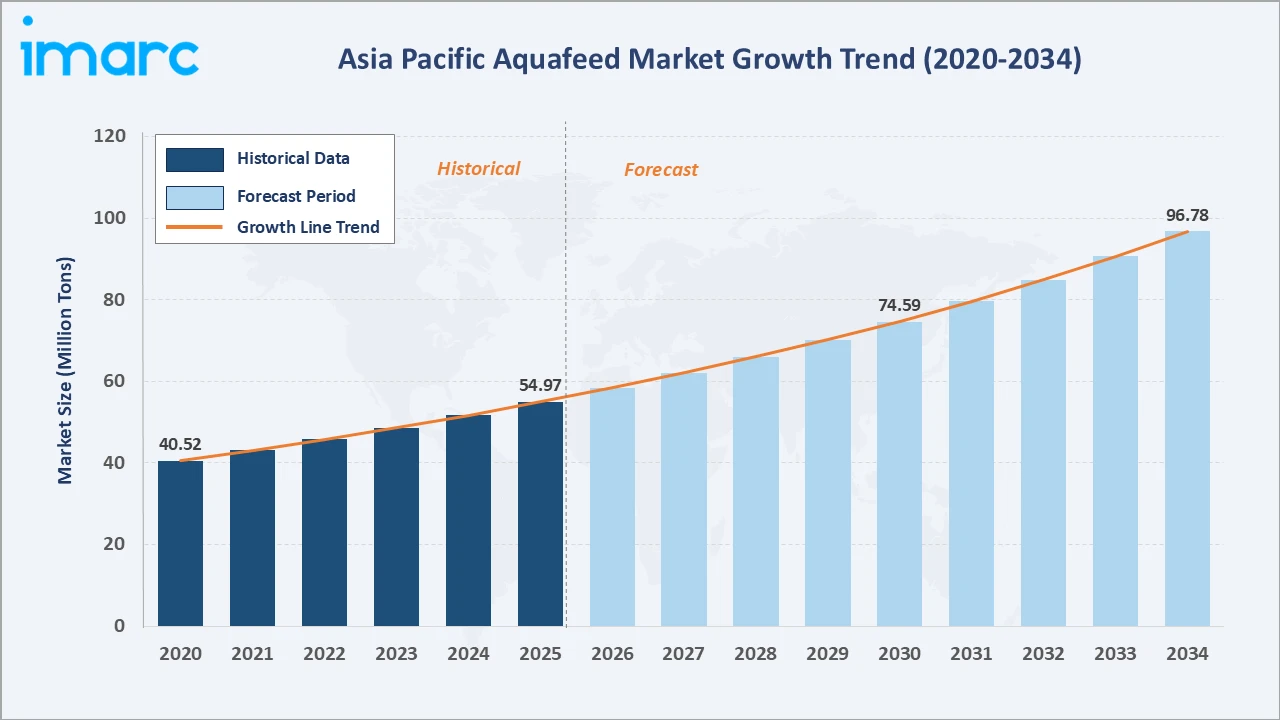
The Asia Pacific aquafeed market reached 54.97 Million Tons in 2025 and is projected to reach 96.78 Million Tons by 2034, growing at a CAGR of 6.29% during 2026-2034. Growth is driven by rising seafood consumption, expanding aquaculture production, and growing adoption of high-efficiency feed formulations across China, Indonesia, and India. Aquafeed demand is further supported by government initiatives promoting sustainable aquaculture and rising investment in advanced feed processing technologies across the region. Soybean leads the ingredient segment at 36.8% share, while vitamins dominate the additives segment at 31.6%, reflecting the industry's continued focus on nutritional optimization and feed conversion efficiency.
Market Snapshot
|
Metric |
Value |
|
Market Size (2025) |
54.97 Million Tons |
|
Forecast Market Size (2034) |
96.78 Million Tons |
|
CAGR (2026-2034) |
6.29% |
|
Base Year |
2025 |
|
Historical Period |
2020-2025 |
|
Forecast Period |
2026-2034 |
|
Dominant Ingredient |
Soybean (36.8%, 2025) |
|
Dominant Additive |
Vitamins (31.6%, 2025) |
|
Leading Country |
China (31.7%, 2025) |
The market expanded from 40.52 Million Tons in 2020 to 54.97 Million Tons in 2025, supported by rising aquaculture production and seafood demand, anchored at 74.59 Million Tons in 2030 and forecast to reach 96.78 Million Tons by 2034 as sustainable feed formulations and precision aquaculture practices continue to accelerate demand across the region. The post-pandemic recovery in seafood trade established a durable baseline of aquafeed consumption that has continued to compound as aquaculture expansion and feed conversion efficiency improvements progress across China, India, and Southeast Asia.
To get more information on this market, Request Sample
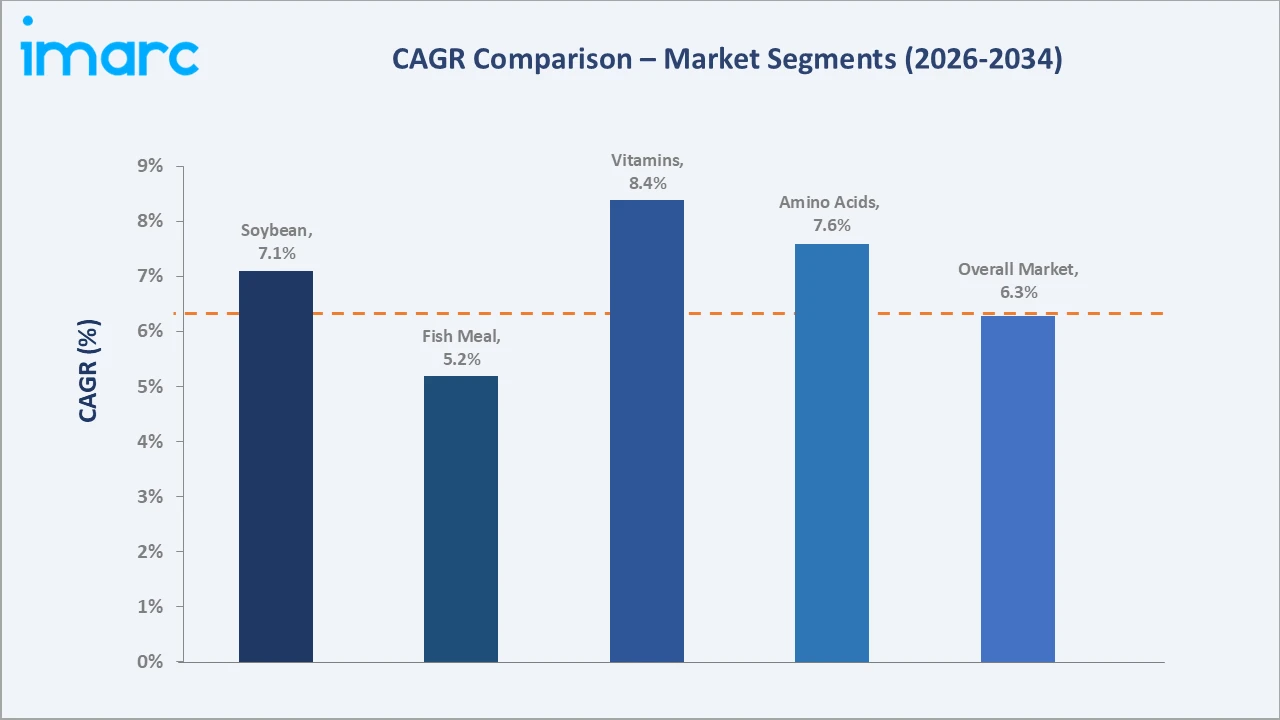
Vitamins grow fastest at approximately 8.4% CAGR as aquaculture operators increasingly prioritize nutritional optimization to improve feed conversion ratios and animal health outcomes. Amino acids follow closely at approximately 7.6% CAGR as precision nutrition formulations become standard practice across large-scale commercial aquaculture operations in the region.
Executive Summary
The Asia Pacific aquafeed market reached 54.97 Million Tons in 2025, representing the region's position as the global center of aquaculture production and seafood supply. Aquafeed is the foundational nutritional input sustaining the region's fish, shrimp, and mollusk farming operations, performing the essential growth, health, and disease-resistance functions that underpin modern aquaculture productivity. The market is projected to reach 96.78 Million Tons by 2034.
Soybean at 36.8% dominates through its cost-effective protein content and widespread adoption as a fish meal substitute across the region's aquafeed formulations. Vitamins at 31.6% lead the additives segment through growing emphasis on nutritional optimization and animal health across commercial aquaculture operations. China at 31.7% leads regionally through its position as the world's largest aquaculture producer, supported by Indonesia's expanding shrimp farming sector and India's growing freshwater aquaculture base.
Key Market Insights
|
Insight |
Data |
|
Dominant Ingredient |
Soybean - 36.8% share (2025) |
|
Dominant Additive |
Vitamins - 31.6% share (2025) |
|
Leading Country |
China - 31.7% share (2025) |
|
Market Opportunity |
Alternative protein sources; precision nutrition formulations; sustainable feed certification |
Key Analytical Observations Supporting the Above Data:
- Soybean at 36.8%: Soybean dominates due to its cost-effective protein content, wide availability, and continued substitution for fish meal across aquafeed formulations. Its widespread adoption across carp, tilapia, and catfish feed by major aquafeed manufacturers further strengthens segment demand. Continued investment in soybean processing infrastructure across China and India is reinforcing this segment's structural leadership position.
- Vitamins at 31.6%: Vitamins dominate the additives segment due to their critical role in supporting immune function, growth rates, and disease resistance across farmed aquatic species. With aquaculture operations scaling toward higher stocking densities, nutritional supplementation generates substantial and sustained demand. Rising adoption of precision feeding technologies is further reinforcing the vitamins segment's leadership position.
- China at 31.7%: China leads through its position as the world's largest aquaculture producer and its extensive freshwater and marine farming operations spanning carp, shrimp, and tilapia production. In 2025, China's continued investment in intensive aquaculture systems generated substantial additional demand for high-quality aquafeed formulations. This highlights how production scale and technology investment are reinforcing China's structural leadership position.
Asia Pacific Aquafeed Market Overview
The Asia Pacific aquafeed market encompasses the formulation, manufacture, and supply of compounded nutritional feed for farmed aquatic species, combining proteins, carbohydrates, fats, vitamins, and functional additives to support growth, health, and disease resistance across carp, shrimp, tilapia, catfish, and other commercially farmed species.
The ecosystem integrates raw material and ingredient suppliers, aquafeed manufacturers, feed additive and premix producers, distribution and farm supply partners, and regulatory bodies overseeing feed safety and quality standards across the region. Macroeconomic factors include rising seafood consumption, expanding middle-class protein demand, government aquaculture development programs, and continued investment in sustainable feed technologies.
Market Dynamics
To evaluate market opportunities, Request Sample
Market Drivers
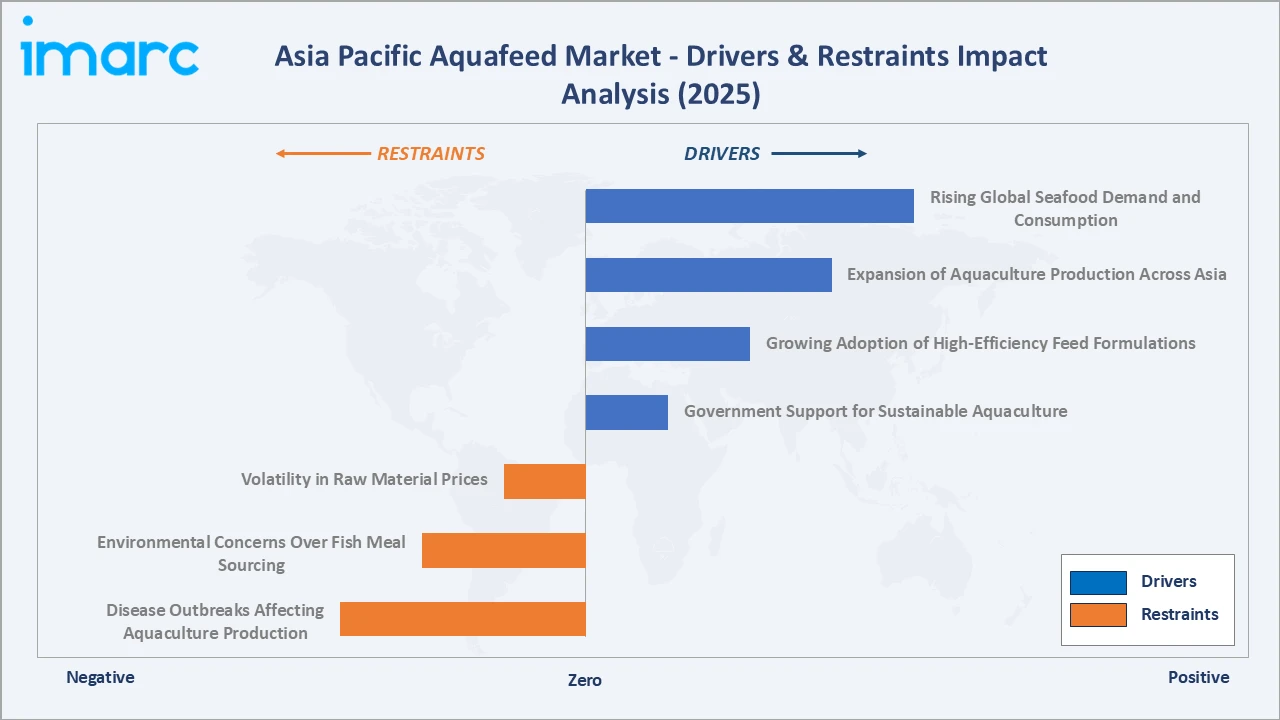
- Rising Global Seafood Demand and Consumption: Growing consumer preference for seafood as a healthy protein source across China, Japan, and Southeast Asia is boosting demand for farmed aquatic species and, in turn, aquafeed. Expanding middle-class populations with rising disposable income are increasingly incorporating seafood into their diets, driving sustained aquaculture production growth. Rising export demand for shrimp and fish from Indonesia, Vietnam, and India is further accelerating aquafeed procurement. Government-backed nutrition and food security programs across the region are also promoting seafood consumption among domestic populations.
- Expansion of Aquaculture Production Across Asia: The continued expansion of fish, shrimp, and mollusk farming operations across China, India, and Southeast Asia is driving sustained demand for compounded aquafeed. Rising investment in intensive and semi-intensive aquaculture systems is increasing stocking densities and feed conversion requirements. Government initiatives promoting aquaculture as a rural livelihood and export revenue source are further expanding the addressable market for feed suppliers.
- Growing Adoption of High-Efficiency Feed Formulations: Rising awareness of feed conversion ratio optimization is accelerating adoption of precision-formulated aquafeed among commercial aquaculture operators. Improved formulations reduce feed wastage and environmental impact while enhancing growth rates and profitability. This shift is compelling manufacturers to expand their premium and specialized feed product lines across shrimp and high-value fish species.
- Government Support for Sustainable Aquaculture: Government initiatives promoting sustainable and certified aquaculture practices across China, India, and Vietnam are driving demand for traceable, high-quality aquafeed formulations. Regulatory support for reducing wild fish meal dependency is accelerating adoption of alternative protein sources. Rising public and private investment in aquaculture infrastructure is further reinforcing this structural demand driver.
Market Restraints
- Volatility in Raw Material Prices: Fluctuating prices for soybean, fish meal, and fish oil used in aquafeed manufacturing create margin pressure and pricing uncertainty for manufacturers across the value chain. Extended raw material lead times during periods of global supply disruption further complicate production planning.
- Environmental Concerns Over Fish Meal Sourcing: Growing scrutiny of wild-caught fish meal sourcing practices and their impact on marine ecosystems is creating regulatory and reputational pressure on aquafeed manufacturers. This is compelling the industry to accelerate investment in alternative protein sources, which often carry higher production costs during the transition period.
- Disease Outbreaks Affecting Aquaculture Production: Periodic disease outbreaks in shrimp and fish farming operations can disrupt aquaculture production cycles, creating short-term volatility in aquafeed demand. These outbreaks can also increase production costs as farmers invest in biosecurity measures and specialized health-supporting feed formulations.
Market Opportunities
- Alternative Protein Source Development: Growing demand for sustainable fish meal alternatives presents an opportunity for manufacturers to develop insect meal, algae-based, and single-cell protein formulations. These alternative proteins can reduce dependency on wild fish stocks while meeting the nutritional requirements of farmed aquatic species. Manufacturers that establish early scale in alternative protein production can capture significant first-mover advantage.
- India's Expanding Freshwater Aquaculture Sector: India's rapidly growing freshwater aquaculture base, supported by government schemes promoting fish farming as a rural livelihood, presents a substantial volume opportunity for aquafeed manufacturers. Regional manufacturers with localized production and distribution strategies are well positioned to capture this emerging demand pool.
Market Challenges
- Intensifying Price Competition from Regional Manufacturers: Local and regional aquafeed manufacturers are increasingly offering cost-competitive alternatives to established global brands, compressing pricing power and margins for international players operating across Asia Pacific markets. Global brands are responding by accelerating regional manufacturing localization to maintain price competitiveness.
- Fragmented Regulatory and Quality Standards Across Regional Markets: Varying feed safety regulations, import duties, and quality certification requirements across China, India, and Southeast Asia complicate cross-border product launches for manufacturers. Manufacturers with dedicated regional compliance teams hold a meaningful speed-to-market advantage over smaller competitors.
Emerging Market Trends
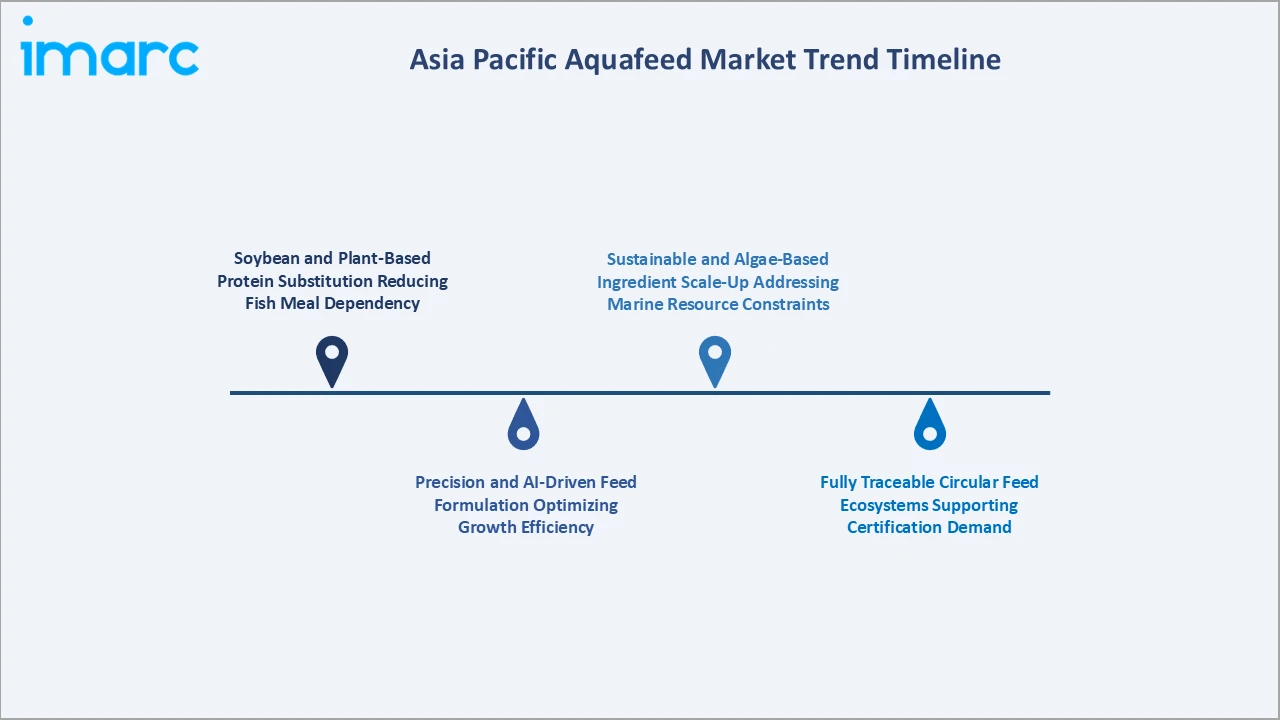
1. Soybean and Plant-Based Protein Substitution Reducing Fish Meal Dependency
Substitution of soybean and other plant-based proteins for traditional fish meal is accelerating as manufacturers seek to reduce dependency on wild-caught fish stocks and manage raw material cost volatility. This is driving investment in improved soybean processing technologies that enhance digestibility and nutritional value for farmed aquatic species. Continued advancement in enzyme and amino acid supplementation is further supporting the nutritional equivalence of plant-based formulations relative to fish meal.
2. Precision and AI-Driven Feed Formulation Optimizing Growth Efficiency
Precision and AI-driven feed formulation is emerging as manufacturers leverage data analytics to optimize nutrient composition for specific species, growth stages, and farming conditions. This design trend can enhance feed conversion ratios and reduce production costs for aquaculture operators. As data infrastructure continues to expand across commercial farms, demand is rising for aquafeed formulated using precision nutrition modeling.
3. Sustainable and Algae-Based Ingredient Scale-Up Addressing Marine Resource Constraints
Sustainable and algae-based ingredient scale-up is emerging as manufacturers invest in single-cell protein and microalgae cultivation to diversify aquafeed protein sources beyond conventional fish meal and soybean. This shift can reduce environmental impact while meeting the essential fatty acid requirements of farmed species. As production costs for algae-based ingredients continue to decline, wider commercial adoption is expected across premium aquafeed segments.
4. Fully Traceable Circular Feed Ecosystems Supporting Certification Demand
Fully traceable circular feed ecosystems are emerging as retailers and export markets increasingly demand certified sustainable seafood supply chains. This trend is driving aquafeed manufacturers to implement blockchain and digital tracking systems that verify ingredient sourcing and production practices. As international seafood buyers tighten sustainability requirements, demand is increasing for aquafeed with verifiable environmental and social credentials.
Industry Value Chain Analysis
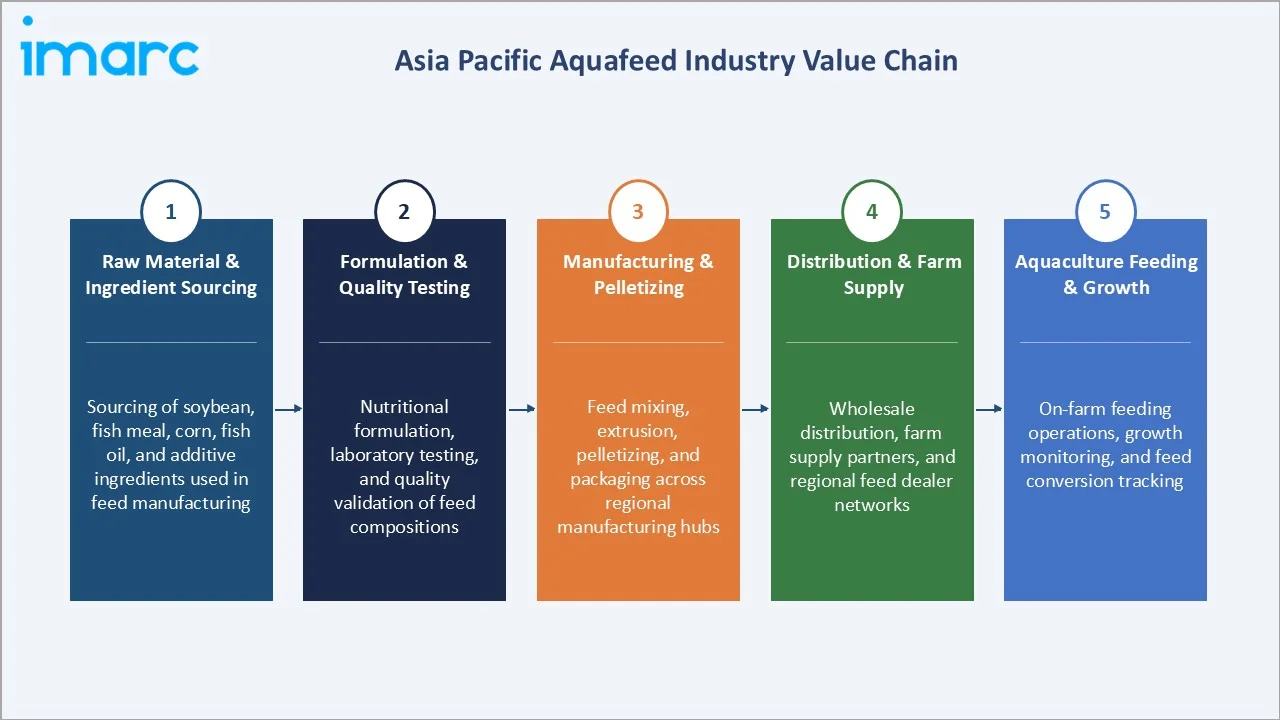
The Asia Pacific aquafeed value chain integrates raw material and ingredient sourcing, feed formulation and quality testing, manufacturing and pelletizing, distribution and farm supply, and aquaculture feeding and growth.
|
Stage |
Key Participants |
|
Raw Material & Ingredient Sourcing |
Sourcing of soybean, fish meal, corn, fish oil, and additive ingredients used in feed manufacturing |
|
Formulation & Quality Testing |
Nutritional formulation, laboratory testing, and quality validation of feed compositions |
|
Manufacturing & Pelletizing |
Feed mixing, extrusion, pelletizing, and packaging across regional manufacturing hubs |
|
Distribution & Farm Supply |
Wholesale distribution, farm supply partners, and regional feed dealer networks |
|
Aquaculture Feeding & Growth |
On-farm feeding operations, growth monitoring, and feed conversion tracking |
The value chain's commercial architecture continues to consolidate toward vertically integrated operations as leading manufacturers seek greater control over ingredient quality and supply chain traceability.
Technology Landscape in the Asia Pacific Aquafeed Industry
Precision Nutrition Formulation Technology
Precision nutrition formulation technology enables aquafeed manufacturers to tailor nutrient composition to specific species, growth stages, and farming conditions using data-driven modeling. These solutions improve feed conversion efficiency and reduce nutrient wastage, supporting both profitability and environmental sustainability for aquaculture operators across the region.
Extrusion and Pelletizing Technology
Advanced extrusion and pelletizing technology enables manufacturers to produce feed with improved water stability, digestibility, and nutrient retention. These processing improvements reduce feed wastage in aquaculture ponds and enhance growth performance, making them increasingly standard across mid-tier and premium aquafeed product lines.
Market Segmentation Analysis
The report covers the following segments:
|
Segment Category |
Leading Segment |
Market Share |
Year |
|
Ingredient |
Soybean |
36.8% |
2025 |
|
Additives |
Vitamins |
31.6% |
2025 |
|
Product Form |
Pellets |
🔒 |
2025 |
|
End User |
Carps |
🔒 |
2025 |
|
Country |
China |
31.7% |
2025 |

By Ingredient
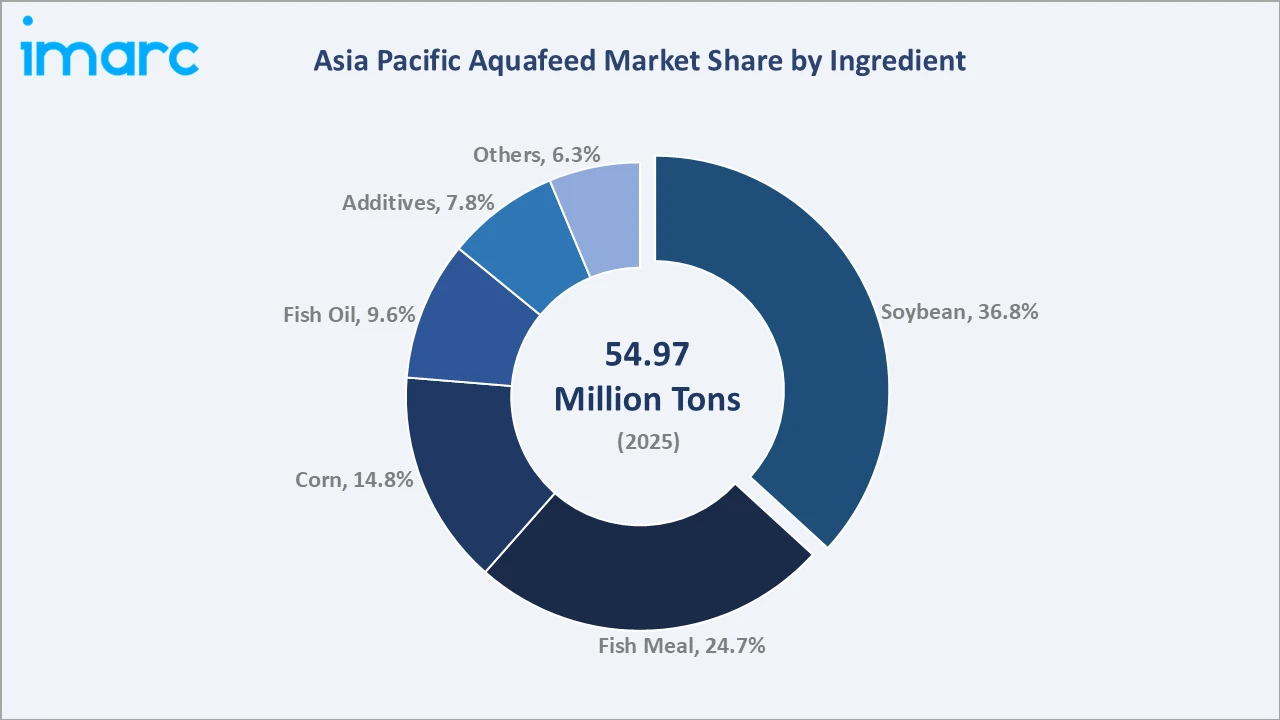
Soybean leads the ingredient segment at 36.8% in 2025, driven by its cost-effective protein content and widespread adoption as a sustainable substitute for traditional fish meal across aquafeed formulations.
To access detailed market analysis, Request Sample
Fish meal holds 24.7% share, remaining essential for high-value carnivorous species requiring concentrated protein and amino acid profiles, while corn at 14.8% and fish oil at 9.6% provide carbohydrate energy and essential fatty acids respectively.
By Additives
Vitamins lead the additives segment at 31.6% in 2025, reflecting the industry's continued emphasis on supporting immune function, growth rates, and disease resistance across farmed aquatic species.
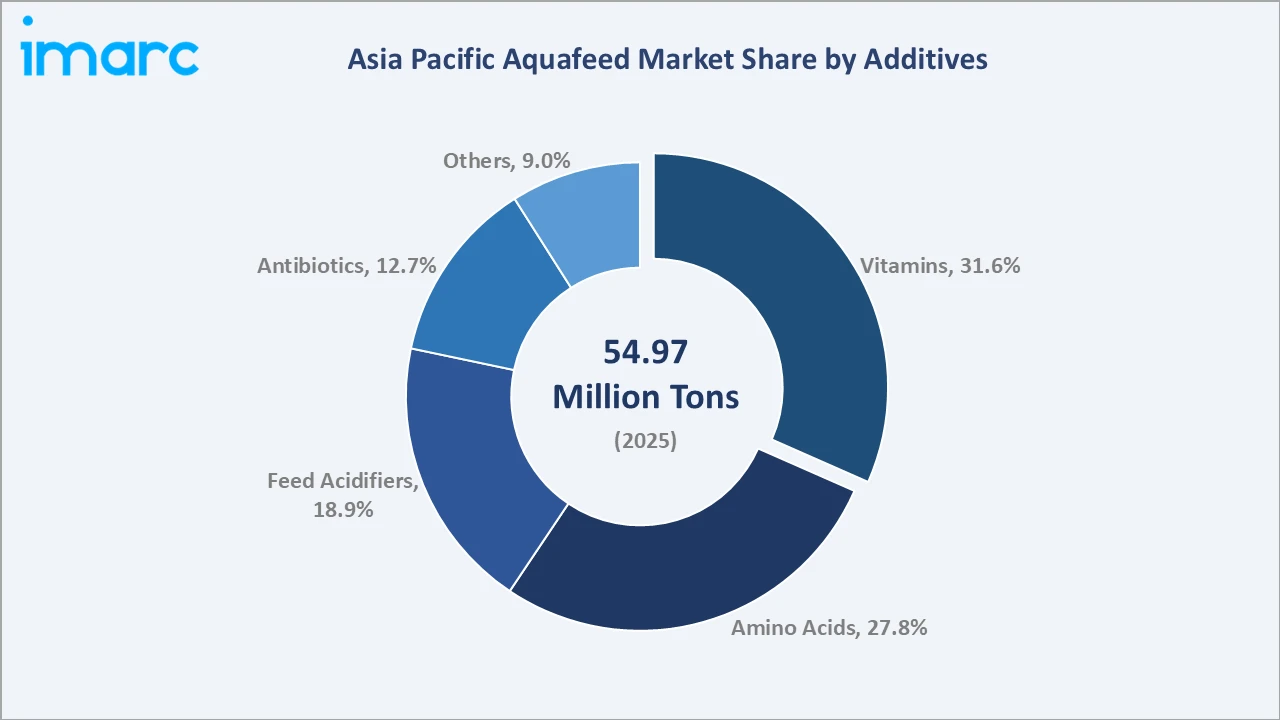
Amino acids hold 27.8% share, supporting protein synthesis and growth optimization, while feed acidifiers at 18.9% and antibiotics at 12.7% support digestive health and disease prevention across commercial aquaculture operations.
Regional Market Insights
|
Country |
Share (2025) |
Key Market Characteristics |
|
China |
31.7% |
Leading market driven by extensive aquaculture production capacity, a large freshwater and marine farming base, and continued technology investment |
|
Indonesia |
16.8% |
Driven by expanding shrimp farming, growing export demand, and rising government aquaculture support |
|
India |
12.6% |
Supported by rapid freshwater aquaculture expansion and government schemes promoting fish farming as a rural livelihood |
|
Vietnam |
9.8% |
Driven by strong export-oriented shrimp and catfish farming sectors with rising international demand |
|
Thailand |
8.7% |
Supported by an established shrimp farming industry and strong aquaculture export infrastructure |
|
Japan |
7.1% |
Driven by advanced aquaculture technology and strong domestic demand for premium seafood species |
|
Bangladesh |
5.2% |
Supported by growing freshwater aquaculture and rising domestic seafood consumption |
|
Malaysia |
4.2% |
Driven by expanding aquaculture infrastructure and government-backed food security initiatives |
|
South Korea |
2.9% |
Supported by advanced aquaculture technology and strong quality standards for premium seafood exports |
|
Others |
1.0% |
Emerging aquaculture markets across the wider Asia Pacific region |
China, at 31.7%, leads through its extensive aquaculture production capacity and continued technology investment. Indonesia, at 16.8%, reflects expanding shrimp farming and rising export demand supporting sustained aquafeed demand growth.
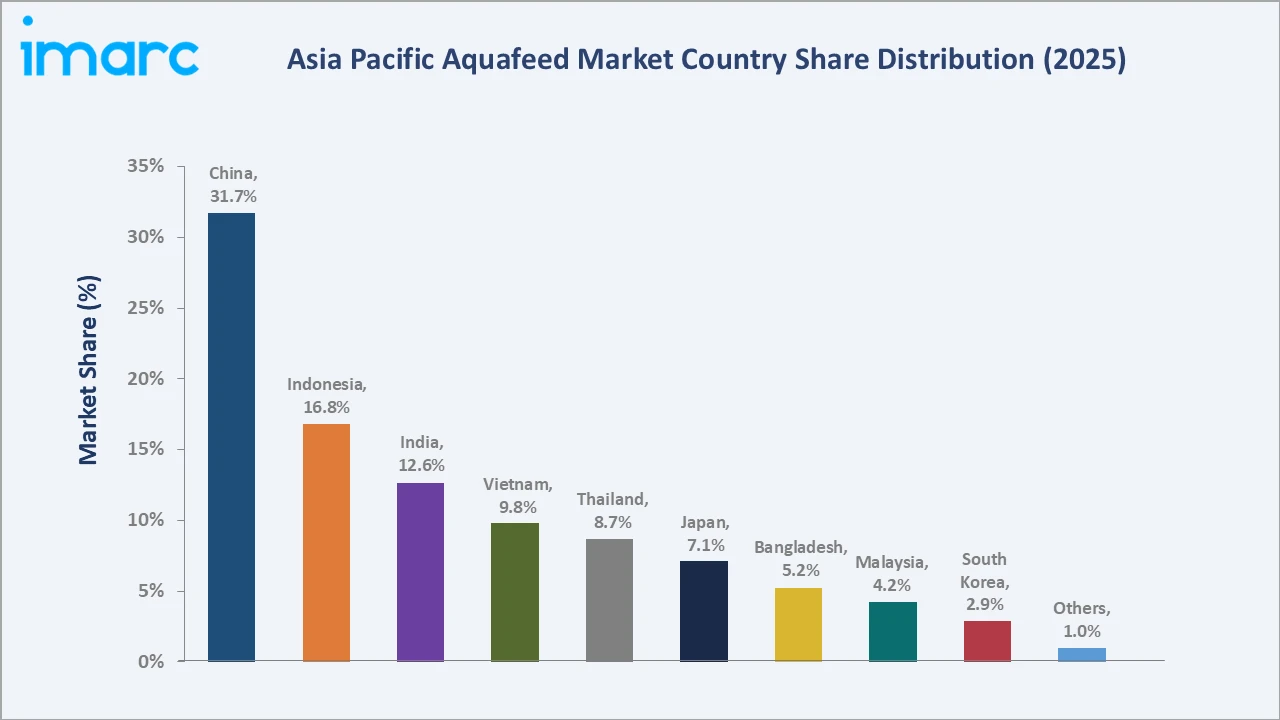
India, at 12.6%, and Vietnam, at 9.8%, represent structurally important markets driven by freshwater aquaculture expansion and export-oriented shrimp farming, respectively. Thailand, Japan, and other regional markets collectively contribute the remaining share through steady aquaculture production and premium seafood demand.
Competitive Landscape
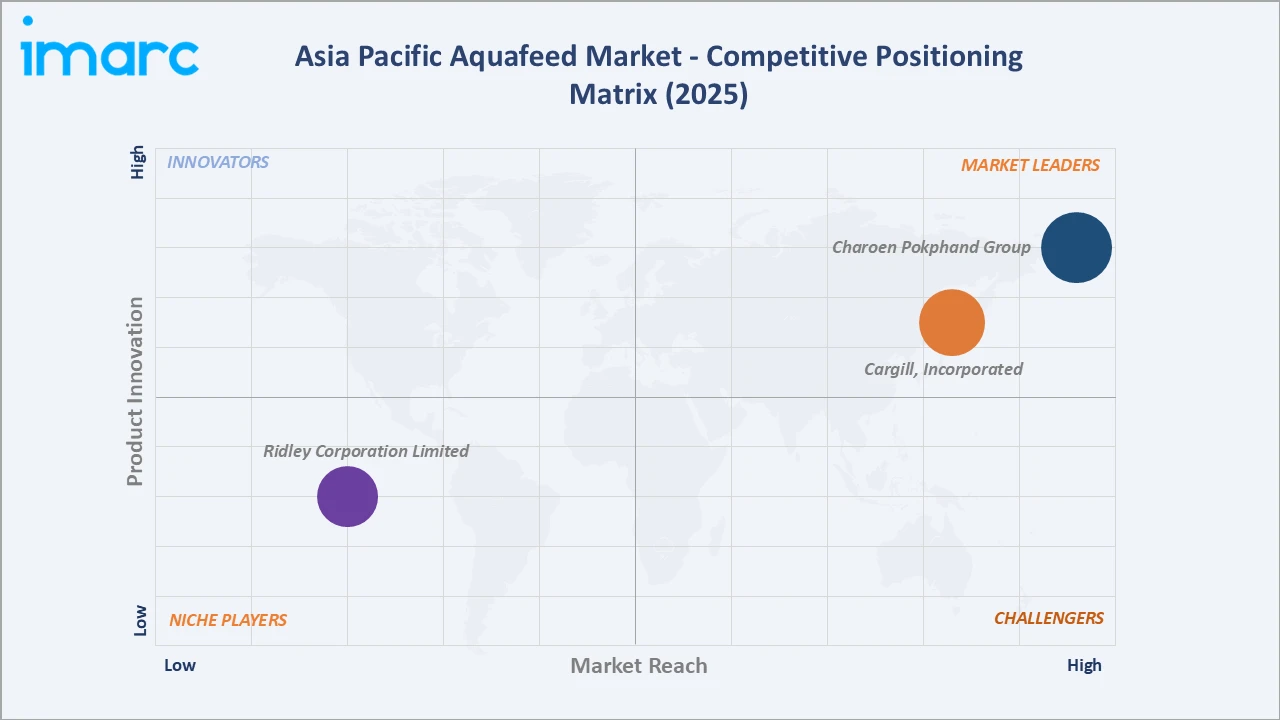
The Asia Pacific aquafeed market competitive landscape is moderately consolidated, comprising global agribusiness conglomerates, specialized aquafeed manufacturers, and regional producers competing across multiple species and formulation segments.
|
Company Name |
Key Products |
Market Position |
Core Strength |
|
Charoen Pokphand Group |
Shrimp Feed, Fish Feed, Aquaculture Solutions |
Market Leader |
Leading regional agribusiness conglomerate with vertically integrated aquaculture and feed operations |
|
Cargill, Incorporated |
Aquafeed, Shrimp Feed, Fish Feed Premixes |
Market Leader |
Global agribusiness leader with extensive aquafeed portfolio and strong regional distribution |
|
Ridley Corporation Limited |
Aquafeed, Fish Feed, Animal Nutrition Solutions |
Niche Player |
Cost-competitive feed solutions with strong regional penetration across Asia Pacific markets |
Key players include Charoen Pokphand Group, Cargill, Incorporated, Ridley Corporation Limited, and others.
Key Company Profiles
Charoen Pokphand Group
Charoen Pokphand Group is a leading Thailand-based agribusiness conglomerate with an extensive aquafeed portfolio spanning shrimp and fish feed sold across Asia Pacific through both direct sales and integrated farming operations.
- Key Products: Shrimp Feed, Fish Feed, Aquaculture Solutions
- Strategic Focus: Expanding vertically integrated aquaculture and feed operations tailored to commercial farming customers across the region. The company continues to deepen partnerships with regional aquaculture farms to strengthen distribution reach across emerging Southeast Asian markets. It is also investing in precision nutrition and biosecurity technology to support disease-resistant feed formulations.
Cargill, Incorporated
Cargill is a global agribusiness company with a strong presence in the aquafeed market through its comprehensive nutrition portfolio serving commercial aquaculture customers across Asia Pacific.
- Key Products: Aquafeed, Shrimp Feed, Fish Feed Premixes
- Strategic Focus: Strengthening its sustainable aquafeed portfolio and expanding distribution across China, India, and Southeast Asia's commercial aquaculture segments. The company is prioritizing partnerships with regional aquaculture farms to improve product availability and technical support. Continued investment in alternative protein sourcing remains central to its competitive positioning.
Market Concentration Analysis
The Asia Pacific aquafeed market is moderately consolidated, with the key players collectively accounting for a meaningful share of premium and mid-tier segment revenue. Regional and local manufacturers account for a substantial share of entry-level and value-tier volume, particularly across India and Indonesia. Market concentration is expected to remain broadly stable over the forecast period as regional manufacturers continue to gain share in price-sensitive segments while global brands retain leadership in the premium and specialty nutrition product tiers. Continued investment in local manufacturing capacity is likely to reinforce the position of established players within the premium segment, even as new entrants target underserved price points across emerging Southeast Asian markets.
Investment & Growth Opportunities
Highest Growth Segments
Vitamins (~8.4% CAGR), amino acids (~7.6% CAGR), soybean-based protein formulations, and alternative protein sources represent the highest-growth investment vectors through 2034.
Emerging Investment Opportunities
Alternative protein and algae-based ingredient development represents the market's highest per-unit-value emerging opportunity, as sustainable, traceable aquafeed formulations command significant price premiums over standard consumer-grade equivalents, with regional certification demand creating a structurally growing demand pool through 2034.
Future Market Outlook (2026-2034)
The Asia Pacific aquafeed market is projected to grow from 54.97 Million Tons in 2025 to 96.78 Million Tons by 2034, delivering a 6.29% CAGR over the forecast period. The market's anchor value of 74.59 Million Tons in 2030 represents an inflection point at which sustainable and alternative-protein formulations are expected to have become the dominant specification across mid-tier and premium segments, precision nutrition technology will have reached greater scale, and fully traceable feed ecosystems will have achieved wider mainstream adoption across the region's leading aquaculture economies.
Two structural forces define market growth through 2034 with strong confidence. The region's compounding seafood demand and aquaculture expansion creates a self-reinforcing demand cycle where production capacity growth begets feed procurement, which begets further aquaculture investment. The sustainability and traceability certification trend across China, India, and Southeast Asia creates an additive demand pool above the already substantial conventional aquafeed base across the region's farming economies.
Research Methodology
Primary Research
Primary research comprised structured interviews with industry stakeholders, including product managers, regional distribution partners, aquaculture farm operators, and feed formulation specialists across China, Indonesia, India, and Vietnam.
Secondary Research
Secondary research encompassed company annual reports, regional aquaculture association data, feed safety regulatory filings, and aquafeed technology industry publications covering the Asia Pacific region.
Forecasting Models
Market volume forecasts were developed using a bottom-up model incorporating regional aquaculture production estimates, average feed conversion ratios by species and ingredient, and premiumization trend adjustments across the historical and forecast periods.
Report Coverage:
| Report Features | Details |
|---|---|
| Base Year of the Analysis | 2025 |
| Historical Period | 2020-2025 |
| Forecast Period | 2026-2034 |
| Units | Million Tons, USD Million |
| Scope of the Report | Exploration of Historical Trends and Market Outlook, Industry Catalysts and Challenges, Segment-Wise Historical and Future Market Assessment:
|
| Ingredients Covered | Soybean, Fish Meal, Corn, Fish Oil, Additives, Others |
| Additives Covered | Amino Acids, Antibiotics, Vitamins, Feed Acidifiers, Others |
| Product Forms Covered | Pellets, Extruded, Powdered, Liquid |
| End Users Covered | Carps, Shrimp, Tilapia, Mollusks, Catfish, Salmon, Lobsters, Others |
| Countries Covered | China, Indonesia, Japan, Bangladesh, Thailand, Vietnam, India, Malaysia, South Korea, Others |
| Companies Covered | Charoen Pokphand Group, Cargill, Incorporated, Ridley Corporation Limited, etc, |
| Customization Scope | 10% Free Customization |
| Post-Sale Analyst Support | 10-12 Weeks |
| Delivery Format | PDF and Excel through Email (We can also provide the editable version of the report in PPT/Word format on special request) |
Frequently Asked Questions About the Asia Pacific Aquafeed Market Report
The Asia Pacific aquafeed market reached 54.97 Million Tons in 2025, driven by the soybean ingredient segment dominant at 36.8%, vitamins leading the additives segment at 31.6%, and China commanding the largest country share at 31.7% through its extensive aquaculture production base and continued technology investment.
The market grows at a 6.29% CAGR during 2026-2034, reaching 96.78 Million Tons by 2034. This growth reflects rising seafood demand, expanding aquaculture production, and continued government support for sustainable aquaculture across the region.
Soybean leads at 36.8% share, driven by its cost-effective protein content and widespread adoption as a sustainable substitute for fish meal. This segment continues to benefit from expanding soybean processing infrastructure across the region.
Vitamins lead at 31.6% through their critical role in supporting immune function and growth rates, creating sustained procurement expansion. Vitamins grow fastest at approximately 8.4% CAGR through continued precision nutrition adoption.
China leads at 31.7% through its extensive aquaculture production capacity, large freshwater and marine farming base, and continued technology investment.
Leading companies include Charoen Pokphand Group, Cargill, Incorporated, Ridley Corporation Limited, and others.
The market is projected to reach approximately 74.59 Million Tons by 2030, with sustainable and alternative-protein formulations becoming the dominant specification across mid-tier and premium segments and precision nutrition technology achieving wider mainstream adoption.
Priority investment opportunities include alternative protein and algae-based ingredient development, precision nutrition formulation technology innovation, and expansion into India's rapidly growing freshwater aquaculture sector.
Need more help?
- Speak to our experienced analysts for insights on the current market scenarios.
- Include additional segments and countries to customize the report as per your requirement.
- Gain an unparalleled competitive advantage in your domain by understanding how to utilize the report and positively impacting your operations and revenue.
- For further assistance, please connect with our analysts.
 Request Customization
 Speak to an Analyst
 Request Brochure
 Inquire Before Buying
Benefits of Customization
- Personalize this research
- Triangulate with your data
- Get data as per your format and definition
- Gain a deeper dive into a specific application, geography, customer, or competitor
- Any level of personalization
Get in Touch With Us
UNITED STATES
Phone: +1-201-971-6302
INDIA
Phone: +91-120-433-0800
UNITED KINGDOM
Phone: +44-753-714-6104
Email: [email protected]
Client Testimonials




.webp)




.webp)













Related Reports

Choose your plan
*Please note that the prices mentioned below are starting prices for each bundle type. Kindly contact our team for further details.*
Single User License
- 1 User License, Access on 2 Devices
- PDF Report + Excel Dataset (Password Protected)
- Lifetime Access
- No Printing Rights
- 10% Free Report Customization
- 10–12 Weeks of Analyst Support
Five User License
- Access for 5 Users, 2 Devices per User
- PDF Report + Excel Dataset (Password Protected)
- Lifetime Access
- Dedicated Account Manager
- 12–14 Weeks of Analyst Support
- No Printing Rights
- 15% Free Report Customization
- 25% Discount on Your Next Purchase
Corporate User License
- Unlimited User Access (Within Your Organization)
- PDF Report + Excel Dataset
- Lifetime Access
- Dedicated Account Manager
- 14–20 Weeks of Analyst Support
- No Printing Rights
- 20% Free Report Customization
- 30% Discount on Your Next Purchase
Essential Insights
What's included:
3 reports
- Lifetime Access
- PDF Reports
- Excel Datasets
- 2 Weeks of Free Analyst Support
- 2 User Licenses
- Access on 2 Devices
- Printing Rights
- Complimentary PowerPoint (PPT) Version
- Complimentary License Upgrade
Professional Access
What's included:
5 reports
- Lifetime Access
- PDF Reports
- Excel Datasets
- 8 Weeks of Free Analyst Support
- 2 User Licenses
- Access on 2 Devices
- Printing Rights
- Complimentary PowerPoint (PPT) Version
- Complimentary License Upgrade
Business Advantage
What's included:
8 reports
- Lifetime Access
- PDF Reports
- Excel Datasets
- 14 Weeks of Free Analyst Support
- 2 User Licenses
- Access on 2 Devices
- Printing Rights
- Complimentary PowerPoint (PPT) Version
- Complimentary License Upgrade
Enterprise Intelligence
What's included:
10 reports
- Lifetime Access
- PDF Reports
- Excel Datasets
- 20 Weeks of Free Analyst Support
- 2 User Licenses
- Access on 2 Devices
- Printing Rights
- Complimentary PowerPoint (PPT) Version
- Complimentary License Upgrade