
India Incense Sticks (Agarbatti & Dhoop) Market Size, Share, Trends and Forecast by Product Type, Demographics, Distribution Channel, and Region, 2026-2034
India Incense Sticks (Agarbatti & Dhoop) Market Summary:
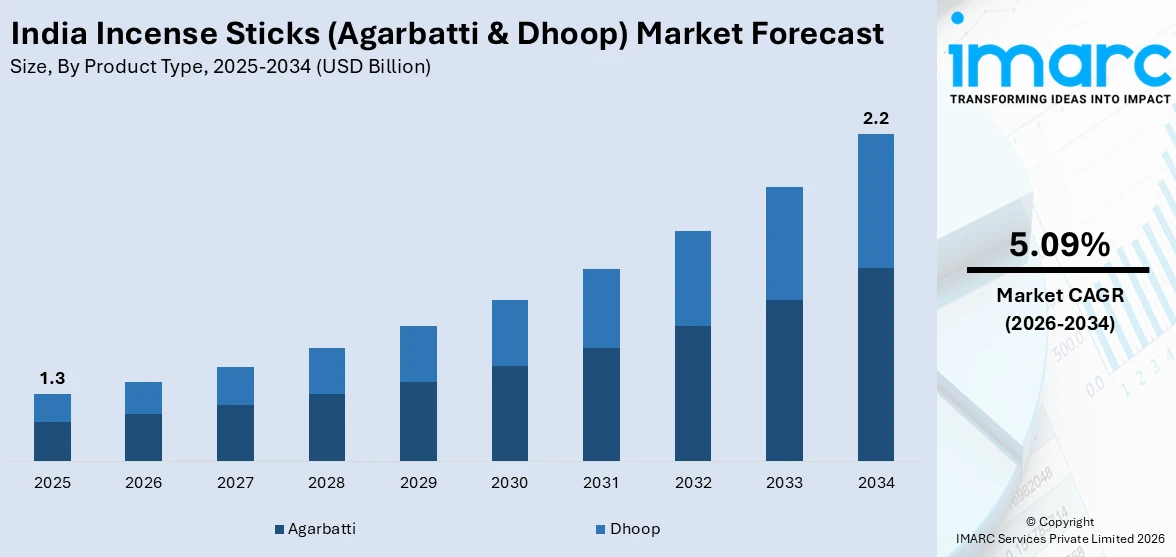
The India incense sticks (agarbatti & dhoop) market grew from USD 1.3 Billion in 2025 to USD 1.5 Billion in 2026 and is projected to reach USD 2.2 Billion by 2034, growing at a compound annual growth rate of 5.09% from 2026-2034.
Sales of incense sticks have been steadily increasing over the past few years, largely due to India's rich spiritual and cultural traditions. Rising consumer inclination toward aromatherapy, wellness rituals, and meditation practices is reinforcing demand. Innovation in fragrances, growing preference for natural and organic formulations, and the expansion of organized retail and e-commerce channels are further strengthening adoption, positioning the market for sustained momentum across diverse consumer segments.
Key Takeaways and Insights:
- By Product Type: Agarbatti dominates the market with a share of 74.5% in 2025, owing to its deep-rooted association with daily worship rituals, wide fragrance availability, and strong consumer preference across both urban and rural households in India.
- By Demographics: Rural leads the market with a share of 58.5% in 2025. This dominance is driven by the enduring significance of traditional rituals, temple-based consumption, and the widespread use of incense products in everyday household spiritual practices across rural India.
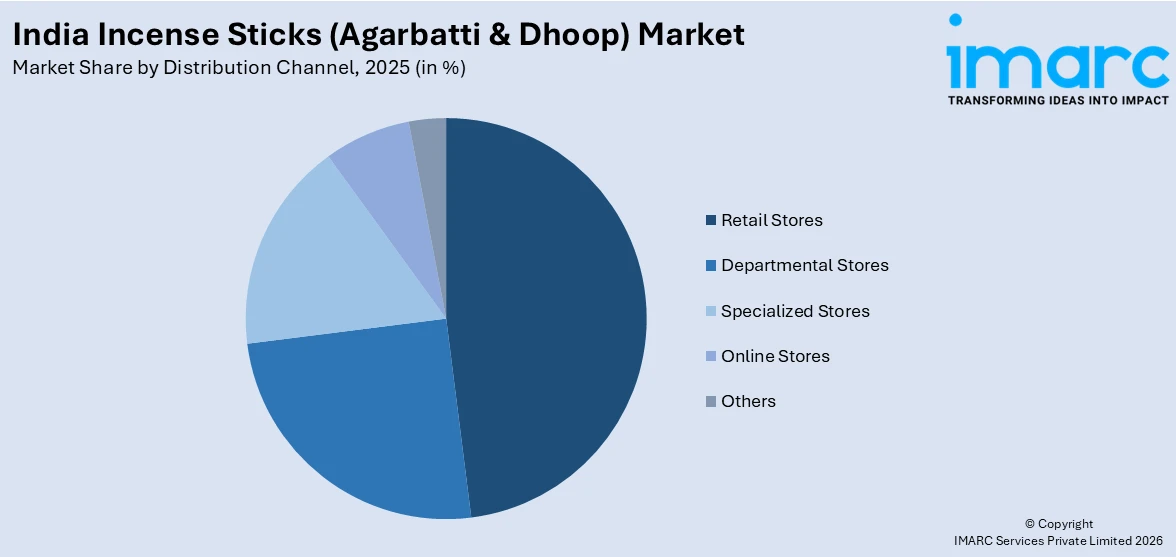
- By Distribution Channel: Retail stores represent the biggest segment with a market share of 48.5% in 2025. This leadership reflects the preference for localized purchasing, the accessibility of neighborhood kirana stores, and the impulse-buying nature of incense products among daily consumers.
- By Region: South India is the largest region with 46.8% share in 2025, driven by the concentration of major agarbatti manufacturing hubs in Karnataka, the presence of a large number of temples, and the deep cultural significance of incense in daily worship.
- Key Players: Key players drive the India incense sticks market by expanding product portfolios, introducing innovative fragrances and eco-friendly formulations, and strengthening distribution networks. Their investments in branding, premiumization, and sustainable manufacturing practices boost awareness, accelerate adoption, and ensure consistent product availability. Some of the key players operating in the market include B. V. Aswathiah & Bros, Hari Darshan Sevashram Private Limited, Hem Corporation Private Limited, ITC Limited, Moksh Agarbattis Company, Mysore Deep Perfumery House (MDPH), N. Ranga Rao & Sons Private Limited, Patanjali Ayurved Limited, and Shree Kalpana Perfumery Works Private Limited.
To get more information on this market Request Sample
The market is advancing as manufacturers, consumers, and industry bodies embrace innovation and sustainability across the fragrance value chain. Deeply embedded in the cultural and spiritual fabric of India, incense sticks remain an integral part of daily worship, meditation, and wellness routines for millions of households. The industry is witnessing a transformative shift toward premium, organic, and charcoal-free formulations as health-conscious consumers seek cleaner and safer alternatives. The growing international demand for Indian agarbatti, supported by expanding export activities to numerous global markets, is further bolstering growth. Enhanced branding strategies, innovative packaging, and the expansion of e-commerce platforms are enabling organized players to penetrate deeper into both domestic and global markets. Government-backed quality standards and sustainable manufacturing initiatives are reinforcing consumer confidence and strengthening the competitive positioning of branded players, supporting the India incense sticks (agarbatti & dhoop) market share.
India Incense Sticks (Agarbatti & Dhoop) Market Trends:
Rising Demand for Organic and Natural Incense Formulations
India is witnessing a significant shift toward organic, charcoal-free, and bamboo-less incense sticks as consumers increasingly prioritize health and environmental sustainability. Manufacturers are reformulating products using natural herbs, essential oils, and recycled floral waste to cater to wellness-conscious buyers. The introduction of national quality certifications and safety standards for agarbatti is further reinforcing this transition by establishing recognized benchmarks for ingredient purity and manufacturing practices. Growing awareness about indoor air quality and the environmental impact of conventional production methods is accelerating consumer preference for cleaner, naturally formulated incense products across both urban and rural markets.
Expansion of Functional and Multi-Purpose Incense Products
The Indian incense market is diversifying beyond traditional worship applications, with growing traction for functional products such as mosquito-repellent and aromatherapy incense sticks. Manufacturers are blending fragrance with pest-control, stress-relief, and air-purification functionalities to create multi-purpose offerings that appeal to a broader consumer base. This trend is driving the growth of the Indian market for incense sticks (agarbatti & dhoop) by attracting consumers who would not have previously used incense. The convergence of wellness, home care, and spiritual product categories is enabling brands to position incense sticks as versatile household essentials rather than purely devotional items.
Growing Premiumization and Brand-Led Market Transformation
The incense sticks market in India is gradually transitioning from an unorganized, commodity-driven segment toward a branded, premium, and value-added category. Consumers are increasingly willing to pay for incense products that offer pure ingredients, artisanal craftsmanship, and sophisticated packaging. Organized players are leveraging sustainability certifications, in-house fragrance research, and digital marketing strategies to differentiate themselves from the largely unbranded mass-market segment. The growing emphasis on traceability, eco-friendly sourcing, and carbon-neutral manufacturing practices is reshaping competitive dynamics, enabling premium brands to build stronger consumer loyalty and command higher margins across domestic and international markets.
Market Outlook 2026-2034:
The India incense sticks (agarbatti & dhoop) market is poised for steady expansion, driven by deepening cultural consumption, premiumization trends, and growing international demand. Ongoing innovation in product formats, fragrance diversity, and eco-friendly manufacturing is expected to attract new consumer segments and strengthen brand loyalty. The market generated a revenue of USD 1.3 Billion in 2025, which is expected to reach USD 1.5 Billion in 2026 and further grow to USD 2.2 Billion by 2034, growing at a compound annual growth rate of 5.09% from 2026-2034. The introduction of BIS quality standards for agarbatti, together with government-backed initiatives to support artisans and cottage industries, is anticipated to enhance product safety, boost consumer confidence, and improve global market access for Indian incense products.
India Incense Sticks (Agarbatti & Dhoop) Market Report Segmentation:
| Segment Category | Leading Segment | Market Share |
|---|---|---|
|
Product Type |
Agarbatti |
74.5% |
|
Demographics |
Rural |
58.5% |
|
Distribution Channel |
Retail Stores |
48.5% |
|
Region |
South India |
46.8% |

Product Type Insights:
- Agarbatti
- Dhoop
Agarbatti dominates the market with a share of 74.5% of the total India incense sticks (agarbatti & dhoop) market in 2025.
Agarbatti remains the most widely consumed incense format in India, deeply embedded in daily worship, festive ceremonies, and spiritual practices. Its popularity is reinforced by extensive fragrance variety, affordability, and widespread availability across retail channels. The bamboo-core stick format enables easy handling and consistent burn quality, making it the preferred choice across diverse demographics. The Indian agarbatti industry, valued at approximately INR 8,000 crore in retail terms, reflecting the product’s ubiquitous presence in Indian homes.
Manufacturers are continually expanding their agarbatti portfolios with innovative fragrances ranging from traditional sandalwood and mogra to contemporary options like green tea, lemongrass, and cinnamon. The shift toward organic, charcoal-free, and bamboo-less agarbatti formulations is attracting health-conscious and environmentally aware consumers. Leading producers are investing in large-scale, modernized manufacturing facilities equipped with advanced machinery to meet rising domestic and international demand. The emphasis on fragrance research, ingredient purity, and sustainable production methods is enabling agarbatti manufacturers to enhance product consistency, scale operations efficiently, and cater to evolving consumer preferences across both traditional and wellness-oriented market segments.
Demographics Insights:
- Urban
- Rural
Rural leads with a share of 58.5% of the total India incense sticks (agarbatti & dhoop) market in 2025.
Rural India constitutes the largest consumption base for incense sticks, driven by the enduring significance of daily worship rituals, temple-centric practices, and traditional household customs. In rural households, agarbatti and dhoop burning is a deeply ingrained daily habit associated with morning and evening prayers. The availability of small, affordable pack sizes through local kirana stores ensures consistent product accessibility. Furthermore, the agarbatti industry provides vital employment opportunities across rural India, with a significant workforce engaged in the sector, a large majority of whom are women contributing to cottage-level production and value addition activities.
Government initiatives such as the Khadi Agarbatti Atmanirbhar Mission (KAAM), launched by the Khadi and Village Industries Commission (KVIC), have further strengthened the rural ecosystem by equipping artisans with automatic agarbatti-making and powder-mixing machines. The mission aims to boost domestic production, create employment for migrant workers and rural women, and reduce dependence on imported raw agarbatti. These efforts are reinforcing rural India’s position as both the primary consumption and production hub for incense sticks nationwide.
Distribution Channel Insights:
Access the comprehensive market breakdown Request Sample
- Retail Stores
- Departmental Stores
- Specialized Stores
- Online Stores
- Others
Retail stores hold the largest share at 48.5% of the total India incense sticks (agarbatti & dhoop) market in 2025.
Retail stores, primarily neighborhood kirana shops and general trade outlets, represent the dominant distribution channel for incense sticks in India. These stores benefit from proximity to consumers, daily foot traffic, and the impulse-purchase nature of low-value incense products. The ability to stock region-specific fragrances and small pack sizes tailored to local preferences further strengthens their appeal. Retail stores generate the majority of total revenue from agarbatti and dhoop products across India, reflecting their critical role in ensuring widespread product reach, availability, and consistent consumer access.
Because the Indian incense sector is so fragmented and organized players only make up a small percentage of total market activity, the traditional retail channel is nonetheless very successful. Local brands and small manufacturers primarily rely on local retail networks for distribution. The channel is changing, though, as branded incense products are increasingly stocked alongside traditional offerings in organized retail and contemporary trade formats. This creates a blended retail environment that supports both mass-market accessibility and premium segment growth across a variety of consumer demographics.
Regional Insights:
- North India
- South India
- East India
- West India
South India dominates the market with a 46.8% share of total India incense sticks (agarbatti & dhoop) market in 2025.
South India is the leading region in the Indian incense sticks market, anchored by Karnataka’s status as the country’s largest agarbatti manufacturing hub, contributing approximately 50% of India’s total production. The region’s dominance is reinforced by favorable geographic conditions, abundant bamboo availability, a robust manufacturing infrastructure, and the deep cultural significance of incense in daily worship and temple rituals. Out of the approximately five lakh people working in the Indian incense sticks industry, an estimated three lakh are based in Karnataka alone.
South India's dominance in the incense stick market is further strengthened by the presence of significant industry giants with headquarters in the area. Strong export infrastructure is another advantage of the area; shipments of agarbatti from southern ports serve a wide range of worldwide markets on several continents. Its position as the hub of India's incense business and aspirations for worldwide trade is further reinforced by the fact that the area is the main location for significant industry conferences and trade shows that unite producers, suppliers, and foreign delegates. Together, these elements establish South India as the leading center for export, innovation, and production.
Market Dynamics:
Growth Drivers:
Why is the India Incense Sticks (Agarbatti & Dhoop) Market Growing?
Deep Cultural and Spiritual Significance Driving Everyday Consumption
In Indian homes, temples, and places of worship, burning incense sticks is still a deeply rooted custom. A steady and non-discretionary demand base is created by the importance of agarbatti and dhoop in daily prayers, festive festivities, and significant occasions. India's varied religious landscape, which includes Buddhism, Jainism, Hinduism, and other religions, guarantees that incense items are used all year round in every part of the country. There is a strong institutional demand channel because there are many temples in the country that perform daily ceremonies that call for incense. This product category is resilient even in economic downturns since incense is culturally associated with purification, positive energy, and spiritual well-being. The market is being further expanded by the increasing usage of incense sticks for aromatherapy, yoga, and meditation in addition to religious purposes. The widespread use of agarbatti in households throughout the nation is indicative of its profound importance in Indian daily life. Increased domestic awareness and consumption of premium products are also being influenced by the growing interest in Indian spirituality and wellness practices around the world.
Innovation in Product Offerings and Fragrance Diversification
The Indian market for incense sticks is rapidly evolving as producers create a wide range of modern perfumes and useful items, going beyond traditional odors. Younger, urban consumers who are looking for new fragrant experiences are drawn to new scent variations like green tea, coffee chocolate, strawberry, cinnamon, and lemongrass. In a market that is largely disorganized and fiercely competitive, this variety helps brands stand out. To meet growing customer concerns about indoor air quality, manufacturers are also investing in low-smoke formulas, charcoal-free sticks, and premium masala agarbatti. The market appeal is being further expanded by the creation of useful incense products. For instance, in early 2024, Godrej Consumer Products Limited introduced Goodknight Agarbatti, India’s first and only government-approved anti-mosquito incense stick, combining fragrance with mosquito-repellent functionality. These innovations are broadening the addressable market opportunity by introducing new product categories into the incense business and drawing in customers who might not have previously used incense.
Expanding Export Opportunities and Government Support
India is the world's biggest manufacturer and exporter of incense sticks, which is driving industry expansion. North America, Europe, Southeast Asia, and Africa are major destination markets for the nation's exports of agarbatti goods. The market for Indian incense has increased dramatically because to the growing interest in yoga, meditation, and holistic well-being around the world. India's competitive advantages allow manufacturers to deliver high-quality products at competitive pricing in the global market. These benefits include low labor costs, the availability of trained artisans, and locally produced raw materials. With the implementation of national quality standards for agarbatti that forbid dangerous chemicals and set criteria for production procedures across several product categories, government policies are further fortifying the industry's foundations. Import limitations on raw agarbatti, along with self-reliance-focused government initiatives to increase domestic production and generate jobs in rural areas, are bolstering local manufacturing capacities, increasing India's export competitiveness, and establishing the nation as the world's center for incense production.
Market Restraints:
What Challenges the India Incense Sticks (Agarbatti & Dhoop) Market is Facing?
Intense Competition from Unorganized Manufacturers
The market for incense sticks in India is extremely fragmented, with the majority of production coming from unorganized firms. Due of their cheaper production costs and lack of quality controls, small-scale manufacturers frequently beat organized brands on price. Establishing uniform quality standards across the market is challenging because of the fierce pricing rivalry, which restricts branded players' ability to increase their margins. Concerns about consumer safety are also raised by the proliferation of unapproved and unregistered items.
Raw Material Supply Chain Vulnerabilities
Natural raw resources including bamboo, charcoal powder, jigat paste, and essential oils, many of which are prone to seasonal availability and price swings, are crucial to the incense stick industry. Periodic supply constraints are caused by regulations governing the harvesting of bamboo and the sourcing of particular forest products. Furthermore, despite recent government import limits, the reliance on imported raw agarbatti from nations like China and Vietnam creates supply chain vulnerabilities that may have an impact on pricing stability and manufacturing uniformity.
Growing Health and Environmental Concerns
Certain customer segments are becoming more cautious due to growing understanding of the possible health impacts of indoor smoke exposure from burning incense sticks. Some health-conscious consumers have chosen to cut back on their use of incense or look for low-smoke alternatives due to studies that link extended incense smoke inhalation to respiratory problems. Furthermore, manufacturers are under pressure to reformulate products due to environmental sustainability concerns about deforestation for the manufacturing of charcoal and bamboo, which could raise production costs and undermine the affordability of mass-market offerings.
Competitive Landscape:
The market for incense sticks (agarbatti and dhoop) in India is growing more dynamic as organized manufacturers bolster their market share by developing new products, differentiating their brands, and expanding their distribution networks. To increase their market share in the historically unorganized sector, businesses are investing in high-end and environmentally friendly product lines, cutting-edge manufacturing techniques, and digital marketing platforms. By placing a strategic focus on quality certifications, sustainable sourcing, and fragrance research, branded players are able to differentiate their products and gain the trust of consumers. While investments in export-focused infrastructure and BIS-compliant manufacturing are equipping organized companies for greater competitiveness in both domestic and foreign markets, partnerships with e-commerce platforms and contemporary retail chains are further broadening market reach.
Some of the key players include:
- B. V. Aswathiah & Bros
- Hari Darshan Sevashram Private Limited
- Hem Corporation Private Limited
- ITC Limited
- Moksh Agarbattis Company
- Mysore Deep Perfumery House (MDPH)
- N. Ranga Rao & Sons Private Limited
- Patanjali Ayurved Limited
- Shree Kalpana Perfumery Works Private Limited
India Incense Sticks (Agarbatti & Dhoop) Market Report Coverage:
| Report Features | Details |
|---|---|
| Base Year of the Analysis | 2025 |
| Historical Period | 2020-2025 |
| Forecast Period | 2026-2034 |
| Units | Billion USD, Units |
| Scope of the Report |
Exploration of Historical Trends and Market Outlook, Industry Catalysts and Challenges, Segment-Wise Historical and Future Market Assessment:
|
| Product Types Covered | Agarbatti, Dhoop |
| Demographics Covered | Urban, Rural |
| Distribution Channel Covered | Retail Stores, Departmental Stores, Specialized Stores, Online Stores, Others |
| Region Covered | North India, South India, East India, West India |
| Companies Covered | B. V. Aswathiah & Bros, Hari Darshan Sevashram Private Limited, Hem Corporation Private Limited, ITC Limited, Moksh Agarbattis Company, Mysore Deep Perfumery House (MDPH), N. Ranga Rao & Sons Private Limited, Patanjali Ayurved Limited and Shree Kalpana Perfumery Works Private Limited |
| Customization Scope | 10% Free Customization |
| Post-Sale Analyst Support | 10-12 Weeks |
| Delivery Format | PDF and Excel through Email (We can also provide the editable version of the report in PPT/Word format on special request) |
Frequently Asked Questions About the India Incense Sticks Market Report
The India incense sticks (agarbatti & dhoop) market size increased from USD 1.3 Billion in 2025 to USD 1.5 Billion in 2026.
The India incense sticks (agarbatti & dhoop) market is expected to grow at a compound annual growth rate of 5.09% from 2026-2034 to reach USD 2.2 Billion by 2034.
Agarbatti dominated the market with a share of 74.5%, driven by its deep-rooted association with daily worship rituals, extensive fragrance availability, and widespread consumer preference across both urban and rural households in India.
Key factors driving the India incense sticks (agarbatti & dhoop) market include deep cultural and spiritual consumption traditions, innovative product diversification, expanding export opportunities, government support for domestic manufacturing, and rising consumer interest in wellness and aromatherapy applications.
Major challenges include intense competition from unorganized manufacturers, raw material supply chain vulnerabilities, health concerns related to indoor smoke exposure, regulatory complexities for exports, and sustainability pressures on traditional manufacturing practices.
Need more help?
- Speak to our experienced analysts for insights on the current market scenarios.
- Include additional segments and countries to customize the report as per your requirement.
- Gain an unparalleled competitive advantage in your domain by understanding how to utilize the report and positively impacting your operations and revenue.
- For further assistance, please connect with our analysts.
 Request Customization
 Speak to an Analyst
 Request Brochure
 Inquire Before Buying
Benefits of Customization
- Personalize this research
- Triangulate with your data
- Get data as per your format and definition
- Gain a deeper dive into a specific application, geography, customer, or competitor
- Any level of personalization
Get in Touch With Us
UNITED STATES
Phone: +1-201-971-6302
INDIA
Phone: +91-120-433-0800
UNITED KINGDOM
Phone: +44-753-714-6104
Email: [email protected]
Client Testimonials




.webp)




.webp)













Related Reports

Choose your plan
*Please note that the prices mentioned below are starting prices for each bundle type. Kindly contact our team for further details.*
Single User License
- 1 User License, Access on 2 Devices
- PDF Report + Excel Dataset (Password Protected)
- Lifetime Access
- No Printing Rights
- 10% Free Report Customization
- 10–12 Weeks of Analyst Support
Five User License
- Access for 5 Users, 2 Devices per User
- PDF Report + Excel Dataset (Password Protected)
- Lifetime Access
- Dedicated Account Manager
- 12–14 Weeks of Analyst Support
- No Printing Rights
- 15% Free Report Customization
- 25% Discount on Your Next Purchase
Corporate User License
- Unlimited User Access (Within Your Organization)
- PDF Report + Excel Dataset
- Lifetime Access
- Dedicated Account Manager
- 14–20 Weeks of Analyst Support
- No Printing Rights
- 20% Free Report Customization
- 30% Discount on Your Next Purchase
Essential Insights
What's included:
3 reports
- Lifetime Access
- PDF Reports
- Excel Datasets
- 2 Weeks of Free Analyst Support
- 2 User Licenses
- Access on 2 Devices
- Printing Rights
- Complimentary PowerPoint (PPT) Version
- Complimentary License Upgrade
Professional Access
What's included:
5 reports
- Lifetime Access
- PDF Reports
- Excel Datasets
- 8 Weeks of Free Analyst Support
- 2 User Licenses
- Access on 2 Devices
- Printing Rights
- Complimentary PowerPoint (PPT) Version
- Complimentary License Upgrade
Business Advantage
What's included:
8 reports
- Lifetime Access
- PDF Reports
- Excel Datasets
- 14 Weeks of Free Analyst Support
- 2 User Licenses
- Access on 2 Devices
- Printing Rights
- Complimentary PowerPoint (PPT) Version
- Complimentary License Upgrade
Enterprise Intelligence
What's included:
10 reports
- Lifetime Access
- PDF Reports
- Excel Datasets
- 20 Weeks of Free Analyst Support
- 2 User Licenses
- Access on 2 Devices
- Printing Rights
- Complimentary PowerPoint (PPT) Version
- Complimentary License Upgrade