Top Indian Handicrafts Companies
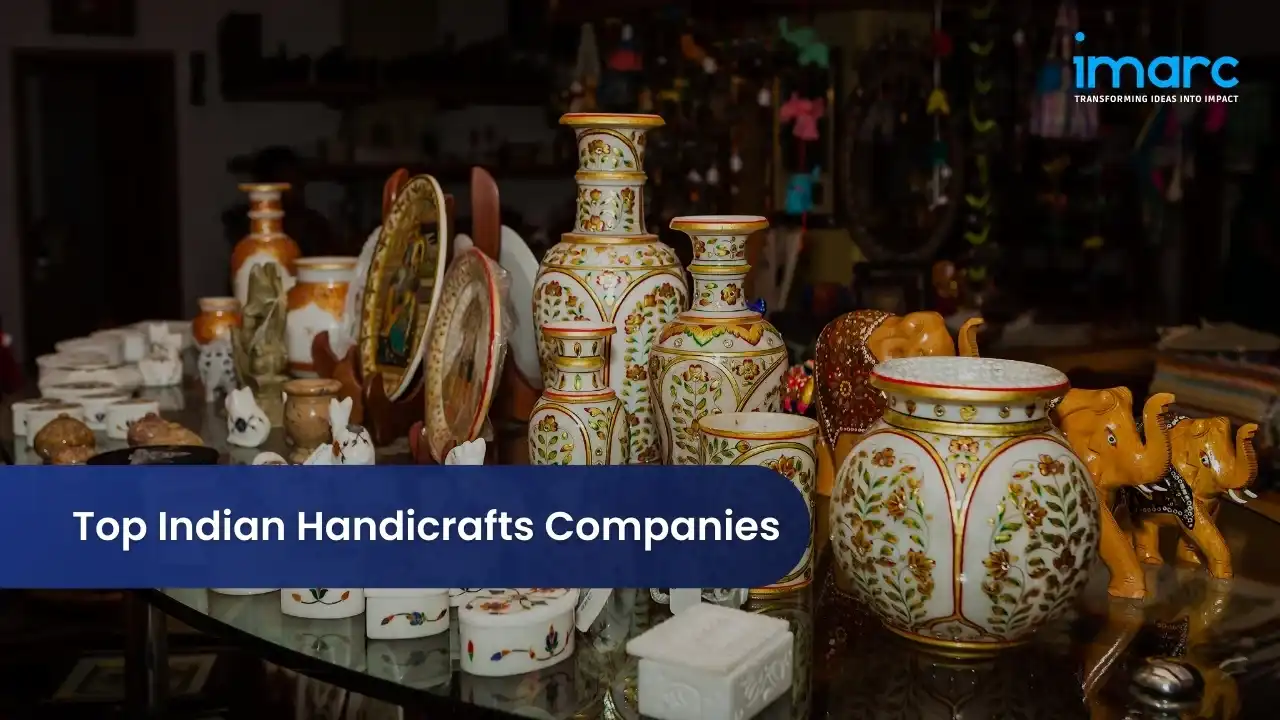
Anokhi, Asian Handicrafts Private Limited, and Gangamani Fashions (Art & Crafts) rank among the top three companies shaping the India handicrafts industry. The market was valued at USD 4,856.73 Million in 2025 and is projected to reach USD 8,299.45 Million by 2034, growing at a CAGR of 6.13% during 2026–2034.
Expanding travel and tourism infrastructure across India is creating substantial growth opportunities for artisan communities, with domestic and international visitors consistently choosing handcrafted souvenirs over mass-produced alternatives. Export volumes have surged across recent years. Through the National Handicraft Development Programme and the Pehchan artisan identification initiative, craftspersons receive infrastructure development, skill training, marketing support, and direct financial assistance that collectively strengthen their competitive position in domestic and export markets.
Digital transformation is expanding market reach and opportunities for traditional artisans. Across rural regions of India, e-commerce platforms enable craftspersons to connect directly with global buyers without traditional intermediaries, accelerating rapidly as smartphone penetration deepens. Launched in November 2024 by the Union Social Justice and Empowerment Ministry, the Tulip portal formalizes digital access for marginalized artisan communities, while collaborations between contemporary designers and craftspersons produce hybrid pieces that fuse heritage techniques with modern aesthetics appealing to international luxury buyers.
Geographic Distribution:
With a 31% market share and established craft clusters spanning Rajasthan, Gujarat, Maharashtra, and Madhya Pradesh, West and Central India supplies the bulk of India’s exportable handicrafts. Jaipur’s block-printing artisans supply brands, including Anokhi, and the Export Promotion Council for Handicrafts tracks Kutch embroidery alongside Madhya Pradesh’s Chanderi and Maheshwari textiles as top-earning international categories.
North India contributes strongly through Uttar Pradesh’s Moradabad and Saharanpur clusters, where HN Handicrafts maintains metalwork and woodcarving operations serving export buyers across North America, Europe, and emerging markets in Southeast Asia. South India brings Karnataka’s organic fiber traditions into focus. Varnam Craft Collective’s fair-trade supply chain in Karnataka directly connects rural artisans with premium international buyers, underpinned by Craft Council of India certification standards.
East India is an emerging growth front. West Bengal’s Dokra metalwork and Odisha’s Pattachitra paintings are commanding rising international collector interest at premium price points. Government-backed Geographical Indication (GI) tagging, export promotion schemes, and digital marketplace access are further accelerating East India’s artisanal sector visibility and global demand.
Key Market Highlights:
- Government-backed artisan welfare schemes are fueling market expansion. Increasing domestic and international tourist footfall is strengthening demand for authentic, locally crafted souvenirs, supporting artisan livelihoods and reinforcing the growth momentum of the market.
- Digital platforms, including dedicated government portals and e-commerce marketplaces, are transforming distribution by enabling direct artisan-to-consumer transactions, eliminating intermediaries and widening the global reach of India’s craft communities.
- Woodware holds an 18% share of the India handicrafts market, based on product type. The segment expansion is anchored by demand for wood-based decorative items and furniture produced in Saharanpur, Jodhpur, and Kerala craft clusters.
- Independent retailers lead the India handicrafts distribution channel landscape with a 26% share, offering curated artisanal selections, direct artisan-community sourcing relationships, and personalized service that resonates with discerning buyers.
- Residential exhibits a clear dominance in the end use segment with a 64% share, propelled by rising home décor spending, cultural affinity for handmade products, urban housing growth, and increasing preference for artisanal aesthetics.
- West and Central India dominates the regional landscape with a 31% market share, powered by Gujarat’s Kutch embroidery, Rajasthan’s block-printing clusters, and Madhya Pradesh’s heritage weaving traditions.
- India’s GI tagging framework, export compliance standards enforced by the Export Promotion Council for Handicrafts, and the National Handicraft Development Programme collectively regulate product authenticity, quality benchmarks, and artisan welfare across the sector.
- Anokhi leads through certified ethical block-printing supply chains, Varnam Craft Collective advances World Fair Trade Organization-aligned artisan models, and Kalagya Arts & Crafts targets digital-native international consumers through dedicated e-commerce investment and contemporary product adaptation strategies.
This article provides a comprehensive analysis of the top India handicrafts companies in the world, including their market position, geographic presence, product offerings, and strategic developments. It highlights how leading players are shaping the India handicrafts market through innovation, expansion, and competitive strategies.
Top Companies in the India Handicrafts Industry:
| Company Name | Headquarters | Founded Year | Primary Market Focus |
|---|---|---|---|
| Anokhi | Jaipur, India | 1970 | Ethical, Traditional |
| Asian Handicrafts Private Limited | New Delhi, India | 2003 | Export, Artisanal |
| Gangamani Fashions (Art & Crafts) | Jaipur, India | 1998 | Luxury, Corporate Gifting |
| HN Handicrafts | Uttar Pradesh, India | 1992 | Diversified, Export |
| Indian Handicrafts Company | Delhi, India | 2014 | Cultural Heritage |
| Kalagya Arts & Crafts | Rajasthan, India | 2016 | Urban, Contemporary |
| Nirmala Handicrafts | Jaipur, India | 1990 | Marble, Stone Crafts |
| Varnam Craft Collective | Karnataka, India | 2012 | Sustainable, Fair Trade |
Company Profiles:
1. Anokhi
Founded in 1970 and headquartered in Jaipur, India, Anokhi has built over five decades of international recognition in hand-block printed textiles, maintaining environmental stewardship alongside an unwavering commitment to Rajasthani craft heritage. Retail stores span India, the United Kingdom, Switzerland, and Southeast Asia. Sourcing exclusively from artisan cooperatives in and around Jaipur, Anokhi sustains livelihoods for traditional block-printers while making authentic handcrafted goods accessible to discerning consumers across domestic and international markets.
- Regional Dominance: India (Rajasthan, Delhi, Mumbai); Export linkage to the United Kingdom, Switzerland, Southeast Asia.
- Product Line: Hand-block printed cotton fabrics, apparel (kurtas, shirts, dresses), home furnishings (bed linen, cushion covers, curtains), accessories (scarves, tote bags).
- Strategic Shift: The firm is focusing on the expansion of direct-to-consumer (D2C) digital retail channels through a revamped e-commerce platform and partnerships with sustainable fashion marketplaces in Europe, targeting eco-conscious international consumers seeking certified hand-block printed textiles with documented artisan provenance.
| Feature | Details |
|---|---|
| Establishment | 1970 |
| Headquarters | Jaipur, India |
| Website | https://www.anokhi.com/ |
| Core Strength | Ethical hand-block printing with documented artisan supply chains |
| Key Innovation | Expansion into sustainable fashion retail with digital-first international reach |
2. Asian Handicrafts Private Limited
Founded in 2003 and headquartered in New Delhi, India, Asian Handicrafts Private Limited has established a strong reputation as a manufacturer and exporter of diverse artisanal products, retaining genuine production techniques while integrating modern design inputs and rigorous quality control. Export relationships span Europe, North America, and the Middle East. Competing on authenticity rather than price, the company sustains direct community partnerships with traditional artisan clusters, producing goods that consistently meet the quality expectations of international buyers.
- Regional Dominance: India (Delhi, Rajasthan, Uttar Pradesh); Export linking to Europe, North America, Middle East.
- Product Line: Wooden handicrafts (carved furniture, decorative showpieces), metal crafts (brass and copper artware), traditional Indian fabrics, stone carvings, gifting accessories.
- Strategic Shift: The firm prioritizes the implementation of ISO-compliant quality management systems across production facilities to improve delivery consistency for European B2B retail partners, targeting bulk export contracts with international home décor chains seeking verified artisanal supply credentials.
| Feature | Details |
|---|---|
| Establishment | 2003 |
| Headquarters | New Delhi, India |
| Website | www.asianhandicrafts.com |
| Core Strength | Diverse artisanal product range with traditional craftsmanship and modern quality standards |
| Key Innovation | ISO-compliant quality management for scalable export operations |
3. Gangamani Fashions (Art & Crafts)
Founded in 1998 and headquartered in Jaipur, India, Gangamani Fashions (Art & Crafts) has built a distinguished reputation as a manufacturer, exporter, and supplier of premium Indian handicrafts, combining mastery of regional craft traditions with strong corporate gifting capabilities. Export relationships span North America, Europe, and Asia-Pacific. Recognized for extensive portfolio diversity, the company seamlessly integrates decorative luxury goods with practical utility products across marble, wood, brass, and gemstone categories, serving both retail and institutional buyer segments.
- Regional Dominance: India (Rajasthan, Delhi); Exports span across North America, Europe, Asia-Pacific.
- Product Line: Marble and wooden handicrafts, brass artware, gemstone paintings, Dokra and Meenakari creations, customized corporate gifts, silver-plated products, gemstone-adorned pen holders, decorative clocks, marble tile paintings.
- Strategic Shift: Gangamani Fashions (Art & Crafts) is working towards the expansion of the corporate and promotional gifting segment through customizable premium artisanal product lines targeting multinational corporations in the technology, banking, and hospitality sectors that are seeking uniquely crafted branded gifting solutions with documented Indian provenance.
| Feature | Details |
|---|---|
| Establishment | 1998 |
| Headquarters | Jaipur, India |
| Website | https://indianethnicgifts.com/ |
| Core Strength | Diverse premium handicrafts portfolio spanning luxury décor and customized corporate gifting |
| Key Innovation | Scalable corporate gifting customization platform with artisan-to-enterprise supply chain integration |
4. HN Handicrafts
Founded in 1992 and headquartered in Uttar Pradesh, India, HN Handicrafts has emerged as a diversified manufacturer and trader of traditional handicraft items with deep proficiency in pottery, metalwork, woodcarving, and textile arts across multiple regional formats. Distribution is strong across India and overseas. Serving domestic gifting markets alongside ethnic art collectors worldwide, the company’s core mission centers on scalable production processes that preserve traditional craftsmanship quality without compromising modern requirements for delivery consistency and competitive pricing.
- Regional Dominance: India (Uttar Pradesh, Rajasthan, Delhi); Exports markets include North America, Europe.
- Product Line: Pottery and ceramic ware, metalwork (brass, copper, iron), woodcarved decorative items, textile art products, traditional collectibles and gifting accessories.
- Strategic Shift: The company is making investments in production standardization through India’s Scheme of Fund for Regeneration of Traditional Industries (SFURTI) and upgrading manufacturing processes to enable consistent delivery timelines for overseas wholesale buyers and reduce operational variability across product categories.
| Feature | Details |
|---|---|
| Establishment | 1992 |
| Headquarters | Uttar Pradesh, India |
| Website | https://www.hnhandicrafts.com/ |
| Core Strength | Scalable multi-craft production preserving traditional quality across pottery, metalwork, and textiles |
| Key Innovation | SFURTI-backed production standardization for export-grade delivery consistency |
5. Indian Handicrafts Company
Founded in 2014 and headquartered in Delhi, India, Indian Handicrafts Company has developed mastery in Rajasthani craft traditions, including blue pottery, miniature paintings, and wood carvings, preserving authentic techniques passed through generations of trained artisans. Rajasthan and Delhi anchor its operations. Anchoring itself through formal ties with government tourism boards and cultural institutions, the company positions its craft studio as a proponent of Rajasthani heritage, with ongoing skill development programs reinforcing artisan community support and product quality standards.
- Regional Dominance: India (Delhi, Rajasthan).
- Product Line: Blue pottery (vases, bowls, tiles), miniature paintings, wood carvings (furniture, decorative panels), traditional Rajasthani handicraft collectibles, cultural souvenirs.
- Strategic Shift: The company is transitioning toward an experience-led business model, integrating craft production with cultural storytelling and immersive retail formats. By emphasizing heritage authenticity, artisan skill development, and D2C engagement, it is enhancing value realization and brand positioning in premium handicraft segments.
| Feature | Details |
|---|---|
| Establishment | 2014 |
| Headquarters | Delhi, India |
| Website | https://www.indianhandicraftscompany.com/ |
| Core Strength | Authenticity in Rajasthani craft traditions with strong government and tourism sector linkages |
| Key Innovation | Experiential tourism model integrating craft production with heritage tourism infrastructure |
6. Kalagya Arts & Crafts
Kalagya Arts & Crafts, which was founded in 2016 and has its headquarters in Rajasthan, India, creates handcrafted home furnishings, art sculptures, and utility items that blend traditional Indian aesthetics with contemporary lifestyle demands, positioning itself as a forward-thinking digital player in a largely offline industry. North America, Europe, and Australia are among the export markets catered to. By making significant investments in digital marketing and online commerce infrastructure, the business has established direct customer interactions that completely avoid traditional distribution middlemen.
- Regional Dominance: India (Rajasthan, urban markets across major cities); Export linkage to North America, Europe, Australia.
- Product Line: Handmade home furnishings, art sculptures, utility art items, contemporary home décor, handcrafted wall art, artisanal gifting accessories.
- Strategic Shift: D2C digital commerce expansion through a dedicated international e-commerce platform with integrated shipping logistics is what Kalagya Arts & Crafts is focusing on. The firm is targeting millennial consumers seeking handmade Indian home décor with verified artisan credentials and modern purchase convenience.
| Feature | Details |
|---|---|
| Establishment | 2016 |
| Headquarters | Rajasthan, India |
| Website | https://www.kalagya.com/ |
| Core Strength | Digital-first customer acquisition with traditional handcraft authenticity for urban and global markets |
| Key Innovation | Dedicated international e-commerce platform with end-to-end artisan-to-consumer supply chain |
7. Nirmala Handicrafts
Founded in 1990 and headquartered in Jaipur, India, Nirmala Handicrafts has built a distinguished reputation as a specialist in marble and stone handicrafts, drawing on the centuries-old carving traditions of the Agra heritage belt. Collectors and international visitors form its core buyer base. Integrating modern precision instruments with traditional hand-carving, the company produces complex carved designs, while sustainable raw material sourcing and craftsman training programs preserve stone-working techniques across artisan generations.
- Regional Dominance: India (Rajasthan, Uttar Pradesh, Agra heritage belt); Export markets include North America, Europe, Middle East.
- Product Line: Decorative marble items, miniature Taj Mahal replicas, marble sculptures, architectural stone elements, carved stone panels, marble inlay work (Pietra Dura), stone functional accessories.
- Strategic Shift: Nirmala Handicrafts is diversifying beyond souvenir-oriented marble replicas into architectural marble panels and custom interior décor pieces commissioned by hospitality brands, targeting premium margins in the luxury hotel fit-out and high-end interior design segment across India.
| Feature | Details |
|---|---|
| Establishment | 1990 |
| Headquarters | Jaipur, India |
| Website | https://nirmalahandicraft.com/ |
| Core Strength | Mastery of marble and stone carving with strong Agra heritage craft credentials |
| Key Innovation | Expansion into hospitality and luxury interior décor with custom architectural stone commissions |
8. Varnam Craft Collective
Founded in 2012 and headquartered in Karnataka, India, Varnam Craft Collective operates as a mission-driven enterprise linking rural artisans with global markets, ensuring fair economic returns for craftsperson communities across South and East India. Rural artisans retain pricing control directly. Specializing in handwoven fabrics, natural fiber products, and organic-dyed textiles, the collective maintains strong commitments to environmental stewardship and social responsibility, building a D2C model that provides favorable pricing outcomes for craftspersons and competitive market access for international buyers.
- Regional Dominance: India (Karnataka, South India, East India artisan communities).
- Product Line: Handwoven fabrics, natural fiber products (jute, bamboo, grass weaves), organic-dyed textiles, sustainable home décor, eco-friendly gifting accessories, artisanal apparel.
- Strategic Shift: In December 2025, Varnam Craft Collective introduced a new character-based collection named The Snugglewalas. The product range was launched with a unique presentation at the Craft Council of Telangana. The set featured 12 meticulously made toy characters, each possessing eccentric traits, including a crocodile fond of lilies, a bee that detests effort, and a cow bursting with diva vibes.
| Feature | Details |
|---|---|
| Establishment | 2012 |
| Headquarters | Karnataka, India |
| Website | https://varnamstore.in/ |
| Core Strength | Fair-trade certified supply chain with direct artisan-to-consumer commerce model |
| Key Innovation | Launched character-driven Snugglewalas collection with unique storytelling and playful traits (December 2025) |
Frequently Asked Questions:
Q1. What is the current market size of the India handicrafts industry?
The India handicrafts market was valued at USD 4,856.73 Million in 2025. IMARC Group projects the market to reach USD 8,299.45 Million by 2034, growing at a CAGR of 6.13% during 2026–2034.
Q2. Who are the top India handicrafts companies?
The leading India handicrafts companies include Anokhi, Asian Handicrafts Private Limited, and Gangamani Fashions (Art & Crafts). These firms are leveraging skilled artisan networks and catering to both domestic and international markets through curated collections and premium retail channels.
Q3. Which segment is growing the fastest?
Woodware leads the product type segment with an 18% share. Growing consumer preference for eco-friendly, wood-based decorative items and the availability of technology upgradation centers in Saharanpur and Jodhpur are accelerating segment output and export competitiveness.
Q4. Which region dominates the India handicrafts market share?
West and Central India dominates the India handicrafts market, holding 31% market share. Rajasthan contributes substantially through renowned clusters in Jaipur, Jodhpur, and Udaipur, each specializing in distinctive craft traditions that attract global buyers and institutional collectors.
Q5. How are leading companies gaining a competitive advantage?
Leading India handicrafts firms are gaining advantage through digital commerce investment, fair-trade certification, and artisan community integration. These firms leverage e-commerce platforms, social media marketing, and virtual exhibitions to reach global consumers, while fair-trade practices and community engagement enhance brand credibility and preserve traditional craftsmanship skills.
About Author:
|
Kailash Soni Senior Team Manager – Market Research (Retail) at IMARC Services Private Limited Kailash Soni is a senior team manager with deep expertise in the retail sector, covering e-commerce, brick-and-mortar formats, D2C brands, omnichannel strategies, and retail technology. He has strong experience in consumer behaviour research, footfall analysis, category management studies, and competitive retail benchmarking for clients across FMCG majors, retail chains, and digital commerce platforms. Kailash has a sharp understanding of evolving shopper journeys and the technology stack enabling next-generation retail experiences. Outside of work, he enjoys graphic design and tracking emerging consumer trends. |