
Brazil IT Training Market Size, Share, Trends and Forecast by Application, End User, and Region, 2026-2034
Brazil IT Training Market Summary:
The Brazil IT training market size was valued at USD 1,837.63 Million in 2025 and is projected to reach USD 3,086.09 Million by 2034, growing at a compound annual growth rate of 5.93% from 2026-2034.
The Brazil IT training market is experiencing robust expansion, driven by accelerating digital transformation across industries, growing demand for specialized technology skills, and increasing corporate investments in workforce development. Rising adoption of cloud computing, artificial intelligence (AI), and cybersecurity solutions is propelling the need for comprehensive training programs. Government-backed digital inclusion initiatives and partnerships between training providers and enterprises are further strengthening enrollment growth and expanding access to advanced IT skill development across the country.
Key Takeaways and Insights:
- By Application: Cyber security training dominates the market with a share of 32% in 2025, owing to escalating cyber threats targeting Brazilian organizations, stringent data protection regulations, and growing corporate investments in security awareness programs. The rising sophistication of digital attacks is fueling demand for specialized cybersecurity workforce training.
- By End User: Corporate leads the market with a share of 60% in 2025. This dominance is driven by enterprises prioritizing employee upskilling to maintain competitiveness amid rapid technological evolution, digital transformation initiatives, and the critical need to address the projected shortage of information technology (IT) professionals.
- Key Players: Key players drive the Brazil IT training market by expanding course portfolios, enhancing certification programs, and strengthening partnerships with technology vendors. Their investments in online learning platforms, corporate training solutions, and localized content development boost accessibility, accelerate skill acquisition, and ensure consistent training delivery across diverse enterprise segments nationwide.
The Brazil IT training market is witnessing transformative growth, as organizations across the nation recognize the strategic importance of developing a digitally skilled workforce to navigate the evolving technological landscape. The country's ambitious digital transformation agenda, supported by government initiatives and substantial private sector investments, is creating unprecedented demand for specialized IT education programs. Corporate enterprises are increasingly allocating significant budgets to employee training. The market benefits from a thriving technology ecosystem, with major metropolitan centers, including São Paulo, Rio de Janeiro, and Brasília, serving as primary hubs for IT training activities due to their concentration of corporate headquarters and educational institutions. In September 2024, Microsoft revealed plans to train 5 Million Brazilians in AI skills by 2027, representing a transformative commitment to digital workforce development. The proliferation of e-learning platforms and blended learning models has expanded accessibility, enabling organizations to deliver consistent, scalable training programs while accommodating diverse learning preferences and geographical constraints across the Brazil IT training market share.
Brazil IT Training Market Trends:
Accelerating Integration of AI in Training Curricula
The integration of AI into IT training programs is reshaping the educational landscape across Brazil. Organizations are increasingly incorporating AI-focused modules, covering machine learning (ML), generative AI, and automation technologies into their training portfolios. As per IMARC Group, the Brazil generative AI market size reached USD 371.2 Million in 2025. This trend reflects the broader technological shift occurring across industries, with enterprises seeking professionals capable of developing and implementing AI-driven solutions. The growing emphasis on AI competencies is enabling Brazilian professionals to contribute meaningfully to innovative projects while positioning organizations for competitive advantages in the digital economy.
Rising Adoption of Cloud-Based Learning Platforms and Certification Programs
Cloud-based learning platforms are experiencing substantial adoption across the Brazil IT training market, as organizations seek flexible, scalable training solutions. The shift towards online and hybrid learning models enables enterprises to deliver consistent training experiences to geographically dispersed workforces. As per the Work Life Experience survey, conducted by Sodexo in 2023, in Brazil, 54% of participants utilized the hybrid work model, averaging 2.1 days of remote work per week. Major technology vendors are expanding their certification programs in Portuguese, enhancing accessibility for Brazilian professionals seeking industry-recognized credentials. This trend supports continuous professional development while reducing infrastructure costs associated with traditional classroom-based training approaches.
Growing Emphasis on Cybersecurity Workforce Development and Specialized Training
Cybersecurity training has emerged as a critical priority for Brazilian organizations responding to escalating digital threats. The implementation of the Brazilian General Data Protection Law has intensified demand for professionals skilled in data protection, compliance frameworks, and security incident response. Organizations are investing in specialized programs covering ethical hacking, threat analysis, and security operations center management. This heightened focus on cybersecurity education reflects the urgent need to protect critical infrastructure and sensitive data assets across enterprise environments.
Market Outlook 2026-2034:
The Brazil IT training market demonstrates a promising trajectory, driven by sustained digital transformation initiatives, increasing corporate investments in workforce development, and expanding government support for technology education. The market generated a revenue of USD 1,837.63 Million in 2025 and is projected to reach a revenue of USD 3,086.09 Million by 2034, growing at a compound annual growth rate of 5.93% from 2026-2034. The forecast period anticipates accelerating demand for specialized training programs addressing emerging technologies, including AI, cloud computing, and advanced cybersecurity. Corporate enterprises are expected to continue prioritizing employee upskilling initiatives to address persistent talent shortages, while educational institutions expand their technology curricula to meet evolving industry requirements. Strategic partnerships between training providers and technology vendors will enhance program quality and relevance, supporting market expansion across regional markets.
Brazil IT Training Market Report Segmentation:
|
Segment Category |
Leading Segment |
Market Share |
|
Application |
Cyber Security Training |
32% |
|
End User |
Corporate |
60% |
Application Insights:
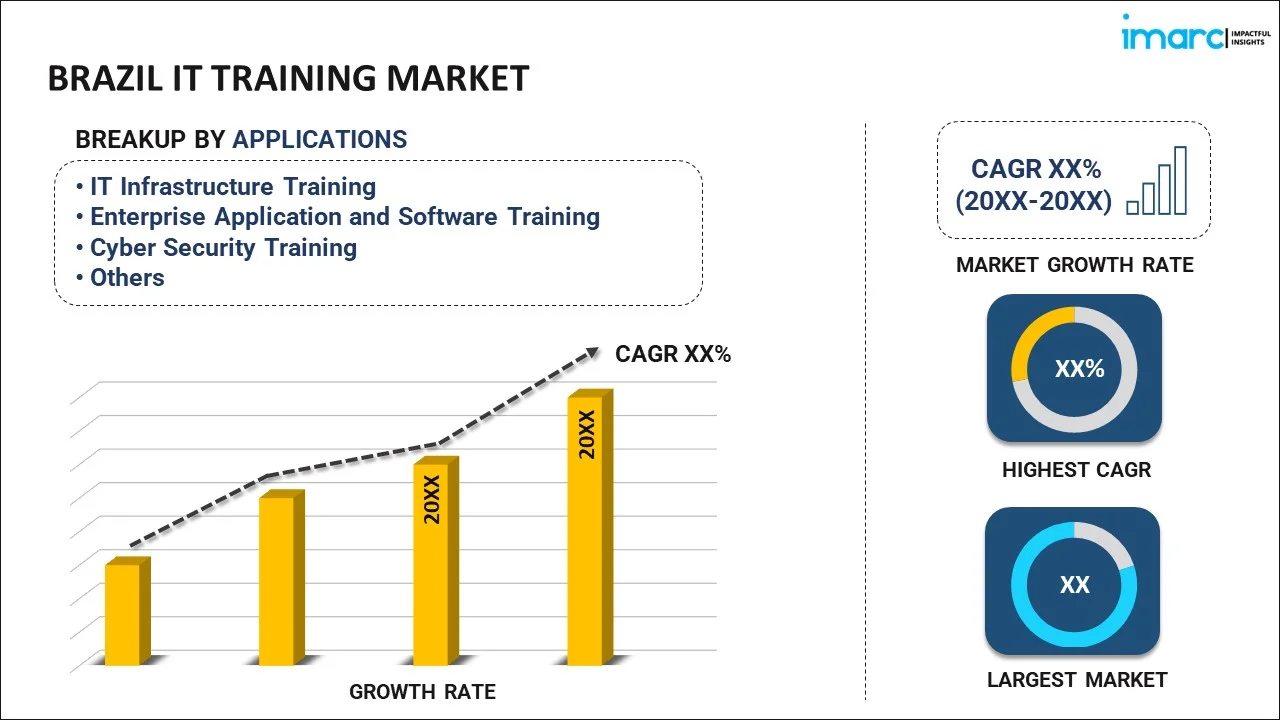
To get detailed segment analysis of this market, Request Sample
- IT Infrastructure Training
- Enterprise Application and Software Training
- Cyber Security Training
- Database and Big Data Training
- Others
Cyber security training dominates with a market share of 32% of the total Brazil IT training market in 2025.
Cyber security training’s dominance in the Brazil IT training market reflects the escalating threat landscape confronting organizations across the nation. In December 2025, Brazil experienced the largest percentage rise in cyberattacks, recording an average of 3,520 attacks per organization weekly, marking a 38% rise from 2024. This heightened vulnerability has compelled enterprises to invest substantially in security awareness programs, technical certification courses, and specialized training initiatives targeting security operations professionals. The implementation of Brazil's General Data Protection Law has further intensified demand for compliance-focused training programs.
Additionally, the rapid digitalization of banking, e-commerce, healthcare, and government services in Brazil is expanding the attack surface, increasing the urgency for continuous cyber security skill development. Small and medium enterprises (SMEs) are also entering the training market, driven by rising ransomware incidents and stricter client security requirements. Cloud security, incident response, and ethical hacking courses are witnessing strong enrollment, as organizations modernize IT infrastructure. Cyber security training providers are increasingly offering localized content in Portuguese, blended learning models, and industry-aligned certifications to address skill gaps efficiently and ensure workforce readiness.
End User Insights:
- Corporate
- Schools and Colleges
- Others
Corporate leads with a share of 60% of the total Brazil IT training market in 2025.
The corporate segment's commanding position in the Brazil IT training market reflects enterprises' strategic commitment to workforce development amid accelerating digital transformation. Large corporations across numerous industries, such as finance, retail, healthcare, and manufacturing, are investing heavily in training their employees in skills like cloud computing, data analytics, and enterprise software applications. This commitment to investing in their employees is also motivated by competitive demands to retain their human capital and yet reduce the cost of attracting labor.
Organizations are increasingly exploiting the benefits of e-learning platforms, as well as a mixed learning approach, in order to roll out efficient training options in a geographically fragmented workforce ecosystem. The corporate training industry in Brazil, focused on corporate enterprise needs, indicates a healthy growth rate, owing to increasing requirements in skilled human resources (HR) expertise. Corporate enterprises are engaging strategic partnerships with multiple technology providers and training institutions to obtain industry-specific training offerings.
Regional Insights:
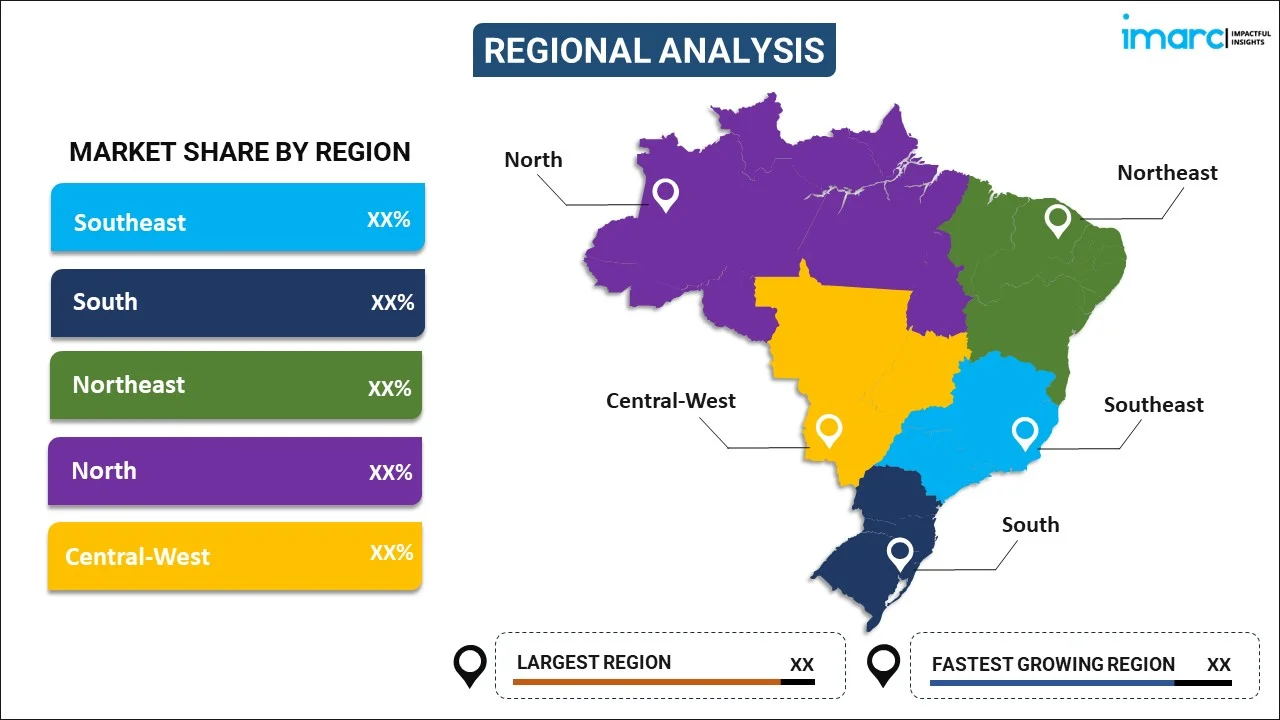
To get detailed regional analysis of this market, Request Sample
- Southeast
- South
- Northeast
- North
- Central-West
Southeast, anchored by São Paulo and Rio de Janeiro, holds significance in the Brazil IT training market due to its concentration of corporate headquarters, technology companies, and educational institutions. The region's thriving startup ecosystem and established technology infrastructure create sustained demand for specialized IT training programs.
South demonstrates strong IT training demand, driven by growing technology clusters in cities, including Porto Alegre and Curitiba. The region's industrial base and expanding service sector require continuous workforce upskilling in enterprise applications, database management, and emerging technologies. Educational institutions and corporate training providers are expanding their presence to address regional demand.
Northeast presents emerging opportunities for IT training expansion, as digital transformation initiatives extend beyond traditional technology hubs. Government programs supporting digital inclusion and workforce development are creating new training demand. Regional technology parks and innovation centers are driving investments in professional development.
North represents a developing market for IT training services, with demand concentrated in urban centers, including Manaus. Infrastructure limitations and connectivity challenges present barriers to training delivery. Government initiatives supporting digital inclusion through satellite-based broadband programs are gradually expanding access to online learning platforms across remote communities.
Central-West, including the federal capital Brasília, demonstrates growing IT training demand, driven by government agencies and expanding agribusiness technology requirements. The region benefits from increasing investments in digital infrastructure supporting public sector modernization. Corporate training programs addressing cloud computing and data analytics are gaining traction across government ministries and private enterprises.
Market Dynamics:
Growth Drivers:
Why is the Brazil IT Training Market Growing?
Accelerating Digital Transformation and Corporate Technology Investments
Digital transformation initiatives across Brazilian industries are creating unprecedented demand for IT training programs as organizations seek to build technology-capable workforces. The mean Digital Transformation Index Brazil (ITDBr) for companies increased from 3.3 in 2023 to 3.7 in 2024, on a scale from 1 to 6, reflecting intensifying corporate focus on technological capabilities. Enterprises across the banking, retail, healthcare, and manufacturing sectors are implementing comprehensive digital strategies requiring employees proficient in cloud computing, data analytics, and enterprise software applications. This transformation is compelling organizations to invest substantially in training programs that develop critical digital competencies. The expansion of e-commerce and digital payment systems demonstrates the broader digitalization trend driving training requirements. Corporate leaders increasingly recognize technology as a growth engine, lifting consulting, implementation, and professional development demand across the market.
Critical IT Professional Shortage and Workforce Development Imperatives
Brazil faces a significant IT talent shortage that is driving substantial investments in professional training and development programs. Industry reports forecasted a shortfall of 530,000 IT specialists by 2025, with around 53,000 new tech graduates joining the workforce each year. This pronounced talent gap is creating intense competition for qualified professionals while compelling organizations to develop internal training capabilities. Companies are increasingly partnering with educational institutions and technology vendors to establish comprehensive upskilling programs addressing immediate workforce requirements. The shortage spans critical technology domains, including AI, cloud computing, cybersecurity, and data science, intensifying demand for specialized training offerings. Organizations are responding by implementing training programs, mentorship initiatives, and certification pathways to develop talent internally while attracting professionals seeking career advancement opportunities.
Government Initiatives and Public-Private Partnerships (PPPs) Supporting Digital Skills Development
Government policies and strategic PPPs are significantly accelerating the growth of the Brazil IT training market by aligning workforce development with national digital transformation goals. Public sector modernization initiatives are increasing the need for professionals skilled in software development, cloud computing, data management, and cybersecurity across government departments. To meet this demand, global technology companies are actively collaborating with federal and state agencies, universities, and vocational institutes to deliver structured, large-scale training programs focused on emerging digital skills. Institutions play a pivotal role by continuously expanding their technology-focused curriculum and integrating industry-relevant tools and platforms through partnerships with international technology providers. These collaborations help ensure that training content remains aligned with real-world industry requirements. Additionally, policy-driven initiatives are improving access to digital education in underserved regions, strengthening inclusion and talent distribution.
Market Restraints:
What Challenges the Brazil IT Training Market is Facing?
Regional Digital Infrastructure Disparities and Connectivity Limitations
Significant disparities in digital infrastructure between urban and rural regions continue to challenge the effective delivery of IT training across Brazil. Urban centers benefit from relatively strong internet connectivity and access to digital learning resources, while many rural and remote areas face limited or unreliable network coverage. This uneven access constrains the adoption of online and blended training models, reducing the reach of IT education programs beyond major cities. As a result, workforce development efforts struggle to penetrate underserved regions, reinforcing regional skill gaps and limiting employment opportunities in the digital economy. Addressing this infrastructure imbalance remains critical to achieving inclusive and nationwide IT skill development.
High Training Costs and Affordability Constraints for Small Enterprises
The cost of comprehensive IT training programs and professional certifications presents affordability challenges for SMEs and individual professionals seeking career advancement. Premium certification programs from major technology vendors often require substantial investments, limiting accessibility for organizations with constrained training budgets. Economic pressures and currency fluctuations affecting purchasing power further complicate training investment decisions, particularly for companies operating in price-sensitive market segments competing for limited professional development resources.
Rapid Technology Evolution Creating Curriculum Alignment Challenges
The accelerating pace of technological advancement creates persistent challenges for training providers seeking to maintain curriculum relevance and alignment with evolving industry requirements. Educational programs often struggle to keep pace with emerging technologies, including generative AI, advanced cloud architectures, and evolving cybersecurity threats. This misalignment between academic curricula and practical industry demands results in graduates requiring additional training to achieve job readiness, creating inefficiencies in workforce development pipelines.
Competitive Landscape:
The Brazil IT training market exhibits a dynamic competitive landscape, characterized by diverse participants, including international technology vendors, regional educational institutions, and specialized training providers. Market participants are differentiating through localized content development, industry-recognized certifications, and strategic partnerships with enterprise customers. Leading players are investing in digital learning platforms, expanding course portfolios to address emerging technology domains, and developing corporate training solutions tailored to specific industry verticals. Competition intensifies as organizations seek comprehensive training partners capable of delivering scalable solutions across geographically distributed workforces. The emphasis on measurable learning outcomes and direct employment pathways is driving innovations in program design and delivery methodologies.
Recent Developments:
- In August 2025, at the annual ServiceNow São Paulo Summit, ServiceNow and SENAI-SP launched a statewide program for AI training and certification aimed at providing Brazilians with skills in AI and digital workflows. The initiative sought to educate numerous students in 2025, aiding ServiceNow University's worldwide objective of enhancing skills for 3 Million individuals by 2027, featuring localized content in Portuguese and employment readiness assistance.
Brazil IT Training Market Report Coverage:
| Report Features | Details |
|---|---|
| Base Year of the Analysis | 2025 |
| Historical Period | 2020-2025 |
| Forecast Period | 2026-2034 |
| Units | Million USD |
| Scope of the Report | Exploration of Historical and Forecast Trends, Industry Catalysts and Challenges, Segment-Wise Historical and Predictive Market Assessment:
|
| Applications Covered | IT Infrastructure Training, Enterprise Application and Software Training, Cyber Security Training, Database and Big Data Training, Others |
| End Users Covered | Corporate, Schools and Colleges, Others |
| Regions Covered | Southeast, South, Northeast, North, Central-West |
| Customization Scope | 10% Free Customization |
| Post-Sale Analyst Support | 10-12 Weeks |
| Delivery Format | PDF and Excel through Email (We can also provide the editable version of the report in PPT/Word format on special request) |
Key Questions Answered in This Report
The Brazil IT training market size was valued at USD 1,837.63 Million in 2025.
The Brazil IT training market is expected to grow at a compound annual growth rate of 5.93% from 2026-2034 to reach USD 3,086.09 Million by 2034.
Cyber security training dominated the market with a share of 32%, driven by escalating cyberattack incidents across organizations, regulatory compliance requirements, and corporate investments in security workforce development programs.
Key factors driving the Brazil IT training market include accelerating digital transformation initiatives, critical IT professional shortages, government support for digital skills development, and increasing corporate investments in workforce upskilling programs.
Major challenges include regional digital infrastructure disparities limiting training accessibility, high costs of certification programs constraining small enterprise participation, rapid technology evolution creating curriculum alignment difficulties, and connectivity limitations affecting rural training delivery.
Need more help?
- Speak to our experienced analysts for insights on the current market scenarios.
- Include additional segments and countries to customize the report as per your requirement.
- Gain an unparalleled competitive advantage in your domain by understanding how to utilize the report and positively impacting your operations and revenue.
- For further assistance, please connect with our analysts.
 Request Customization
 Speak to an Analyst
 Request Brochure
 Inquire Before Buying
Benefits of Customization
- Personalize this research
- Triangulate with your data
- Get data as per your format and definition
- Gain a deeper dive into a specific application, geography, customer, or competitor
- Any level of personalization
Get in Touch With Us
UNITED STATES
Phone: +1-201-971-6302
INDIA
Phone: +91-120-433-0800
UNITED KINGDOM
Phone: +44-753-714-6104
Email: sales@imarcgroup.com
Client Testimonials




.webp)




.webp)












